How to Get My Child to Respond to Their Name Using Everyday Routines
By Wellness Hub
Last Updated: April 9, 2026
If you are trying to get child to respond to name routine style, you are already thinking in the most realistic direction. Most families do not need more activities in the day. They need better moments inside the day they already have. The good news is that routines naturally create tiny pauses, predictable patterns, and face to face time, which are exactly the conditions that make name response easier to grow.
This is not about testing your child or expecting an instant turn every time. It is about building a warm, repeatable pattern where your child learns, “When I hear my name, something good happens. I can look up and connect.”
Why Everyday Routines Are the Easiest Place To Build Name Response
Routines do a lot of the work for you. They repeat, they have a clear beginning and end, and they usually include natural “wait” moments. Think about the tiny pauses you already have, like holding the cup before you hand it over, waiting for the bath to fill, or standing by the door with shoes in your hand. Those pauses are gold.
In play, kids can get deeply absorbed. In routines, attention often shifts more naturally because the next step depends on you. That makes it easier for your child to notice your voice and easier for you to be close enough for your child to catch your facial expression.
It also helps emotionally. When name response is practiced inside familiar routines, it feels safe and predictable. Your child is not being pulled away from something exciting. They are being invited into connection during something they already understand.
Also read: You Are Not Doing Anything Wrong If Your Toddler Not Responding to Name
What Counts As Responding to Their Name in Real Life?
Many parents picture one specific response, like immediate eye contact. In real life, name response can look like a whole range of small signals, especially at the beginning.
A response might be a quick glance, a pause in the hands, a head turn, a little smile, or a shift of the body toward you. Some children respond with a sound, a raised eyebrow, or a brief stillness that says, “I heard you.” Those early signs matter because they are the first building blocks of consistency.
It can also change by situation. A child might respond quickly at snack time but not while climbing on the sofa. That does not mean they cannot do it. It usually means the moment is harder. Routines help you start where it is easiest, then slowly carry the skill into busier parts of the day.
How To Use a Get Child To Respond To Name Routine Approach Without Turning It Into a Drill
The biggest shift is moving from “I need them to respond” to “I am going to create a moment that makes responding likely.” That mindset keeps things calmer for you and more inviting for your child.
Here are the routine based ingredients that tend to help, without adding anything extra to your schedule:
First, closeness beats volume. If you call from across the house, your child has to work harder to locate you, tune out other sounds, and switch attention. In routines, you are often already nearby. That is the time to use your child’s name in a gentle, friendly voice.
Next, give a real pause. Many children need a beat to process. When parents are busy, it is easy to call the name and keep moving. A small pause communicates, “I am waiting for you,” and it gives your child space to succeed.
Then, make the response feel worth it. This does not mean rewards or bribing. It means your face, your warmth, and your attention become the “payoff.” When your child looks up, you can respond with a smile, a nod, a playful comment, or simply handing them the thing they were already about to get. The message becomes clear: looking toward you helps life flow.
Finally, keep your tone light. A sharp or frustrated voice can make name calling feel like pressure. Most toddlers do better when the invitation sounds friendly and predictable, even when you are tired.
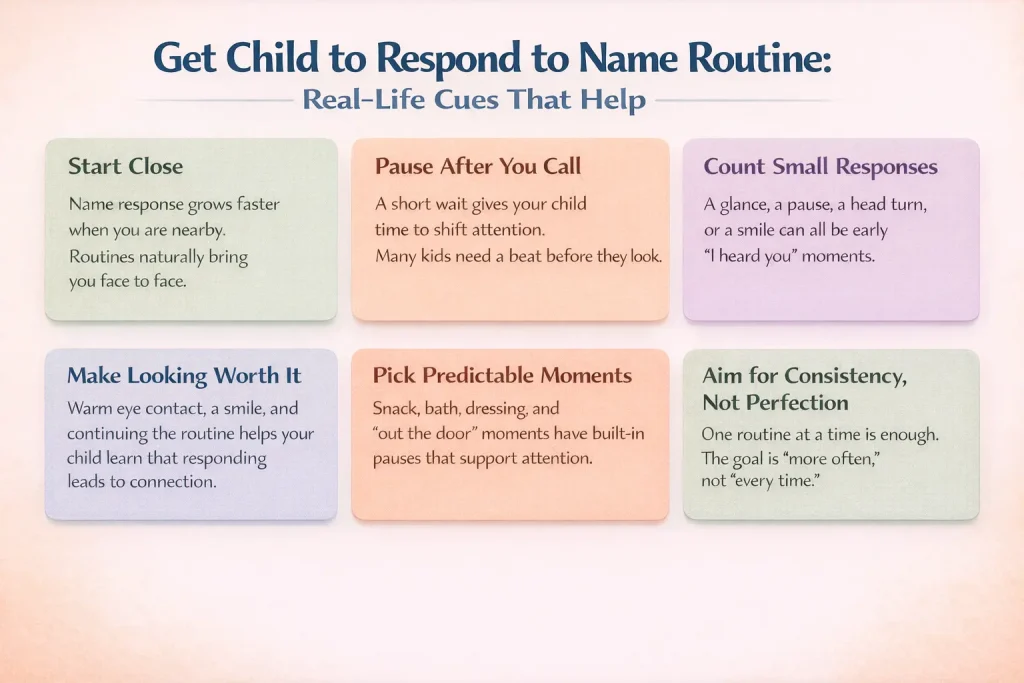
The Routines That Naturally Create the Best Look Up Moments
You do not need to force routines to become practice. You are simply noticing where attention already shifts and using that moment well.
Snack and meals are often the easiest starting point because you control the pacing. There are natural pauses while you open a container, pour water, or place food on the table. If your toddler is not responding to name in play, you may be surprised how much easier it is when they are waiting for something predictable.
Bath time can work well for similar reasons. The environment is contained, you are close, and there are many little transitions like washcloth, towel, pajamas. Those transitions create repeated chances for your child to hear their name and orient to you.
Getting dressed and getting out the door can be tricky, but they also offer built-in “hold” moments. Shoes in your hand, jacket half on, waiting at the doorway. These are moments where your child is already shifting between steps, which can make it easier to catch your voice.
Clean up time can be another gentle opportunity, especially if you are nearby and the expectation is simple. Many toddlers respond better when the request is paired with connection first, rather than calling their name from another room while they are still playing.
If you are thinking, “My child is always on the move, routines are chaotic,” that is still okay. Even one routine that happens most days is enough. Consistency in one small slice of the day often spreads on its own.
Learn More: Why Does My Toddler Not Respond to Their Name When They Are Busy Playing?
Common Routine Mistakes That Make Toddlers Seem Like They Are Ignoring Their Name
Sometimes a toddler looks like they are ignoring their name, but the setup is simply too hard in that moment. A few common patterns show up for many families.
One is calling the name many times in a row. It is an understandable habit, especially when you are trying to get through a routine quickly. The problem is that repeated calling can turn the name into background noise. Your child learns they do not need to respond to the first call because another one is coming.
Another is calling while your child is deeply focused, then expecting an instant turn. Some kids can switch attention quickly. Others need a little runway. If your child is lining up cars or watching water pour, their brain may be “locked in.” Routines often work better because focus naturally breaks between steps.
Distance is another big one. If you call from the kitchen while your child is in the bedroom, there is a lot competing for their attention. Starting close builds success first. Later, when your child is responding more often, you can gently try from a bit farther away.
Tone matters too. When name calling starts to sound like a warning, many toddlers protect themselves by tuning it out. A calm, warm voice keeps the interaction safe and makes it more likely your child will look.
What Progress Looks Like When Routines Are Working
Progress is usually quiet at first. It often shows up as a quicker pause, a faster head turn, or fewer repeats needed from you. You might notice your child responds in one routine, like snack, before they respond in others. That is a normal pattern.
Some families also notice their child starts to “check in” more. They look up with a little grin, or they look to you when they hear their name even if they do not fully turn their body. Those are meaningful steps because they show your child is connecting your voice with attention.
Over time, you may see your child respond even when they are mildly busy, not only when they are waiting. You might also see it generalize to other people, like another parent, a grandparent, or a childcare provider. That is a strong sign the skill is becoming part of your child’s everyday communication.
If you like having a simple way to track this without overthinking it, choose one routine and notice whether your child responds more often this week than last week. You are looking for a gentle upward trend, not perfection.
Read More: It Can Be Normal If Your Toddler Hears You but Does Not Look Up to Their Name
When You Might Want Extra Support, Even if You Are Practicing in Routines
If you have been using routines consistently and it still feels hard to get any response, it can help to talk it through with someone who understands early communication and attention. Support can also be helpful if your child responds in one setting but not another, or if daily life feels stressful because you are constantly trying to get their attention.
Some families also seek help when they are unsure what counts as progress, or when different caregivers are using very different approaches. A little coaching can bring everyone onto the same page so your child gets a clearer, calmer pattern.
If concerns persist, some families consider developmental screening to better understand communication delays or possible autism-related differences. This is not about jumping to conclusions. It is about getting a clearer picture and feeling supported.
If you want a structured, parent friendly place to start, the BASICS App can help you match ideas to your child’s current level and your real routines, without making your day feel busier.
Closing: A routine-based plan you can actually keep up with
If your goal is to get child to respond to name routine by routine, you are choosing a path that is sustainable. You are not adding a new task. You are using the moments you already have and making them a little more connection-friendly.
Pick one routine that happens most days. Stay close, say their name warmly, pause long enough to give them a chance, and respond with genuine delight when they look. Those small moments add up. Over time, your child learns that hearing their name is an invitation, not a demand, and that turning toward you is worth it.
About the Author:
Anuradha Karanam
Speech-language pathologist (7+ years of experience)
Anuradha Karanam is a skilled speech-language pathologist with over 6 years of experience. Fluent in Tamil, Telugu, Hindi, and English, she specializes in parent counseling, speech sound disorders, fluency assessment, and speech-language evaluations. Anuradha excels at working with children with developmental disorders, offering creative and effective therapy programs. Currently, at Wellness Hub, she holds a BASLP degree and is registered with the RCI (CRR No A85500). Her patience, ambition, and dedication make her a trusted expert in her field.
Book your Free Consultation Today
Parent/Caregiver Info:
Client’s Details:
* Error Message