Common Mistakes That Can Quiet Babbling (And What to Do Instead)
By Wellness Hub
Last Updated: February 10, 2026
Babbling is one of those small, joyful parts of early childhood that can make a regular moment feel magical. Your child is stacking blocks and suddenly it’s “ba-ba-ba.” You’re washing hands and you hear a little “da!” It’s playful, it’s social, and it often feels like the very beginning of “real” communication.
And because it’s so exciting, it’s also easy to accidentally change the mood around it.
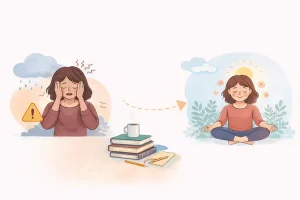
Many loving parents do this without meaning to: we notice a cute sound, we try to get it again, we lean in close, we ask for more, we celebrate big. Sometimes that works. But sometimes it turns babbling into something that feels like a performance, something your child senses they’re being “watched” for. And when that happens, a child who was happily experimenting may suddenly get quiet. If you’ve ever thought, “They were babbling yesterday, but why did it stop?” this is for you. Not to blame you, because this is incredibly common, but to help you keep sound-play light, confident, and connected.
Babbling isn’t a test. It’s your child exploring.
Babbling during play and social interaction often includes repeating sounds like “ba-ba” (reduplicated babble) or mixing syllables like “ba-da” (variegated babble). It tends to show up when your child is relaxed, engaged, and feeling safe enough to experiment.
That’s the key: babbling is exploration. It’s not a trick your child performs on request. When it stays playful, it helps your child learn that communication is a two-way street, something shared with you, full of warmth and connection. Over time, those playful sounds can become longer, more varied, and more confident.
So if babbling seems to fade for a bit, it doesn’t automatically mean anything is wrong. Often it simply means the moment got a little too “big,” and your child decided to pause.
Read More: Why Your Baby Babble Changes Around New People, New Places, or Busy Rooms
Common mistake #1: Turning babbling into “Say ___!”
It’s such a natural impulse. Your child says “ba,” and your brain immediately goes, “Oh! They can do it! Say ‘ball’! Say ‘bye-bye’!” You’re not doing anything wrong—you’re noticing and hoping to build on it.
But for many children, being asked to “say it” changes the feeling of the interaction. What was free and fun can suddenly feel like a demand. Some children respond by trying; many respond by going quiet, looking away, or switching activities.
What to do instead: Keep your responses more like an invitation than a request. You can enjoy the sound your child made, echo it back, and let it be enough. When your child feels no pressure to “get it right,” they’re more likely to keep experimenting.
Common mistake #2: Repeating prompts too quickly (and not leaving space)
Babbling back-and-forth is wonderful—when it’s truly back-and-forth. But sometimes we fill every pause because we’re excited or a little anxious. We repeat the sound again and again, we add more words, we lean in with another prompt before our child has a chance to respond.
Many young children need extra time to process and decide whether they want to join in. If the adult side of the conversation is too fast, the child’s easiest option is to opt out.
What to do instead: Slow the pace of the moment. Let there be comfortable silence. A pause isn’t a failure—it’s part of communication. Often, the quiet space is exactly where your child decides, “I want to try again.”
Common mistake #3: Big reactions that accidentally add pressure
Babbling is adorable. And when it happens, it’s hard not to light up: “Oh my gosh! You said ‘da-da’! Say it again! Everyone, come listen!”
Your joy is real, and your child deserves it. But some children experience big reactions with sudden intensity. They may feel put on the spot, even if no one intended that. The result can be a child who babbles less when they notice you’re watching closely.
What to do instead: Keep your warmth steady and calm. Think “soft delight” rather than “surprise party.” Smiles, gentle enthusiasm, and warm eye contact can communicate, “I love hearing you,” without making your child feel like they need to repeat it on demand.
Common mistake #4: Correcting the sound or shaping it too quickly
When you hear “ba-ba,” it’s tempting to refine it. “No, say ‘buh.’ Say ‘ball.’ Not ‘ba’—‘ball.’” Again, this comes from a good place: you’re trying to help your child move forward.
But babbling is not meant to be precise. It’s practice. If your child senses that their sound wasn’t “right,” they may decide it’s safer not to try.
What to do instead: Treat early sounds as meaningful attempts. You can model clear speech naturally in your own voice without requiring your child to match it. Your child learns a lot just by hearing you and they keep their confidence when their efforts are welcomed.
Common mistake #5: Only responding when the sound is “good”
Sometimes parents don’t realize they’re doing this. We get especially animated when we hear something that resembles a real word (“da-da,” “ma-ma,” “bye”), and we respond less when it’s squeals, growls, or long strings of mixed sounds.
But to your child, all of that is communication practice. If they learn that only certain sounds get attention, they may babble less overall or they may become cautious, waiting until they can produce the “right” sound.
What to do instead: Respond to the joy of the interaction, not the accuracy of the sound. When your child vocalizes during play, you can acknowledge it as part of your shared moment. This helps your child feel, “My voice matters,” which is the foundation you want.
Common mistake #6: Using babbling as a check-in throughout the day
It’s understandable: you want to know if your child is progressing. So you try little tests. “Can you say ‘ba’?” “Do ‘da-da’!” “Show Grandma your sounds!”
The problem is that frequent checking can make vocal play feel like a job. And children, especially toddlers, often protect their autonomy by refusing. Not because they can’t, but because they don’t want to.
What to do instead: Let babbling show up where it naturally fits—during play routines, silly moments, songs, books with rhythm, peekaboo, bath time, mealtime. When it’s woven into connection, it tends to flourish without anyone needing to measure it in the moment.
What supportive babbling looks like in real life
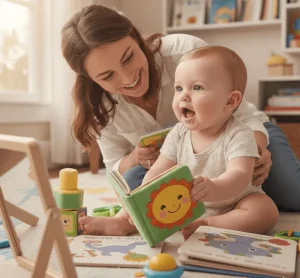
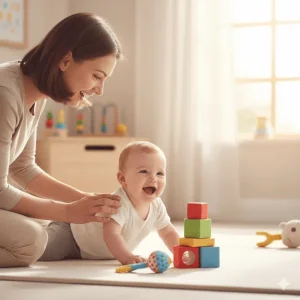
Support doesn’t have to be complicated. It often looks like you are being present and responsive when your child experiments with sound. You might notice your child babbling while pushing a toy car, glance at them with a smile, and echo their sound once. Your child might look back, babble again, and you respond—like a gentle conversation made of syllables.
Over time, you may see more frequent babbling during play, more variety in the sounds, and more moments where your child looks at you while vocalizing as if to say, “Did you hear that?” Those are meaningful signs of growing confidence and connection.
And if your child goes quiet for a while? That can be part of the natural rhythm, too. Children often cycle through phases—more sounds one week, more focused play the next. The goal isn’t constant performance. It’s a growing comfort with using their voice in shared moments.
When you might want a little extra support (without panic)
Sometimes parents simply want reassurance or fresh ideas for keeping communication playful, especially if they feel stuck in prompting or unsure how to respond. If you’d like guidance that fits into everyday routines, speech and autism app like BASICS App can be a helpful, low-pressure way to understand goals like “babbling during play and social interaction” and see what supportive interaction can look like in real family life.
Seeking support doesn’t mean you’ve done anything wrong. It usually means you care, you’re paying attention, and you want to protect your child’s confidence.
A calm reminder to take with you
Babbling grows best in an atmosphere of ease. Your child doesn’t need you to be a speech coach. They need you to be a safe, steady partner, someone who enjoys them, notices them, and makes room for their voice.
If you’ve accidentally made babbling feel a little too “important,” you can always reset. Soften the moment. Follow your child’s lead. Let the sounds be playful again. Because in the end, babbling isn’t just noise; it’s your child practicing connection. And every relaxed, pressure-free exchange is building something that lasts.
About Author
Rajini Darugupally
Speech-Language Pathologist
Rajini is a passionate and dedicated Speech-Language Pathologist with over 9+ years of experience, specializing in both developmental speech and language disorders in children and rehabilitation in adults. Driven by a desire to empower each individual to find their voice, Rajini brings a wealth of experience and a warm, genuine approach to therapy. Currently, at Wellness Hub, she thrives in a team environment that values innovation, compassion, and achieving results for their clients.
Book your Free Consultation Today
Parent/Caregiver Info:
Client’s Details:
* Error Message