What Not to Do When Encouraging First Words: Common Mistakes That Can Shut Talking Down
By Rajini D
Last Updated: February 26, 2026
If you’re trying to help your child say their first words, it can start to feel like every moment carries weight during early communication development. You hear “mama” once and wonder how to make it happen again. You offer “more” at snack time and quietly hope this will be the day it sticks. And when your child stays quiet, or uses a sound that is close but not quite the word, it’s easy to think you must be doing something wrong.
You’re not.
Most parents reach for the same tools without even realizing it. Asking for the word, repeating it many times, correcting it quickly, or waiting expectantly all come from love and concern. But some of these well-meaning habits can slowly make talking feel like a performance instead of a shared moment.
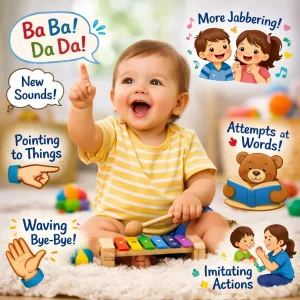
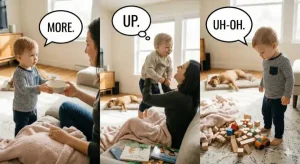
Early words and proto-words like “ta,” “uh-oh,” “up,” or “mm” grow best in everyday situations that feel safe, playful, and relaxed. The aim is not perfect pronunciation. The aim is your child using simple sounds or words to express a message, to ask, to share, to comment, and to feel understood. Here are some common “save your energy” mistakes that can quiet talking down, along with gentle shifts that help keep communication open.
Protecting Communication Development: What to Avoid
Mistake 1: Turning talking into a quiz
It often begins with good intentions. “What’s this?” “Say ball.” “Can you say mama?” You want to help your child connect words to the world. But for many children, being put on the spot can make them freeze. Even if they almost know the word, the feeling of being watched and waiting for the right answer can stop them from trying.
A helpful shift is to see early words as participation, not performance. Instead of asking your child to prove what they can say, it can feel easier to talk alongside them. When words are offered naturally as part of the moment, children often feel safer experimenting.
Mistake 2: Prompting again and again when they don’t say it
When you’re eager to see progress, it’s tempting to repeat yourself. “Say up. Up. Up! Can you say that?” You might even hold the snack or toy and wait.
But repeated prompting can make the moment feel tense and stuck. Your child may begin to feel like they are failing, or they may learn that communication is about meeting a demand rather than sharing an idea. Some children respond by getting silly, turning away, or avoiding the interaction, not because they are stubborn, but because the pressure feels uncomfortable.
Often, the most supportive response is to keep things warm and moving. If your child reaches, looks, points, or makes any sound, they are already communicating. Responding to that message, while still gently modeling a simple word, keeps the connection going without turning it into a standoff.
Also read: 10+ Simple Home Activities That Encourage Early Words Like “More,” “Up,” and “Uh-Oh”
Mistake 3: Correcting too quickly or too often
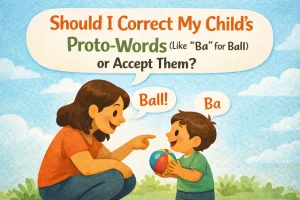
When your child says “ba” for “ball,” or “muh” for “more,” it’s natural to want to tidy it up. “No, say ball. Ball.” Many parents worry that accepting the unclear version will teach the wrong habit.
But early words are meant to be messy. Proto-words and approximations are a normal bridge to clearer speech. If every attempt is corrected, a child can start to feel that trying is only safe if they can do it perfectly. That can make a cautious talker even quieter.
A gentler approach is to treat their attempt as meaningful. You can respond as if you understood, because you did, and then model the clearer word naturally in your reply. This gives your child two important messages at once: “I got you,” and “Here is the next step.”
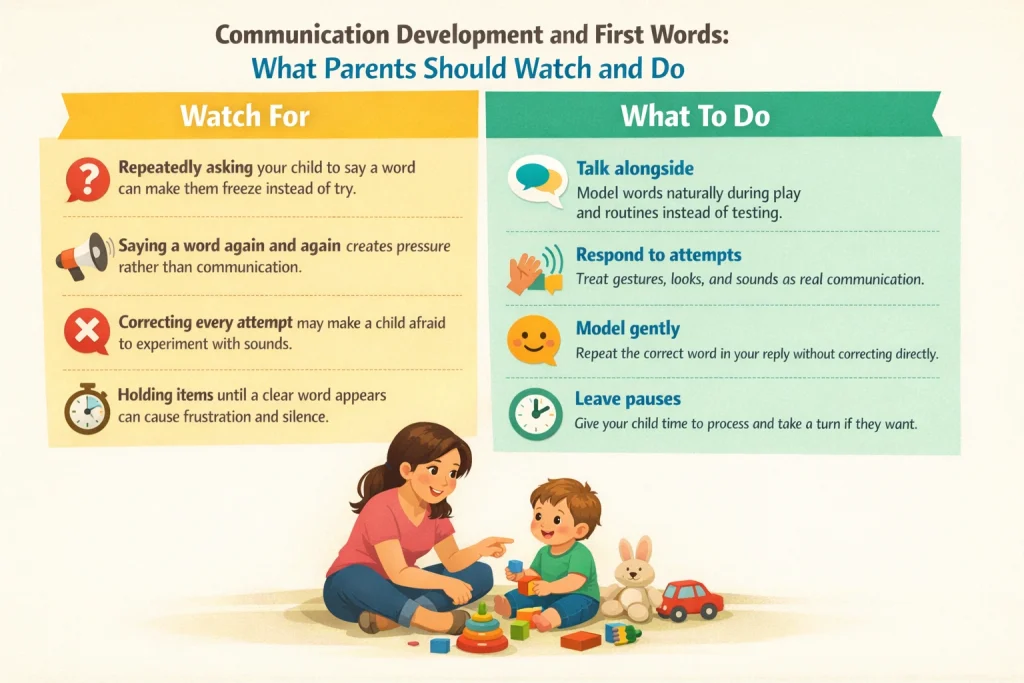
Mistake 4: Holding back what they want until they “use their words”
Many of us grew up hearing “Use your words,” and it sounds helpful. But when it becomes a requirement, especially for a child who is still learning, communication can start to feel like a gate they cannot pass through.
If your child reaches for milk and you wait until they say “milk,” you might get the word sometimes. You might also get tears, anger, or silence. Over time, this can teach that talking only happens under pressure, not as a way to connect.
Early communication is bigger than spoken words. Looking, pointing, handing you an item, pulling you toward something, and making a sound are all real attempts. When those attempts are respected, children often feel safer moving toward words like “more,” “up,” “mama,” or “uh-oh.”
Read more: What Counts as an “Early Word”? A Parent-Friendly Guide to Proto-Words and Meaningful Sounds
Mistake 5: Filling every silence with more talking
When a child is quiet, many parents talk more. You narrate, label, ask questions, offer choices, and repeat words, hoping something will spark a response.
Language input is important, but constant talking can leave no room for your child’s turn. Many children need extra time to process what they hear and decide whether they want to try a sound. If there is no space, there is no invitation.
The shift here is small. It is not about becoming silent or turning life into training. It is about letting moments breathe. A brief pause after you model a word can quietly say, “You can take a turn if you want,” without demanding anything.
Mistake 6: Expecting first words to sound “right”
First words rarely sound like adult speech. A child might say “mah” for “mama,” “mo” for “more,” “duh” for “up,” or use one sound for many meanings. They may pair a sound with a gesture or use an excited “uh” to comment on something interesting.
All of that counts.
When only perfect words get attention, children can learn that partial attempts do not matter. But partial attempts are often where the real growth is happening. Those early sounds are your child practicing timing, control, and confidence, while discovering that their voice has an effect.
If your child looks at you after making a sound, that is especially meaningful. It often means, “Did you understand me?” Your warm response helps make the next attempt more likely.
Mistake 7: Comparing your child to other talkers
It is hard not to compare. Another child at the park is chatting, while yours is lining up cars quietly. A cousin the same age says “more,” “dog,” and “bye,” and you are still waiting for something consistent.
Comparison creates urgency, and urgency creates pressure. Pressure makes risk-taking harder. And risk-taking is exactly what early talking needs. Progress with early words is often uneven. You might hear a new word once and then not again for days. Your child may use “up” only in one routine or say “uh-oh” only when something falls. That does not mean the word is gone. It usually means it is still settling in.
What helps instead: keeping early words joyful and doable
If these mistakes sound familiar, that is okay. Most parents try them because they care. The good news is that supporting early words does not require special tools or perfect timing. It is mostly about protecting your child’s willingness to try.
Children are more likely to use early words and proto-words when they feel understood, when attempts are welcomed, and when communication stays playful. In everyday routines like snacks, dressing, bath time, and play, simple words such as “more,” “up,” “mama,” “ta,” and “uh-oh” fit naturally. When those words belong to real moments, they tend to stay because they mean something.
And when your child’s attempt is quiet or unclear, it can still be treated as a real message. That is often the difference between a child who keeps experimenting and one who decides it is safer not to try.
About the Author:
Rajini Darugupally
M.Sc., Speech-Language Pathologist (9+ years of experience)
Rajini is a passionate and dedicated Speech-Language Pathologist with over 9+ years of experience, specializing in both developmental speech and language disorders in children and rehabilitation in adults. Driven by a desire to empower each individual to find their voice, Rajini brings a wealth of experience and a warm, genuine approach to therapy. Currently, at Wellness Hub, she thrives in a team environment that values innovation, compassion, and achieving results for their clients. Connect with Rajini to learn more about how she can help you or your loved one find their voice.
Book your Free Consultation Today
Parent/Caregiver Info:
Client’s Details:
* Error Message