My Child Won’t Take Turns During Play Is That Normal?
By Rajini D
Last Updated: March 3, 2026
You’re at the park or on the living room floor, watching what you hoped would be a sweet little play moment. Instead, it turns into grabbing, clutching, running off with the toy, or a firm “Mine!” The other child looks upset. Another parent looks over. And you’re left feeling that familiar mix of worry and embarrassment.
If you’ve wondered, “Is my child supposed to be taking turns by now?” especially when your child won’t take turns during play, you’re not alone. Turn-taking is one of those social skills that adults value highly, but young children grow into it slowly, unevenly, and with lots of messy practice along the way. The comforting truth is that many children struggle with turn-taking during play, especially when they’re excited, tired, or deeply focused. That doesn’t mean you’re doing anything wrong. It usually means your child is still learning how shared play works.
Why a Child Won’t Take Turns During Play
To adults, taking turns can seem straightforward: you go, I go, we keep it fair. But for a child, turn-taking asks for several big skills all at once. It means noticing another person’s wants, pausing their own plan, waiting briefly, and trusting that the toy (or the fun) will come back to them. It also means managing strong feelings, because play can feel high-stakes when you’re little. That truck isn’t just a truck; it’s the best thing in the world at that moment.
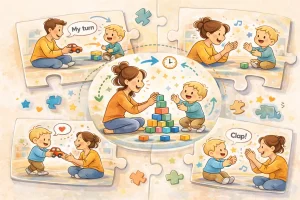
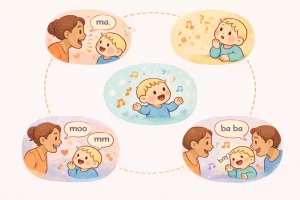
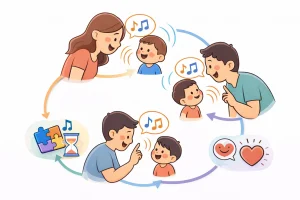
Turn-taking also isn’t only about toys. It includes vocal turn-taking (back-and-forth sounds or words), simple routines (like taking turns turning book pages), and playful exchanges (like rolling a ball back and forth). These are all part of the same growing skill: learning the rhythm of “me and you” together.
What’s typical when turn-taking is still developing
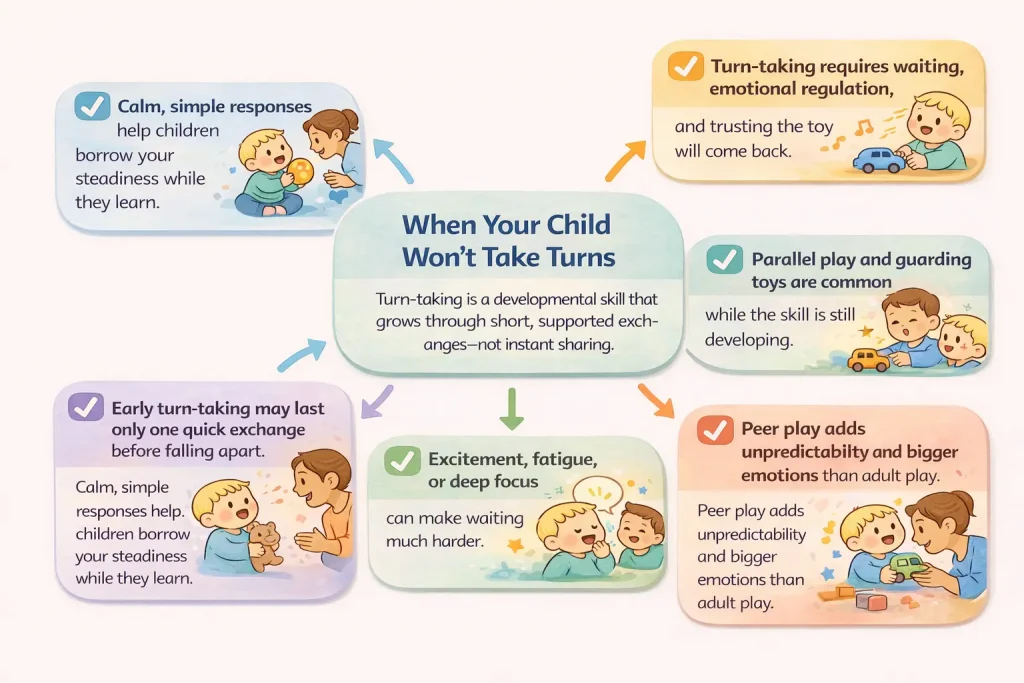
A lot of early play doesn’t look like sharing. It can look like parallel play, two children playing side by side with similar toys, mostly doing their own thing. It can look like collecting and guarding. It can look like a child insisting on being “the boss” of the game. And even when children understand the idea of taking turns, they may not be able to do it consistently. Many parents notice their child can take turns beautifully at home with a familiar adult, then struggle the moment another child enters the picture. That’s common. Peer play adds unpredictability, competition, and big emotions.
It’s also common for turn-taking to come and go depending on the day. A child who can wait briefly in the morning may fall apart over the same situation before dinner. That’s not manipulation or stubbornness, it’s often just a sign that their “waiting muscles” are tired.
Why it’s harder when kids are excited, tired, or focused
If turn-taking falls apart most during high-energy moments, that makes sense. When children are excited, their bodies are moving fast and their impulses are strong. When they’re tired or hungry, patience is usually the first skill to disappear. And when they’re deeply focused, like lining up cars, building a tower, acting out a pretend scene, being interrupted can feel genuinely upsetting.
Some children also need a little more time to shift attention. If they’re immersed in play, they may not be ready to hand something over the instant another child reaches for it. In those moments, what looks like “won’t take turns” can be “needs a moment to transition.”
What early turn-taking can look like even for a second
Parents often imagine turn-taking as a long, smooth exchange: your child hands over the toy, waits calmly, then gets it back and repeats. But early turn-taking is usually much smaller and easier to miss.
It might look like your child rolling a ball to you once, then crawling away. It might look like a quick “your turn” moment with a favorite toy, followed by your child grabbing it back. It might look like a brief pause before reaching for the next snack, or letting you turn one page of the book before insisting on doing the rest.
These tiny moments still count. Turn-taking grows through short exchanges that gradually stretch into longer back-and-forths. Over time, many children move toward maintaining several exchanges three, five, or more especially in calm, familiar routines. If your child can do one small exchange, that’s a real starting point. If they can do it sometimes, that’s still progress. Consistency comes later.
What to say to yourself when play gets grabby
When a child won’t take turns, it can feel personal, like they’re being rude, or like you’re being judged as a parent. But in most cases, what you’re seeing is a child who wants something and doesn’t yet have the skills to handle the “in-between” part: the waiting, the sharing, the trusting.
A helpful reframe is: “My child isn’t giving me a hard time. They’re having a hard time.” That mindset makes it easier to stay calm, which matters because children borrow our calm when they don’t have enough of their own. It also helps to remember that turn-taking is not a character trait. It’s a developmental skill. Skills grow with time, experience, and supportive relationships.
How to respond in the moment without turning it into a battle
Most parents don’t need a complicated plan, they need a steady way to handle the moment without escalating it. In real life, it can help to keep your response simple and warm. Many families find that naming what’s happening in a neutral way (“You really want that toy”) and holding a calm boundary (“We’re taking turns”) keeps things from feeling like a lecture or a power struggle.
It’s also okay if your child can’t manage a full “hand it over and wait” moment yet. Sometimes the best you can do is help the play reset, by shifting to a different toy, creating a little space, or moving into a calmer activity. That isn’t “giving in.” It’s protecting the relationship and keeping play from turning into a meltdown.
And when your child does show even a flicker of turn-taking, a pause, a glance, a brief exchange, those are the moments worth noticing. Children tend to repeat what brings connection.
Turn-taking is about connection, not perfect manners
It’s easy to feel pressure to make your child “share nicely,” especially in public. But early turn-taking isn’t really about politeness. It’s about learning that play can be shared and enjoyable, not just defended.
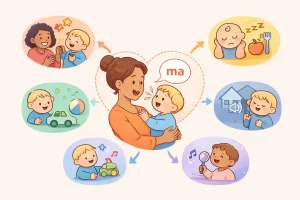
That’s why some of the earliest turn-taking happens in simple, low-stakes routines with you: a back-and-forth sound (“ba!” “ba!”), a quick exchange with a toy, a playful “my turn/your turn” rhythm, or letting you have a moment before they reach in again. These are the building blocks of cooperation and patience, and they often come before a child can manage turn-taking smoothly with peers.
Over time, those small experiences add up. Children begin to understand the pattern: turns come back. Waiting ends. Play continues.
When you might want extra support without assuming anything is wrong
Sometimes parents feel stuck, not because their child is “behind,” but because the day-to-day moments feel stressful. You might want extra support if your child won’t take turns regularly and it leads to big upsets, if playdates feel hard to navigate, or if you’re simply unsure what’s reasonable to expect right now.
Some families like having a simple framework to lean on at home. Tools like BASICS can help parents focus on goals like turn-taking through everyday play and routines, with short videos and guidance that keep things light and doable. It’s not about pushing a child, it’s about noticing small steps and building on them gently.
And sometimes, support is as simple as hearing, “Yes, this is common,” and giving yourself permission to stop measuring your child against the most cooperative kid at the playground.
A gentle note for parents
If your child won’t take turns during play right now, it doesn’t mean they’re selfish, and it doesn’t mean you’ve missed some crucial parenting window. It usually means they’re still learning a skill that takes time: sharing attention, managing excitement, waiting briefly, and staying in a back-and-forth exchange.
Turn-taking often grows quietly. It shows up in a one-second pause, a quick roll of the ball, a moment of eye contact, a tiny exchange that ends sooner than you hoped. Those moments are not “almost.” They are the beginning.
And when you respond with calm, steady expectations and warmth, especially in everyday routines, you’re already giving your child the best environment for this skill to grow.
About the Author:
Rajini Darugupally
M.Sc., Speech-Language Pathologist (9+ years of experience)
Rajini is a passionate and dedicated Speech-Language Pathologist with over 9+ years of experience, specializing in both developmental speech and language disorders in children and rehabilitation in adults. Driven by a desire to empower each individual to find their voice, Rajini brings a wealth of experience and a warm, genuine approach to therapy. Currently, at Wellness Hub, she thrives in a team environment that values innovation, compassion, and achieving results for their clients. Connect with Rajini to learn more about how she can help you or your loved one find their voice.
Book your Free Consultation Today
Parent/Caregiver Info:
Client’s Details:
* Error Message