Why Your Child Avoids Crayons, Scissors, or Small Toys and How to Make It Easier
By Wellness Hub
Last Updated: February 2, 2026
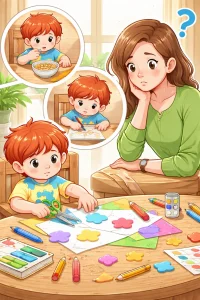
You set out crayons and paper, hoping for a few quiet minutes. Or you offer child-safe scissors for a simple craft. Maybe you bring out small toys, such as blocks, beads, or tiny figures, only to watch your child push them away, leave the table, or melt down before you have even started.
It is easy for parents to land in a worried place: Are they behind? Are they being stubborn? Why does this feel so hard?
If this is your home right now, take a breath. Avoiding fine-motor activities is common in early childhood, and it often has less to do with attitude and more to do with how the task feels in your child’s hands. Many children need time and the right “fit” before controlled hand and finger movements feel comfortable.
This article will help you understand a few non-alarming reasons children avoid precision tasks, what “fine motor control” really involves, and how you can adjust materials and expectations so participation feels more doable and more positive for everyone.
When your child avoids fine-motor play, it is often about comfort, not character
Fine-motor activities ask a lot from a small body. Holding a crayon with control, opening and closing scissors, or managing tiny pieces requires smooth, graded, purposeful movements. This means your child has to coordinate fingers, regulate pressure, and keep movements steady enough to get the result they want.
That is a big request when those skills are still developing.
So when a child avoids these tasks, it is often a form of communication: This feels hard, I am not sure what to do, or I do not like how this feels in my hands. That is very different from being lazy or defiant. It is also different from not being interested in learning. Many children are eager learners, but they do not want to feel frustrated.
Also read: How to Support Better Hand Control During Mealtime Without Turning Dinner Into Therapy
Why crayons, scissors, and small toys can feel surprisingly hard
1) The effort is bigger than it looks
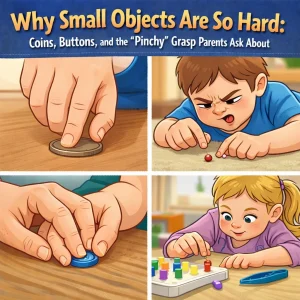
To an adult, coloring is simple. To a child, it can feel like trying to write with a slippery tool while keeping their arm steady and their fingers doing something precise. The same is true for small toys that require careful pinching, turning, pressing, or placing.
Some children can do these movements, but it takes so much concentration that they avoid the activity unless they are very motivated.
2) Their hands may use “too much” or “too little” force
A common reason children resist is that they have not yet found the “just right” pressure. They may press so hard the crayon breaks, tear paper when they are meant to fold it, or squeeze a glue bottle until it floods the page. Other children are so gentle that nothing seems to work well, and they feel defeated quickly.
This is part of developing controlled hand and finger movements, learning to regulate force and coordinate fingers smoothly. It comes with time and repeated, meaningful experiences.
3) The tools may not match their current stage
Sometimes the activity is not the problem. The materials are. Thin crayons, stiff scissors, tiny pieces, or slippery objects can demand a level of control your child is still building. When the tool is hard to manage, your child may decide the whole activity is “not for me.”
4) They are protecting themselves from frustration
Many children are very aware when something is not going well. If coloring does not look like they imagined, or cutting does not follow the line, they may quit quickly to avoid the uncomfortable feeling of I cannot do this.
This is especially true if they have been corrected often, compared to siblings, or praised mainly for neat results. Even gentle, well-meant comments like “Try harder” can feel like pressure when a child already feels unsure.
5) They are tired, hungry, or already “full” from the day
Fine-motor tasks often show cracks when children are depleted. After school, after a busy outing, or near bedtime, controlled movements can be harder to access. Avoidance in those moments is not a sign of low ability. It is a sign your child is running low on energy and attention.
What fine-motor control really means and what it is for
This stage of development is not just about crafts or handwriting. Controlled hand and finger movements help children interact confidently with their world: playing with toys, feeding themselves, brushing teeth, opening containers, turning pages, building, drawing, and helping with simple tasks.
As control becomes smoother and more purposeful, you may notice your child looks more comfortable holding objects, switches grips more easily depending on the task, and joins in more often because it feels less frustrating. Over time, that ease supports independence, and it often supports social play too, because children can share, build, and participate without constantly struggling with the pieces.
What “progress” can look like when a child has been avoiding
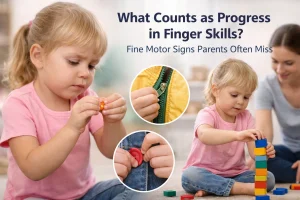
When a child has been steering clear of these activities, improvement is often quiet at first. It may look like staying at the table a little longer, touching the materials without protest, or trying for a few seconds before asking for help.
You might notice your child experimenting by using two hands, changing how they hold something, switching to a different grip, or choosing a tool that feels better. Those moments count. They are signs your child is building comfort and control, even if the final product still looks messy.
How to make fine-motor activities feel easier without turning it into a lesson
The goal is not to convince your child to do the activity. The goal is to make participation feel safe and doable so your child can gradually build smoother control through everyday play.
1) Start with “easier wins” for the hands
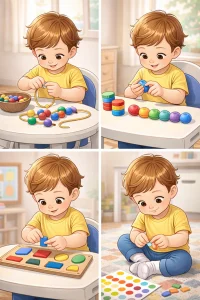
Many children tolerate whole-hand or resistance-based play more easily than precision tasks. Things like squeezing, tearing, pressing, pulling, or pushing can feel satisfying and successful, and they naturally support the kind of controlled hand use that later makes crayons and scissors easier.
You may find your child is more open to materials that offer feedback, such as playdough, sponges in the bath, bubble wrap, spray bottles, or toys with big buttons and levers, because their hands can feel what is happening.
2) Let the tool do more of the work
If crayons are a battle, it is okay to use tools that are easier to hold and control. Chunkier crayons, short crayons, or markers with a comfortable grip can reduce the effort. For cutting, some children do better when the paper is sturdier and the scissors feel smooth to open and close.
This is not cheating. It is meeting your child where they are so the experience is more successful, and success is what builds willingness.
3) Keep expectations focused on participation, not performance
A child who avoids fine-motor play often expects it to go badly. When adults focus on neatness, staying inside lines, or finishing a page, it can confirm that fear.
Instead, it helps when the message is: You can explore this. You do not have to be perfect. When the outcome matters less, children are more likely to try, and trying is where control develops.
4) Offer choice and control where you can
Avoidance often decreases when children feel some ownership. Small choices can change the emotional tone: which color, which paper, whether to sit or stand, whether to do a little or a lot, whether to do it together or side by side. When children feel trapped in an activity, they resist. When they feel they can leave and return, they are more likely to engage.
5) Notice the moment they are ready to stop
Fine-motor tasks can fatigue hands quickly. Stopping while it is still going “okay” can protect the positive association. Many children will come back another day if they do not feel pushed past their limit.
This can be hard for parents, especially when you finally see them participating. But ending on a manageable note often leads to more willingness next time.
When it helps to get a little extra support
Sometimes parents simply want reassurance that they are responding well, or they want fresh ideas that fit their child’s personality. If avoidance is frequent and you are not sure how to make these moments feel easier, extra support can be helpful, not because something is wrong, but because parenting is already full and you deserve tools that reduce stress.
Speech and Autism therapy Apps like BASICS can offer a gentle way to understand goals like using hands and fingers with controlled movements during play and daily routines, with simple guidance that fits into real life. Some families also prefer working with a professional who can help them choose expectations and materials that match their child right now.
A calm reminder for parents
A child who avoids crayons, scissors, or small toys is not telling you they will not learn. They are telling you the task currently feels too hard, too frustrating, or too uncomfortable.
With time, supportive materials, and lower-pressure experiences, many children become more comfortable and confident using their hands. And as that comfort grows, you will often see more participation in play, daily routines, and early learning, along with that quiet pride that comes from realizing, I can do this. If today’s attempt ended in refusal, it does not mean you are failing or your child is stuck. It simply means you are still in the “making it feel doable” stage, and that stage is a real and important part of development.
Book your Free Consultation Today
Parent/Caregiver Info:
Client’s Details:
* Error Message