How to Teach Turn-Taking Without Power Struggles or Forced Sharing
Last Updated: March 3, 2026
If you’ve ever watched two kids reach for the same toy and felt your shoulders tense, you’re in familiar territory. Many parents feel stuck between two options that both feel wrong: forcing a child to share and bracing for the meltdown, or letting it go and worrying you’re “allowing” rude behavior.
The good news is there’s a third path. You can teach turn-taking in a way that protects play, keeps connection first, and still builds the skill. Turn-taking can be taught gently and playfully, without turning you into the referee or making your child feel like they’re losing something.
Turn-taking isn’t really about manners. It’s about learning the rhythm of “back and forth” in play and in everyday routines rolling a ball, taking a turn with a favorite toy, waiting briefly, and staying in the exchange for a few rounds. Those small moments add up to patience, cooperation, and shared joy.
Why “Forced Sharing” So Often Backfires When You Teach Turn-Taking
When adults say “Share!” in the heat of the moment, we usually mean well. We want fairness. We want peace. We want our child to learn kindness.
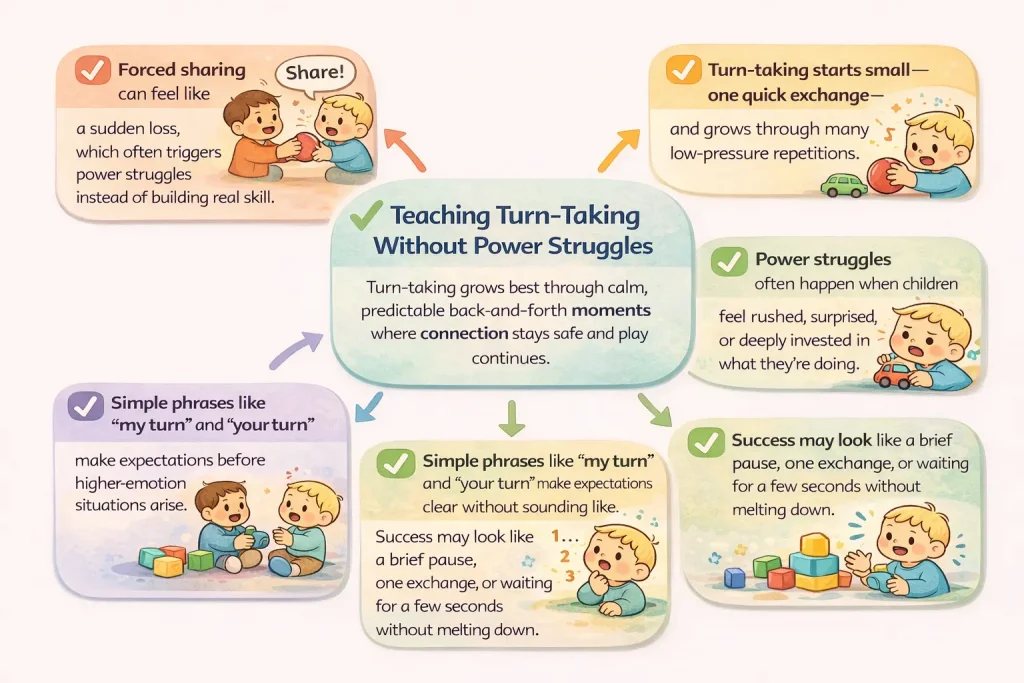
But to a young child, “share” can land like: “Give up what you’re using right now.” And if they’re deeply engaged, by building, pretending, lining things up, figuring out how something works, that request can feel like a sudden interruption. It’s not that they’re being selfish. It’s that they’re still learning how to pause, wait, and trust that they’ll get another turn.
Forced sharing also tends to create a win-lose feeling. One child gets the toy; the other child loses it. That’s a setup for power struggles, not skill-building. When you teach turn-taking instead of demanding sharing, you keep the focus on the relationship and the game: we’re doing something together, and it goes back and forth.
What turn-taking really looks like in early childhood
Turn-taking isn’t an all-or-nothing skill. It often starts small and grows in little bursts.
At first, taking turns might look like a quick exchange one roll of a ball back and forth, one silly sound copied, one block added to a tower. Over time, many children can stay with it longer, maintaining three to five (or more) back-and-forth exchanges. That’s a big deal developmentally, and it’s built through lots of low-pressure experiences.
It also helps to remember that turn-taking isn’t only about toys. It includes vocal turn-taking (“your turn” to make a sound, “my turn” to respond), gestures (showing, giving, pointing), and routines (who picks the snack, who turns the page, who pushes the button).
When you widen the definition, you start noticing opportunities everywhere and it stops feeling like a constant battle over possessions.
Why power struggles happen around turns
Power struggles usually show up when a child feels surprised, rushed, or cornered. If they think the only way to keep playing is to defend the toy, their body goes into “hold on tight” mode. That’s not a character flaw; it’s a very normal protective response.
Another common reason is timing. Adults often ask for turn-taking at the exact moment a child is most invested: right when they finally got the truck to do what they wanted, right when the tower is almost done, right when the pretend story is getting good.
And sometimes, the expectation is simply too big for the moment. Waiting “just a minute” can feel endless to a young child. Even a short pause takes practice. When you approach turn-taking as a skill that grows, rather than a rule that must be obeyed, you’ll naturally choose expectations that reduce conflict.
The gentle shift that keeps play positive
A helpful mindset is to move from “You have to share” to “We’re going to make this work for both of you.” That might mean you narrate what you see, set a calm expectation, and keep the tone light. Not as a lecture, and not as a demand, more like you’re guiding the flow of play.
Often, the most effective tool is a simple pause. A brief pause gives your child time to process what’s happening and what you’re asking, especially when emotions are rising. In many families, that tiny beat that is paired with a warm face and steady voice, changes the whole moment. You’re not trying to “win” the interaction. You’re trying to keep the relationship safe enough that your child can practice the skill.
Simple language that reduces battles
Parents often ask what to say in the moment, because it’s hard to find words when two kids are upset. The goal isn’t to deliver the perfect line it’s to communicate a clear, calm expectation that turn-taking is possible.
In everyday play, many children respond well to short, cheerful phrases like “My turn,” “Your turn,” and “Then me.” Those phrases are easy to repeat and easy for children to copy later.
When a toy is the problem, it can help to name the plan instead of the problem. Something like, “You’re using it. When you’re done, it’s their turn,” communicates that you’re not taking it away right now, and that another turn is coming. For some children, that reassurance is what helps them loosen their grip, literally and emotionally. And when waiting is hard, you can acknowledge it without giving in to chaos: “Waiting is tough. I’m here. We’ll take turns.” That kind of steady confidence often calms things faster than repeated explanations.
Also read: My Child Won’t Take Turns During Play Is That Normal?
What success can look like without perfect sharing
It’s easy to imagine success as a child happily handing over a toy with a smile. Sometimes that happens. Often, it doesn’t at least not at first.
Real progress might look like your child pausing for a second instead of grabbing. Or handing the toy over with a frown but without screaming. Or tolerating one back-and-forth exchange before running off. Or watching you take a turn without melting down.
Those moments count. Turn-taking is built on many small experiences of “I can wait briefly, and play continues. I’m not losing everything.” If you start looking for those small wins, you’ll feel less pressure to force a big “sharing” moment before your child is ready.
Keeping connection first when siblings or friends are involved
Turn-taking gets harder when there’s another child involved, because emotions rise faster and the stakes feel higher. In those moments, it can help to think of yourself as the “keeper of the game,” not the judge.
Your job isn’t to decide who’s right. It’s to keep play safe enough that it can continue. That might mean you stay close for a while, narrate turns, and help the play feel predictable. Predictability is calming for young children.
It also helps to hold a fair boundary without making anyone the “bad kid.” If one child is having a hard time, you can still protect the other child’s experience while staying kind: “You really want it. It’s hard to wait. We’re going to take turns.” No shaming, no threats, just calm leadership.
Over time, children learn that you won’t force sudden losses, and you also won’t let play become a free-for-all. That balance is where trust grows.
Turn-taking grows best in low-pressure moments
One of the easiest ways to avoid power struggles is to practice turn-taking when no one is fighting. That’s why simple back-and-forth games, rolling a ball, making silly sounds, taking turns adding to something, can be so powerful. They build the “rhythm” of turn-taking in a way that feels fun, not corrective.
Even daily routines can carry the skill. Letting your child take a turn turning pages, choosing between two snacks, or doing a small “you go, then I go” moment creates repetition without tension. And repetition is what makes the skill feel natural later, when the situation is more challenging.
When you want extra support without making it a big deal
If turn-taking feels like a constant source of conflict in your home, it doesn’t mean you’re doing anything wrong. Some children need more time, more repetition, or more support staying calm in the middle of excitement.
Speech and Autism therapy apps like BASICS can be a helpful option if you want simple guidance for building everyday social skills through play and routines, with language ideas and short examples that keep things gentle and realistic. It’s not about “fixing” your child, it’s about giving you a clearer path forward when you’re tired of the same struggle.
A calming reminder for parents
Your child doesn’t learn turn-taking by being forced to give things up. They learn it by experiencing safe, predictable back-and-forth moments, where play continues, adults stay steady, and connection stays intact.
If turn-taking has been messy lately, you’re not behind. You’re in the middle of a very normal learning curve. Each small exchange, each brief wait, each “my turn/your turn” moment is building something bigger: patience, cooperation, and the feeling that being with other people can be enjoyable.
And that’s the real goal, not perfect sharing, but shared play that feels good for everyone.
About the Author:
Rajini Darugupally
M.Sc., Speech-Language Pathologist (9+ years of experience)
Rajini is a passionate and dedicated Speech-Language Pathologist with over 9+ years of experience, specializing in both developmental speech and language disorders in children and rehabilitation in adults. Driven by a desire to empower each individual to find their voice, Rajini brings a wealth of experience and a warm, genuine approach to therapy. Currently, at Wellness Hub, she thrives in a team environment that values innovation, compassion, and achieving results for their clients. Connect with Rajini to learn more about how she can help you or your loved one find their voice.
Book your Free Consultation Today
Parent/Caregiver Info:
Client’s Details:
* Error Message