Mealtime Grasp Struggles: Helping Your Child Hold Utensils Without Turning Dinner Into a Battle
By Wellness Hub
Last Updated: February 9, 2026
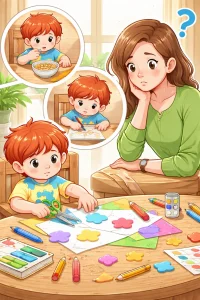
If mealtimes at your house include a spoon that keeps twisting, a fork that gets dropped again and again, or a child who would rather use their fingers than deal with utensils, you are not alone. Many parents notice that their child’s utensil grasp looks awkward, changes constantly, or falls apart as soon as the food becomes tricky.
It can be more stressful than we expect, because eating happens several times a day. When something feels difficult at every meal, it is easy for everyone to arrive at the table already tense.
The reassuring truth is that using utensils is a whole-hand skill that develops slowly. It is not just about strength or doing it the “right” way. It is about your child learning how to choose a grasp, keep it steady, and adjust it as the food and the moment change. That kind of learning takes time, and it often looks messy before it looks smooth.
Why utensil grasp can be harder than it seems
From the outside, using a spoon looks simple: hold it, scoop, lift, eat. But for a child, each part of that sequence asks their hands to do something slightly different.
Utensils are long and narrow, which makes them easier to wobble than chunky toys. The angle matters too. Tilt the spoon a little and the food slides off. Twist the fork and it will not pierce the food. Then add real-life mealtime factors: a plate that moves, a bowl that slips, food with different textures, and the feeling of being watched. Suddenly, a child who can “use a spoon” in a calm moment may struggle when dinner is rushed or the food is harder to manage.
It also helps to remember that children are still learning how to change their grasp for different tools. A crayon, a block, a toothbrush, and a fork all ask for different hand positions. When your child switches grips or goes back to fingers, they are not being stubborn. They are experimenting and trying to figure out what works.
Also read: Why Your Child Switches Grips Mid-Task And When That’s Totally Okay
What utensil struggles often look like at home
Parents describe these struggles in very familiar ways. The spoon may slide down in the hand until the grip is right near the bowl. The fork may start in one hand, move to the other, and then get dropped. Some children bend their wrist at an odd angle or lift their elbow high to compensate. Others manage a few bites and then suddenly seem to forget how to hold the utensil at all.
All of this can be part of the learning process. Progress often shows up quietly: fewer drops, a steadier scoop, a quicker return to the utensil after using fingers, or a child who tries again without melting down. These are real signs of growth, even if the grasp still does not look polished.
The hidden factor: mealtime emotions and pressure
Utensil skills do not grow best in a tense environment. That is not a parenting failure, it is simply how bodies work. When a child feels rushed, corrected, or compared, their muscles often tighten. Tight hands are not coordinated hands. And when a parent has already wiped up three spills and just wants the meal to move forward, impatience is very human too.
If dinner has started to feel like a test, it can help to quietly shift the goal. Instead of “hold it correctly,” think “stay comfortable and keep the meal moving.” A calm meal protects your relationship with food, and it also gives your child more chances to practice without stress.
What makes utensils easier to manage during real meals
Sometimes the biggest change comes from the tool itself, not from teaching.
Many families notice that child-sized utensils feel easier to manage than adult ones. A smaller, lighter spoon or fork can be simpler to control while your child is still learning how to adjust their grasp. Some children also do better with slightly thicker handles because they do not need to squeeze as hard to feel stable.
Food matters too. Utensils are hardest when foods slide, crumble, or need a lot of force. When a meal includes at least one easy-to-manage food, something that stays on the spoon or is easy to spear, children often feel more capable. That confidence carries into the rest of the meal.
Plates and bowls help more than we realize. A bowl that does not slide, a plate with a small edge, or a surface that keeps dishes steady can reduce the extra work your child’s hands have to do. When the dish stays still, your child can focus on the utensil instead of chasing the bowl.
Supportive routines that keep the table peaceful
Most parents do not want to add more “practice” to their day. The good news is that utensil grasp grows through ordinary meals, especially when routines leave space for learning.
One helpful shift is to treat utensils as tools, not a test. Some children do best when they start with fingers and pick up the utensil once they are settled and hungry. Others like having both options on the table and choosing what feels easiest. When children feel some control, they are often more willing to try.
It can also help to reduce how much correction happens during the meal. Children notice constant feedback, even when it is gentle. If you find yourself saying “Hold it like this” or “No, not that way” many times, you are not alone. You might try saving comments for moments when your child is already doing well. A simple observation like “You got that scoop” can support confidence without turning dinner into a lesson.
And if your child’s grasp falls apart when they are tired, that is useful information, not failure. Evening meals are often the hardest time of day for coordination. Some families notice their child uses utensils best at breakfast or lunch, and that is perfectly okay. Skills often appear first when children are rested and calm.
What success can look like even before it looks perfect
It is easy to imagine success as a neat grip and a clean shirt. In real life, success usually comes in stages.
You might see your child keep the utensil in their hand longer before switching to fingers. Or you may notice them adjust their grip when the spoon twists. Or they may stay at the table longer, try more bites, and look proud when something works.
These moments matter because the real goal is not a picture-perfect grasp. It is your child feeling capable using everyday tools during daily routines. Comfort and confidence come first. The way it looks often improves after that.
When it helps to get a little extra guidance
Sometimes parents simply want reassurance that they are choosing helpful tools or ideas that match their child’s personality and their family’s mealtime rhythm. That is a very reasonable place to be.
If you would like a structured, parent-friendly way to think about hand skills across daily routines, including mealtime tool use, BASICS can be an optional support. It is designed to guide everyday goals in a calm and practical way, without turning your home into a therapy space.
A gentle closing note for parents
If utensil grasp has become a daily frustration, it does not mean you have done anything wrong, and it does not mean your child is refusing to learn. It usually means the tool, the food, the moment, or the expectations do not quite match your child’s current skills.
When you focus on keeping meals calm, offering tools that feel manageable, and noticing small improvements, you give your child the best chance to grow this skill over time. And you protect what matters most at the table: connection, comfort, and the feeling that mealtime is a safe place to try.
Book your Free Consultation Today
Parent/Caregiver Info:
Client’s Details:
* Error Message