Baby Not Pointing or Imitating? Milestones, Red Flags & What to Do
Last Updated: April 30, 2026
Written by: Rajini Darugupally, M.Sc., Speech-Language Pathologist
Clinical focus: Child speech, language development, early communication, parent guidance
Worried because your baby is not pointing, waving, copying sounds, or imitating actions yet? These early communication skills matter because they help children share attention, learn words, connect with people, and build social understanding.
But one missed skill does not automatically mean something is wrong. Some babies develop gestures, sounds, and imitation at different speeds. What matters is the full pattern: your child’s age, response to name, gestures, eye contact, sounds, play, imitation, and whether skills are improving over time.
This guide explains what many babies do between 12 and 24 months, which signs deserve a closer look, simple activities you can try at home, and when to speak with a pediatrician, speech therapist, or child development specialist.
For a broader age-wise view, you can also check our developmental milestones chart to track speech, movement, play, and social skills.
What Many Babies Do Between 12 and 24 Months
Developmental milestones are not a strict test. They are general signs that help parents and professionals notice how a child is learning, communicating, moving, and connecting. CDC describes milestones as skills most children, around 75% or more, can do by a certain age.
Between the ages of 12 and 24 months, toddlers typically start hitting some exciting communication milestones. These early skills lay the foundation for speech, social interaction, and learning. Of course, every child moves at their own pace , but here’s a general idea of what you might expect during this stage:
| Age Range | Many Babies May | Why It Matters | Ask for Help If… |
|---|---|---|---|
| Around 12 months | Wave bye-bye, play simple games like pat-a-cake, respond to familiar words, use sounds like mama or dada | Shows early social communication and understanding | Your baby does not wave, respond to familiar interaction, or loses skills |
| Around 16–18 months | Try a few words, follow simple one-step directions, point to show something interesting, copy simple actions | Shows growing language, imitation, and shared attention | Your child is not using words, not pointing to share interest, or not copying actions |
| Around 18–24 months | Use more gestures, imitate actions, understand simple routines, begin combining communication with sounds or words | Builds the foundation for speech, play, and social learning | Your child has limited gestures, limited imitation, little social interest, or slow progress |
| Any age | Keep gaining skills over time | Steady progress matters more than perfection | Your child loses words, gestures, eye contact, play skills, or social interest |
Responding to Their Name
By around 12 months, most babies turn their head, smile, or look toward you when you call their name. It shows they recognize you’re talking to them.
Pointing to Show Interest
Pointing is one of the first ways toddlers share their thoughts without words. They might point to a favorite toy, a dog outside, or something they want you to notice.
Waving, Clapping, and Other Simple Gestures
Gestures like waving “bye-bye,” clapping hands, or blowing kisses usually start to appear. These little actions are important signs that your child is connecting and communicating.
Using Simple Words
By 18 months, many toddlers can say a few simple words like “mama,” “dada,” “ball,” or “bye.” They may not be perfectly clear yet — that’s completely okay!
Following Basic Instructions
Simple directions like “come here,” “give me the ball,” or “sit down” can often be understood and followed by toddlers in this age range.
Imitating Sounds and Actions
Your child might try copying the sounds you make, clap when you clap, or mimic funny faces. Imitation is a huge building block for learning speech and social skills.
Read More: My 3-Year-Old Only Uses Gestures – Is It a Speech Delay?
When to Ask for Help: Red Flags for Pointing, Imitation, and Early Communication
It’s important to remember that every child develops at their own pace, but certain early signs can help parents know when it might be a good idea to seek a little extra support. Early action doesn’t mean something is “wrong” — it simply means giving your child the best chance to thrive.
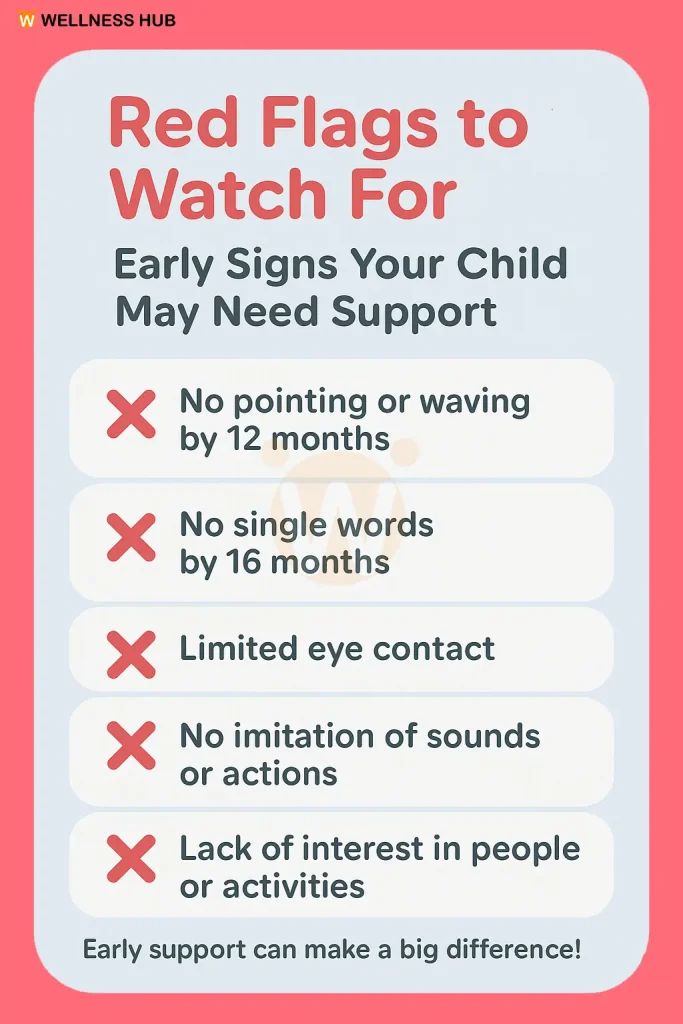
Every child develops at their own pace, but some signs deserve attention. You do not need to panic, but you should not ignore repeated concerns either.
| Area | Ask for Help If Your Child… |
|---|---|
| Gestures | Does not wave, show, reach, point, or use gestures to communicate |
| Pointing | Does not point to ask for help or point to show interest by around 18 months |
| Imitation | Does not copy sounds, facial expressions, clapping, waving, or simple play actions |
| Response to Name | Rarely turns, looks, or reacts when you call their name |
| Words | Has no clear words by around 16–18 months or is not adding new sounds/words over time |
| Understanding | Does not follow simple familiar instructions like “give me,” “come here,” or “sit down” |
| Social Interest | Rarely joins simple games, avoids shared play, or shows limited interest in people |
| Regression | Loses words, gestures, imitation, eye contact, or social interest they previously had |
One sign alone does not confirm a delay or autism. But if you notice several signs together, slow progress over time, or any loss of skills, speak with your child’s pediatrician and ask whether developmental screening or early intervention support is needed.
A note about autism screening: Not pointing, not imitating, limited gestures, reduced response to name, or limited social interest can sometimes appear in children who need further developmental evaluation. These signs do not automatically mean autism. However, the American Academy of Pediatrics recommends general developmental screening at 9, 18, and 30 months, and autism-specific screening at 18 and 24 months. If you are concerned, ask your pediatrician about screening.
If limited pointing, imitation, response to name, and social interest appear together, our autism checklist can help you prepare better questions for your pediatrician.
Simple Activities to Encourage Pointing, Imitation, and Early Speech
You do not need expensive toys or formal teaching to support early communication. Babies and toddlers learn best through short, playful, repeated moments with real people.
Choose one or two activities below and repeat them during daily routines. Do not pressure your child to perform. Model the action, pause, wait, and celebrate any attempt to look, reach, copy, gesture, or make a sound.
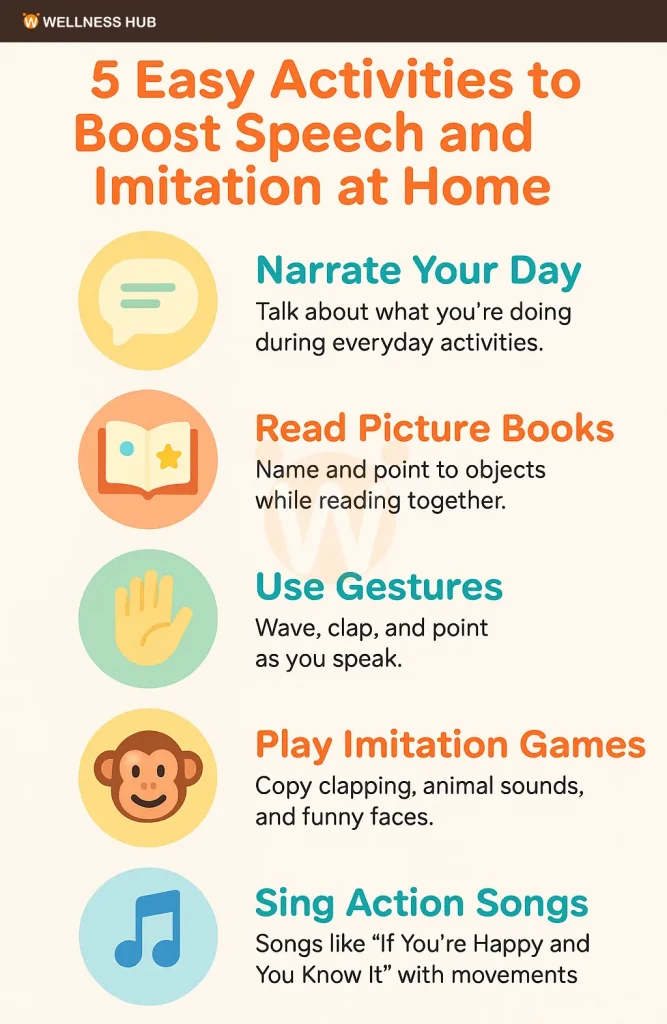
Here are some easy, playful ways to get started:
Narrate Your Daily Activities
Talk during simple routines like dressing, bathing, eating, and cleaning up. Use short phrases that match what your child sees.
Examples:
- “Shoes on.”
- “Wash hands.”
- “Open door.”
- “More banana.”
- “Ball down.”
Common mistake to avoid:
Do not talk nonstop. Say a short phrase, pause, and give your child time to look, gesture, sound, or respond.
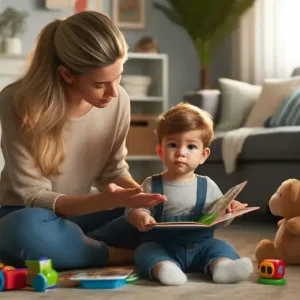
2. Read Picture Books with Pointing
Choose simple picture books with animals, people, vehicles, or daily objects. Point to one picture at a time and name it slowly.
Examples:
- “Dog.”
- “Big car.”
- “Baby sleeping.”
- “Where is the ball?”
Common mistake to avoid:
Do not turn reading into a test. If your child does not point when asked, you point first and say, “Here is the dog.”
3. Use Gestures With Words
Pair simple words with simple actions. This helps your child connect body movement with communication.
Examples:
- Wave and say “bye-bye.”
- Clap and say “yay.”
- Reach up and say “up.”
- Shake your head and say “no.”
- Point and say “look.”
Common mistake to avoid:
Do not force your child’s hand to point or wave. Model the gesture many times and give your child a chance to copy.
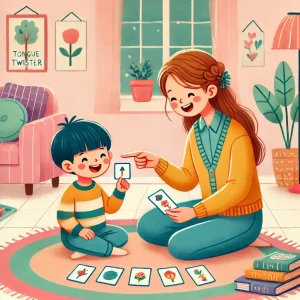
4. Play Copy-Me Games
Imitation grows when the game feels fun, not forced. Sit face-to-face and copy your child first. If your child taps the table, you tap too. If your child makes a sound, repeat it back.
Try:
- Clap hands
- Tap the table
- Make animal sounds
- Blow kisses
- Wave bye-bye
- Push a toy car
- Feed a doll or teddy
Common mistake to avoid:
Do not start with difficult imitation. Begin with big, easy actions before expecting sounds or words.
5. Sing Action Songs
Songs help because they repeat the same words, sounds, and movements. Repetition gives your child more chances to join in.
Try:
- “If You’re Happy and You Know It”
- “Wheels on the Bus”
- “Open Shut Them”
- “Twinkle Twinkle Little Star” with hand actions
Common mistake to avoid:
Do not sing the full song too fast. Pause before the key action and wait to see if your child looks, smiles, moves, or copies.
Repetition, rhythm, and fun movements help children join in more easily.
| Activity | How It Helps |
|---|---|
| Narrating daily routines | Builds vocabulary and language understanding |
| Reading interactive books | Strengthens listening and attention skills |
| Using gestures with words | Connects actions to language |
| Playing imitation games | Develops copying and communication skills |
| Singing action songs | Encourages speech rhythm, memory, and movement |
If your child is also not using words, read why isn’t my 1-year-old talking yet for simple home strategies.
When Professional Guidance Can Help
Home activities are helpful, but they are not a replacement for professional guidance when important communication signs are missing. A speech therapist or child development specialist can observe how your child communicates, plays, imitates, responds, understands, and uses gestures.
Professional guidance may help if:
- Your child is not pointing, waving, showing, or using gestures
- Your child is not imitating sounds, actions, or facial expressions
- Your child is not using words by 16–18 months
- Your child rarely responds to their name
- Your child seems less interested in people or social games
- Your child gets frustrated because they cannot communicate
- Your child loses skills they previously had
A therapist can help you understand whether your child needs monitoring, home strategies, speech therapy, occupational therapy, developmental screening, or further evaluation.
| Myth | Truth |
|---|---|
| “Waiting will fix everything.” | Early support often leads to faster and stronger communication growth. |
| “All kids are the same.” | Every child has a unique learning style and pace. |
| “Getting help means something is wrong.” | Asking for help shows strength, love, and smart parenting. |
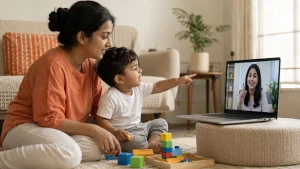
If your child needs structured support, online speech therapy for kids can help with early words, gestures, imitation, and communication routines
Conclusion
Many parents wonder if their child’s speech and communication skills are on track, and it’s completely normal to feel unsure. At Wellness Hub, we believe every child has amazing potential, and early support can make a big difference. You don’t have to wait or guess. Our caring team is ready to guide you with expert advice, simple screenings, and personalized one-on-one therapy. Remember, you know your child best, and taking early steps can open new doors for their growth. We believe in your child’s potential — and we’re here to help you nurture it.
Frequently Asked Questions:
1. Is it normal if my 1-year-old doesn’t point to things?
It’s common for babies to start pointing by around 12 months. If your child isn’t pointing yet, it could mean they need a little extra help with communication skills. Early support can really make a difference.
2. What are early signs of a speech delay in toddlers?
Early signs include not pointing or waving by 12 months, not using simple words by 16 months, poor eye contact, and not copying sounds or actions. If you notice these, it’s a good idea to talk to a speech therapist.
3. Should I be worried if my baby doesn’t imitate sounds?
Babies usually start copying sounds, faces, and actions in the first year. If your baby is not imitating by 12–15 months, it’s best to check with a professional to see if early speech therapy can help.
4. How can I help my toddler learn to point and imitate?
You can encourage these skills by using gestures often, playing simple imitation games, reading books together, and singing songs with actions. Small daily activities build strong communication skills over time.
5. When should I see a speech therapist for my toddler?
If your child isn’t using gestures, saying words, making eye contact, or trying to imitate by 15–18 months, it’s a good idea to book a speech therapy consultation. Early help leads to better results.
6. What happens during an early speech therapy session?
A speech therapist will play and interact with your child in a fun, relaxed way. They’ll show you easy activities to support speech and imitation at home, and create a plan just for your child’s needs.
7. Is online speech therapy effective for toddlers?
Yes! Online speech therapy works very well, especially for young children. At Wellness Hub, our therapists guide parents through simple activities at home that boost speech and communication skills.
8. How do I know if my child needs early intervention for speech?
Look for signs like not pointing, not using words, not making eye contact, or not showing interest in people. If you are concerned, trust your instincts — early screening can give clear answers.
9. What is a developmental milestone checklist?
A developmental milestone checklist helps you track important skills like speaking, pointing, waving, and social play. It shows if your child is on track or might need extra support. You can get a free checklist from Wellness Hub.
10. Can speech delays go away without therapy?
Some late talkers do catch up on their own. But if your child is missing key communication milestones, speech therapy can help them build strong skills early, making learning easier later.
About the Author:
Rajini Darugupally
M.Sc., Speech-Language Pathologist (9+ years of experience)
Rajini is a passionate and dedicated Speech-Language Pathologist with over 9+ years of experience, specializing in both developmental speech and language disorders in children and rehabilitation in adults. Driven by a desire to empower each individual to find their voice, Rajini brings a wealth of experience and a warm, genuine approach to therapy. Currently, at Wellness Hub, she thrives in a team environment that values innovation, compassion, and achieving results for their clients.
Book your Free Consultation Today
Parent/Caregiver Info:
Client’s Details:
* Error Message