


Ending Playtime and Starting Homework – Social Story for Kids
₹80
₹160
50% off
0 (0 ratings)
Grade Levels
Kindergarten - Grade 3 (Ages 5-9)
Content Overview
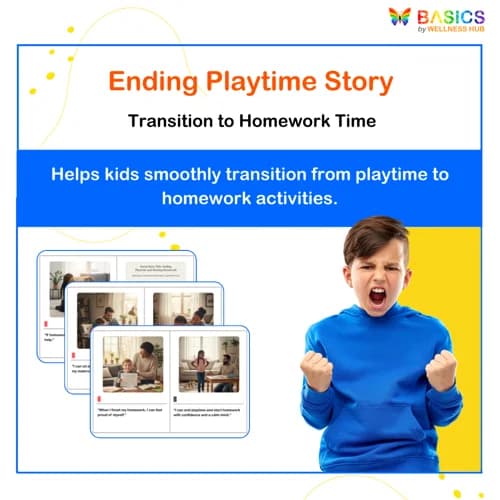
Format: Printable PDF, Total Pages: 11, Features: 16 segments with real images, vocabulary, spelling, comprehension, role-play activities
Categories
Share


About the Product
Introduction
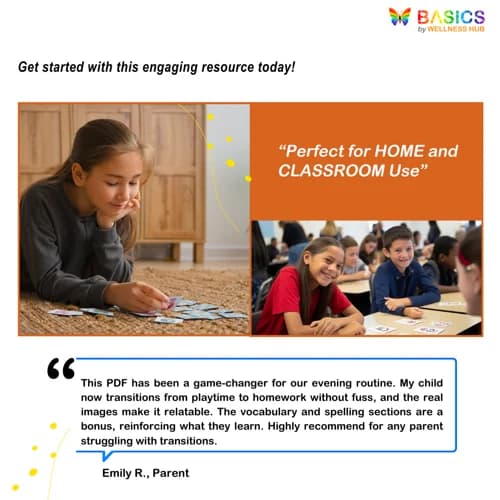
Transitioning from playtime to homework can be challenging for many children, but understanding this routine is crucial for developing time management and responsibility. Our Ending Playtime and Starting Homework Social Story PDF is designed to guide children through this transition using relatable scenarios and real-life images. This resource helps children visualize and understand the process of ending playtime and beginning homework, making it easier for them to adapt to daily routines. Ideal for use in speech therapy, special education, and at home, this social story supports children in building independence and confidence in managing their time effectively.
Product Details
- Format: Printable PDF
- Total Pages: 11
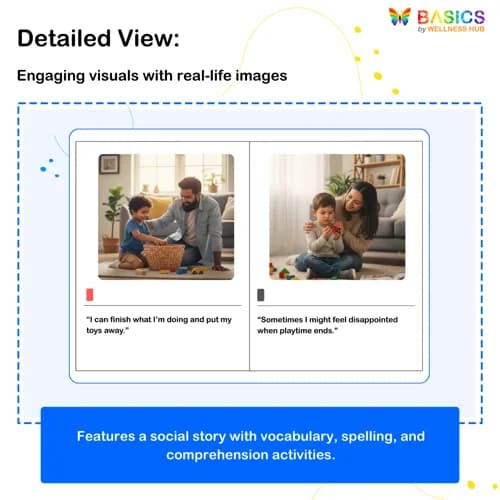
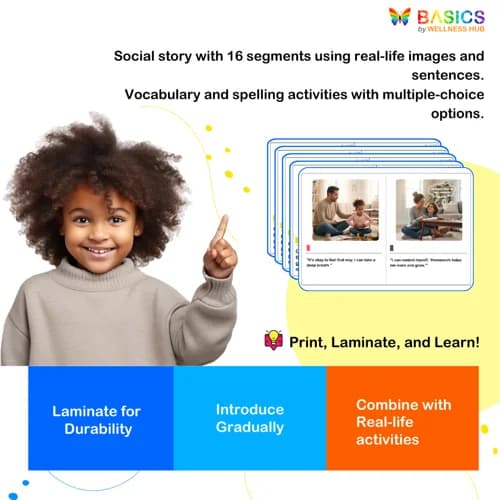
- Social Story: 8 pages, with 16 segments featuring real images and first-person sentences
- Vocabulary Section: Page 9 includes 5 vocabulary words from the story, with multiple-choice questions to select the correct meaning
- Spelling Section: Page 9 also features 5 spelling words from the story, with multiple-choice questions to choose the correct spelling
- Comprehension: Page 10 includes comprehension and open-ended questions to reinforce understanding
- Role-Play Activities: Page 11 offers role-play scenarios to practice transitioning from playtime to homework
- Designed For: Children needing support with routine transitions, suitable for use in educational and therapeutic settings
Educational Benefits
1. Facilitates Smooth Transitions
- Helps children understand the steps involved in moving from playtime to homework.
- Reduces anxiety and resistance by providing a clear, visual guide to the transition process.
2. Enhances Time Management Skills
- Teaches children how to prioritize tasks and manage their time effectively.
- Encourages the development of routines that balance work and play.
3. Supports Language and Literacy Development
- Expands vocabulary through targeted word exercises and comprehension questions.
- Improves spelling skills with interactive spelling activities.
4. Promotes Independence and Responsibility
- Encourages children to take ownership of their schedule and responsibilities.
- Fosters a sense of accomplishment as children learn to manage transitions independently.
5. Engages Visual Learners
- Utilizes real-life images to help children connect with the content and understand the context.
- Appeals to children who benefit from visual aids and structured learning approaches.
Instructions for Use
Step 1: : Read the Social Story Together
- Begin by reading the social story with the child, focusing on each segment.
- Discuss the images and sentences, ensuring the child understands the transition from playtime to homework.
- Ask questions like:
- "What do you do when playtime is over?"
- "How do you feel about starting your homework?"
Step 2: : Vocabulary and Spelling Practice
- Use page 9 to reinforce vocabulary and spelling.
- Have the child choose the correct meaning for each vocabulary word.
- Encourage them to select the correct spelling for each word, discussing why it's important.
Step 3: : Comprehension and Discussion
- Move to page 10 and explore the comprehension questions.
- Encourage the child to think about the story and answer questions in their own words.
- Use open-ended questions to promote deeper understanding (e.g., "Why is it important to finish playtime before starting homework?").
Step 4: : Role-Play Activities
- Engage in role-play scenarios found on page 11.
- Act out the transition from playtime to homework, using props if available.
- Encourage the child to practice using phrases from the story, such as "Now it's time to start my homework."
Step 5: : Reinforce Learning in Real-Life Situations
- Encourage the child to apply what they've learned during actual transitions from playtime to homework.
- Provide positive feedback and support as they practice managing their time and responsibilities.
- Revisit the social story regularly to reinforce understanding and confidence in transitioning routines.
Activities Using the Resource
1. Picture and Sentence Matching
Objective: Enhance comprehension and recall of transition steps.
How to Play:
- Print and cut out each segment's picture and sentence separately.
- Mix them up and ask the child to match each picture with the correct sentence.
- Discuss each match, reinforcing the sequence of transitioning from playtime to homework.
Skill Development:
- Visual association
- Sequential thinking
- Reading comprehension
2. Vocabulary and Spelling Quiz
Objective: Reinforce language skills through interactive learning.
How to Play:
- Use page 9 as a quiz format.
- Read each vocabulary word aloud and discuss both meaning options before choosing.
- Spell out each word together, emphasizing the correct spelling.
- Celebrate correct answers to build confidence.
Skill Development:
- Vocabulary expansion
- Spelling accuracy
- Critical thinking
3. Comprehension Storyboard
Objective: Deepen understanding through creative expression.
How to Play:
- After reading the social story, ask the child to draw a storyboard of the transition process.
- Encourage them to illustrate each step and write a sentence describing it.
- Share and discuss their storyboard, focusing on the importance of each step.
Skill Development:
- Creative expression
- Narrative skills
- Understanding of routines
4. Role-Play Transition Practice
Objective: Practice real-life application of transitioning skills.
How to Play:
- Use page 11 for role-play scenarios.
- Set up a play area and a homework station.
- Act out the transition from playtime to homework, using phrases from the story.
- Switch roles and repeat, allowing the child to guide the transition.
Skill Development:
- Social skills
- Routine application
- Confidence in transitions
5. Real-Life Transition Chart
Objective: Apply learned concepts to daily routines.
How to Play:
- Create a chart outlining the steps from the social story.
- Place it in a visible area where transitions occur.
- Use the chart as a guide during actual transitions, marking off each step as completed.
- Provide positive reinforcement for successful transitions.
Skill Development:
- Time management
- Independence
- Routine consistency
Frequently Asked Questions
Q1: How can I access the Ending Playtime and Starting Homework Social Story PDF?
A1: You can access the PDF by visiting our Wellness Hub website and navigating to the home therapy resources section. Once purchased, the PDF is available for immediate download and can be printed for personal use.
Q2: Is there a limit to how many times I can print the PDF?
A2: No, there is no limit. You can print the PDF as many times as you need for personal or educational use. However, redistribution or commercial use is not allowed as per our licensing agreement.
Q3: What is your refund policy for digital resources?
A3: Due to the nature of digital products, we do not offer refunds once a resource has been downloaded. We encourage you to review the product details and sample pages before purchasing to ensure it meets your needs.
Q4: How can I get support if I have questions about using the resource?
A4: Our support team is available to assist you with any questions or issues. You can contact us via the support section on our website or email us directly. We aim to respond within 24 hours to provide guidance and assistance.
Q5: How does the social story help with transitioning from playtime to homework?
A5: The social story uses real-life images and first-person narratives to guide children through the transition process. It helps them visualize and understand each step, reducing anxiety and building confidence in managing their routines.
Q6: Can this resource be used in therapy sessions?
A6: Yes, it is designed for use in speech therapy, special education, and other therapeutic settings. Therapists can use it to support children in developing time management skills and transitioning routines effectively.
Q7: Are there activities included to reinforce learning?
A7: Yes, the PDF includes vocabulary and spelling exercises, comprehension questions, and role-play activities. These activities are designed to deepen understanding and provide practical application of the concepts learned.
Q8: How can I incorporate this resource into daily routines at home?
A8: You can use the social story as a visual guide during transitions, discuss the vocabulary and spelling words, and engage in role-play activities. Creating a real-life transition chart can also help reinforce the steps in daily routines.
Q9: What skills does this resource aim to develop?
A9: The resource focuses on enhancing time management, language and literacy development, independence, and responsibility. It also supports visual learners by using real-life images to connect with the content.
Q10: Can I use this resource with groups of children?
A10: Yes, the resource can be adapted for group settings. Activities like role-play and comprehension discussions can be done in small groups, encouraging social interaction and collaborative learning.
Usage Rights and Restrictions
Allowed Usage:
- Personal use by parents, teachers, and therapists.
- Printable for classroom, home, or therapy settings.
- Can be used in group or one-on-one learning sessions.
Not Allowed:
- Reselling, redistributing, or modifying the resource for commercial use.
- Sharing publicly (e.g., on blogs, social media, or websites) without permission.
- Uploading the file to public sharing platforms.
If you need a bulk license for schools or therapy centers, please contact us.
Conclusion
The Ending Playtime and Starting Homework Social Story PDF is a comprehensive resource designed to ease the transition from playtime to homework for children, fostering essential skills such as time management, independence, and responsibility. With its engaging real-life images and first-person narratives, this social story effectively supports visual learners and encourages practical application through vocabulary, spelling, comprehension, and role-play activities. Ideal for use in educational and therapeutic settings, this resource is perfect for parents, teachers, and therapists seeking to help children navigate daily routines with confidence and ease.