You Are Not Doing Anything Wrong If Your Toddler Not Responding to Name
Last Updated: April 8, 2026
If you are noticing your toddler not responding to name sometimes, and then doing it beautifully the next day, it can mess with your confidence fast. Many parents tell me they start replaying everything. Did I say it wrong? Did I wait too long? Did I “ruin” progress somehow? I want you to hear this clearly: ups and downs are a normal part of learning attention and connection, especially in toddlerhood. A wobbly week does not erase the good moments you have already seen.
The goal is not a perfect, robotic turn every single time. It is a growing pattern of “I heard you, I noticed you, I can shift my attention toward you.” That pattern builds in real life, with real distractions, real feelings, and real toddler energy.
Read More: It Can Be Normal If Your Toddler Hears You but Does Not Look Up to Their Name
Why Does Name Response Look Strong One Day and Shaky the Next?
Toddlers do not show skills like a light switch. More often, it looks like a dimmer. Some days the room is bright, some days it is low, and a lot of days it flickers in between.
Here are a few very everyday reasons a name response can come and go, even when your child is learning it:
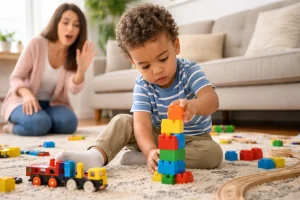
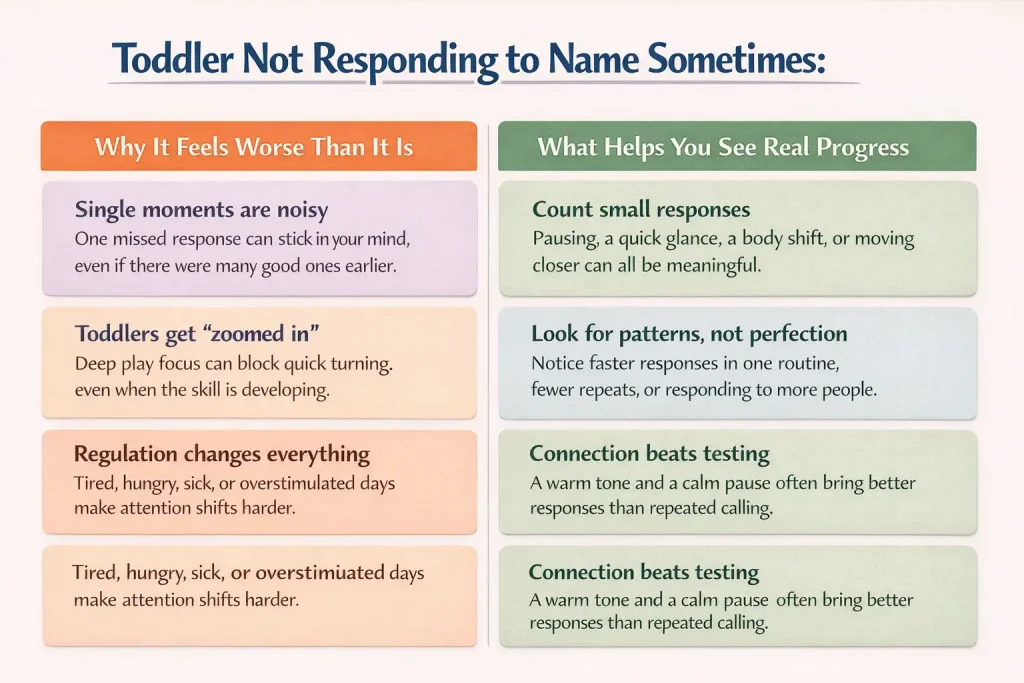
- A toddler’s attention is narrow when they are deeply focused. If your child is lining up cars, watching water pour, or figuring out how a lid works, their brain may be “zoomed in.” In that moment, not turning right away is not defiance. It is concentration.
- Regulation matters. Hunger, tiredness, teething, a cold, or a busy day can make it harder to shift attention. Adults have this too. We just hide it better.
- The environment changes the difficulty level. A quiet living room is easier than a noisy kitchen. Home is easier than a park. Even a different room can feel like a different task.
- The way the name is used changes the meaning. If your child often hears their name right before something ends, like “Name, stop,” or “Name, come here,” they may start to brace themselves. Then you might see less turning, not because they cannot, but because they are unsure what is coming next.
- And sometimes, it is simply development doing what it does. Toddlers grow in bursts. You might see a jump in language, movement, or independence, and attention skills wobble for a bit while everything reorganizes.
If you are thinking, “But yesterday they turned every time,” that actually fits the picture. It means the skill is there. It is just not steady yet.
What Counts as a Response When Your Toddler Not Responding to Name Sometimes Worries You?
When parents feel anxious about inconsistency, they often narrow the definition of success without realizing it. They start looking for one specific response, usually immediate eye contact. Anything else feels like “not responding.”
In real life, responding to a name can be small and still meaningful. It might look like a pause in hands, even if the head does not turn yet. It might be a quick glance from the corner of the eye. It might be a smile, a sound, or a tiny body shift like leaning toward you. Some toddlers respond by moving closer rather than looking up.
Those small responses matter because they show your child is starting to notice the social cue. Over time, those moments often grow into clearer turning, more eye contact, and quicker responses across different routines.
It can also help to remember that toddlers are not built for consistency across every setting. A child might respond easily during snack time but not during block play. That does not mean the skill is “only working sometimes.” It means it is still tied to certain moments that feel easier.
If you want a simple way to think about it, ask yourself: “Did my child show any sign they registered me?” If yes, you are seeing the skill in motion.
Learn More: Why Does My Toddler Not Respond to Their Name When They Are Busy Playing?
How To Spot Progress Without Spiraling Into Comparison
Inconsistent skills can make parents start tracking every single moment. It is understandable, and it is exhausting. The problem is that single moments are noisy data. They are influenced by mood, timing, and what else is happening in the room.
A steadier way to look at progress is to watch for patterns over time. You are looking for gentle shifts like:
- Your child responds faster in one familiar routine, even if other times are still hard.
- You repeat the name fewer times before you get a look.
- Your child responds to more than one person, not just you.
- You notice more “almost responses,” like a pause or a head tilt.
- The response shows up even when your child is across the room, not just right next to you.
Progress can also show up as your own growing confidence. You find yourself pausing a beat longer. You use a warmer tone. You stop testing and start connecting. Those changes often make the biggest difference, and they are easy to miss because they happen inside you.
One more gentle reminder: other kids are not your child’s measuring stick. A cousin who whips around instantly might be in a different temperament, a different phase, or a different environment. Your child’s job is not to perform. Their job is to grow.
Gentle Ways To Support Name Response in Daily Life, Without Turning It Into a Test
Most parents already know the obvious tips, like “say their name.” The part that changes everything is the feeling around it. Toddlers respond best when the moment feels safe, warm, and worth turning toward.
Support can be very simple and still powerful:
- Use your child’s name when you are available for connection, not only when you need compliance. If your child mostly hears their name when something is about to stop, they may start to tune it out.
- Give a real pause after you say it. Many toddlers need a beat to shift attention. If you fill that beat with repeats, your child never gets a clean chance to respond.
- Call from a distance that matches your child’s current success. If your child responds best when you are nearby, that is a good starting point. Distance can grow later.
- Notice your timing. Calling when your child is mid-jump, mid-climb, or mid-squeal is harder than calling during a natural pause. You are not “making it too easy.” You are building the skill where it can succeed.
- Keep your tone inviting. A warm voice and a soft face often do more than volume ever will.
If you have been stuck in a repeat cycle, it can help to shift from “I need you to respond” to “I want to share a moment.” That mindset change is not fluffy. It changes your pacing, your tone, and your patience, which are the ingredients toddlers pick up on.
If Your Toddler Is Not Responding to Their Name, What Should You Avoid Doing?
Parents do not create inconsistency by caring. Still, there are a few common habits that can accidentally make name response harder.
Rapid-fire repeating. When a name turns into background noise, toddlers tune it out. Repeating also raises your stress, which toddlers feel immediately.
Calling only when you are frustrated. If your child senses tension, they may avoid looking because looking feels like walking into trouble.
Calling from another room too soon. Distance adds difficulty. So does competing noise. If your child is not ready for that level yet, it can feel like “they never respond,” even though they do in easier moments.
Turning it into a performance. When toddlers feel watched, they sometimes resist. You might see more success when the moment feels playful and low pressure.
Rushing the pause. Many parents wait one second, then repeat. A slightly longer pause can be the difference between “ignored” and “responded.”
If any of these sound familiar, you are in good company. They are easy habits to fall into when you are trying hard. A small shift back toward calm and connection usually helps more than trying harder.
When Inconsistency is Stressful, What Kind of Support Is Actually Helpful?
Sometimes the hardest part is not the skill itself. It is the emotional toll of not knowing what to do on the “off” days. If you feel yourself getting stuck in worry, support can be less about more activities and more about a clear, gentle plan.
Helpful support often looks like:
- Someone helping you define what counts as a response for your child, right now.
- Simple adjustments to your routines so name response happens more naturally.
- Troubleshooting the moments that always fall apart, like transitions, public places, or sibling chaos.
- A way to track patterns without turning your home into a data sheet.
If you like self-paced guidance, some families use the BASICS App to explore goal-based support in everyday routines without pressure. If you prefer a more personal approach, you might also consider talking with a child development professional who can watch a few real moments and help you fine-tune what you are already doing.
In the final third note, since this topic touches communication and attention: if concerns persist, some families consider developmental screening to better understand communication delays or possible autism-related differences. It is not about jumping to conclusions. It is about getting clarity and support that fits your child.
A steady closing thought for the days it feels like you are going backward
When your toddler not responding to name sometimes shows up again after a good stretch, it can feel personal. It is not. It is a normal part of a skill becoming more flexible across moods, rooms, people, and routines.
Try to hold the bigger picture: your child is learning to shift attention toward a person, not just toward a sound. That is a relationship skill. It grows best in moments that feel warm and safe.
If today was a low-response day, it does not cancel yesterday’s progress. Keep noticing the small signs, keep your tone kind, and keep giving that little pause that lets your child find you. Those are the moments that add up.
About the Author:
Anuradha Karanam
Speech-language pathologist (7+ years of experience)
Anuradha Karanam is a skilled speech-language pathologist with over 6 years of experience. Fluent in Tamil, Telugu, Hindi, and English, she specializes in parent counseling, speech sound disorders, fluency assessment, and speech-language evaluations. Anuradha excels at working with children with developmental disorders, offering creative and effective therapy programs. Currently, at Wellness Hub, she holds a BASLP degree and is registered with the RCI (CRR No A85500). Her patience, ambition, and dedication make her a trusted expert in her field.
Book your Free Consultation Today
Parent/Caregiver Info:
Client’s Details:
* Error Message