Turn-Taking During Snack, Books, and Getting Ready: Easy Routines That Count
By Rajini D
Last Updated: March 3, 2026
If turn-taking feels like a struggle in “games,” and turn-taking routines feel out of reach, you’re not alone. Many parents try a simple back-and-forth activity, like rolling a ball, taking turns with a toy, even a quick “my turn, your turn”, and their child immediately grabs, protests, or walks away. It can feel confusing, especially when you know your child is capable in other ways.
The reassuring part is, turn-taking routines don’t always show up first in games. For a lot of children, it grows more naturally inside predictable routines, the everyday moments that already have a built-in rhythm. Snack, books, and getting ready are full of tiny, low-pressure turns that count just as much as turns in play. This isn’t about training your child to “behave” or forcing sharing before they’re ready. It’s about noticing where turn-taking is already hiding in your day, and gently leaning into it for a few warm, connected exchanges.
Why turn-taking routines can feel easier than games
Games can be unpredictable. There are rules, waiting, and sometimes a feeling of “winning” or “losing.” Even simple turn-taking games can feel like a lot when a child is still learning how to pause, wait briefly, and then jump back in.
Routines, on the other hand, tend to repeat in the same order. Your child often knows what comes next, like a snack appears, the cup comes out, the book opens, shoes go on. That predictability can make it easier for them to tolerate a short wait and participate in a back-and-forth. And importantly, routine-based turn-taking often doesn’t feel like turn-taking to a child. It just feels like life happening with you as if handing, choosing, pausing, and continuing together.
Also read: Why Waiting a Few Seconds Helps Your Child Take a Turn (And How Long to Wait)
What “turn-taking” really looks like at this stage
When parents picture turn-taking, they often imagine clean, polite exchanges: you go, I go, you go, I go. Real early turn-taking is usually messier and quieter than that.
In everyday life, turn-taking can look like your child handing you something and you handing it back. It can look like a brief pause before you open a snack, and your child looking at you as if to say, “Now?” It can be a sound you make and a sound your child repeats back, almost like vocal ping-pong. It can be taking a few page turns together during a book, even if your child flips ahead sometimes.
The goal isn’t perfection. It’s building comfort with the rhythm of back-and-forth, and gradually stretching those moments into 3–5 or more exchanges over time.
Read more: What Counts as Turn-Taking? Small Signs Your Child Is Learning (Even If It’s Messy)
Turn-taking routines at snack time without making it a “lesson”
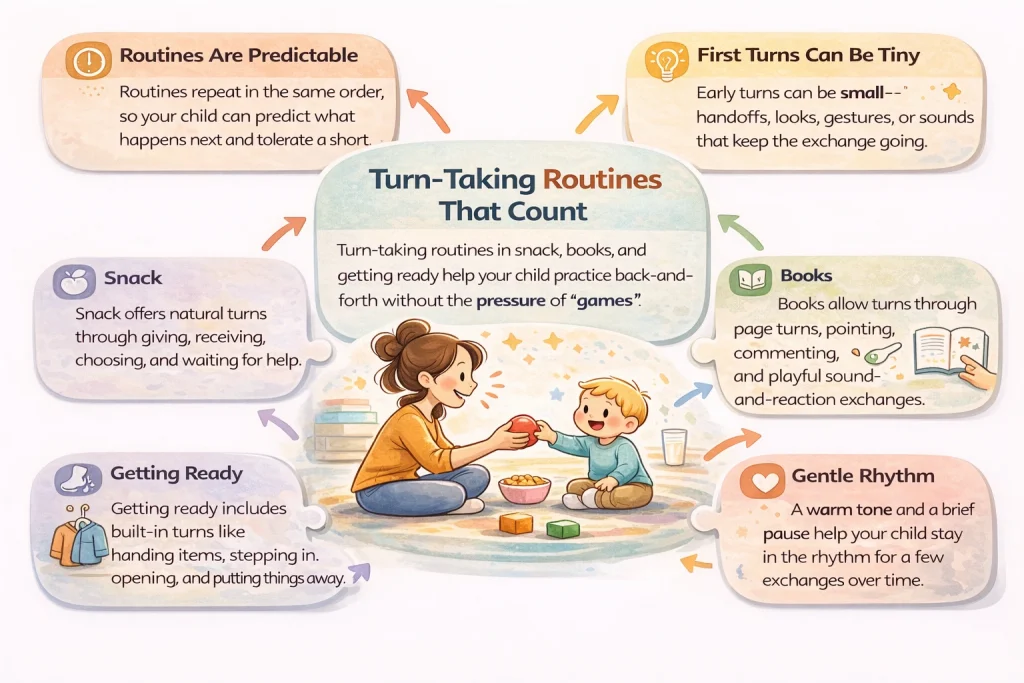
Snack is one of the easiest places to find natural turns because it already includes giving, receiving, and waiting. There are so many small moments where you and your child can share control without turning it into a test, and turn-taking routines can stay simple and natural here.
You might notice turn-taking when your child chooses between two options, when they hand you a wrapper to open, or when they pause while you pour water. Even the simple pattern of “you get a piece, I get a piece” can become a comfortable back-and-forth, especially when it’s paired with a calm voice and a friendly expression.
Some children resist turn-taking most when they’re hungry or tired, which makes sense. If snack time is already a fragile moment in your day, it’s okay to keep it easy. Turn-taking can be as small as one exchange: your child gives, you receive, you give back. That still counts, and it still builds the idea that interactions can go both ways.
Turn-taking routines during books, even with a child who grabs or flips pages
Books are another routine where turns can happen naturally, but many parents run into the same challenge: their child wants to control the book. They grab it, close it, flip ahead, or insist on the same page again and again.
It may help to remember that “book turn-taking” doesn’t have to mean sitting still and taking perfect page turns. It can simply mean sharing the experience in small ways, your child turns a page, you comment; you point, your child looks; you make a sound, your child responds. Those are turns, too.
For some kids, the easiest “turn” is not the page turn at all it’s the back-and-forth of sounds and reactions. You might read one familiar line and pause, and your child fills in a sound, a gesture, or a look. Or your child points at a picture, and you respond with interest. That shared rhythm is the heart of turn-taking: I do something, you respond, and we keep it going for a few rounds.
If your child is a “page flipper,” it doesn’t mean they can’t take turns. It often means they’re excited, curious, or moving quickly through information. You can still find tiny exchanges inside that fast pace.
Turn-taking routines while getting ready, when everyone is already stressed
Getting ready, wearing shoes, coat, backpack, pajamas, toothbrushing, can feel like the least magical time to work on anything. Parents are watching the clock, children are shifting gears, and patience can be thin.
But getting ready is full of built-in turns because it’s naturally a shared task. One person holds, the other steps in. One person hands, the other takes. One person opens, the other puts in. Even when it’s hectic, there are short moments of “my turn, your turn” that happen without adding anything extra to your day.
And because these routines happen every day, they offer repeated practice without you having to create a special activity. Over time, those repeated, low-pressure exchanges help your child get more comfortable with waiting briefly and rejoining the interaction.
If mornings are too intense, bedtime routines often work better. The pace is slower, and many children have more capacity for a few back-and-forth moments.
Keeping the rhythm going for a few exchanges
One of the trickiest parts of turn-taking is not starting, it’s continuing. Many children can do one exchange, then they’re done. That’s normal. Attention, patience, and flexibility are still growing.
What often helps is keeping the “turn” very small and very clear. In routines, turns are naturally short: a handoff, a choice, a pause, a quick sound back and forth. When the turn is small, it’s easier for your child to stay with you long enough to repeat it a few times.
It also helps when the interaction feels friendly rather than demanding. A warm smile, gentle eye contact, and a playful tone can make turn-taking feel like connection instead of control. Celebrating attempts matters too, not with big praise that adds pressure, but with simple warmth that says, “I noticed you. This is nice.”
And if your child doesn’t take their turn right away, a brief pause can be surprisingly powerful. Many children need an extra beat to process what’s happening and decide to join in. Waiting a moment communicates, “I’m here, and it’s your turn whenever you’re ready.”
When turn-taking feels hard, even in routines
Some days, turn-taking falls apart. Your child grabs. They refuse. They melt down. You’re tired and you just want to get a snack or get out the door.
That doesn’t mean you’re doing anything wrong, and it doesn’t mean your child “can’t” learn this. It usually means the moment is too big, too hungry, too rushed, too many transitions, too much stimulation.
On those days, it’s completely okay to prioritize calm and connection over back-and-forth. Turn-taking grows over time through many small experiences, not through pushing in the hardest moments.
A gentle way to think about progress
Progress with turn-taking often looks like slightly longer pauses, slightly more willingness to wait, and slightly more shared exchanges across the day. You might notice your child handing you something and waiting for it back. You might notice more eye contact during a handoff, or a quick smile after you say “my turn.” You might get three exchanges instead of one.
Those are meaningful steps. Turn-taking is a social skill, but it’s also a relationship skill. Each small back-and-forth teaches your child that interactions can be shared, predictable, and even fun.
Optional support if you want ideas that fit your day
If you’d like extra support finding routine-based opportunities for goals like taking turns—without turning your day into a therapy session—tools like BASICS can help parents choose a focus and see simple, everyday examples. Some families like having that gentle structure, especially when they’re not sure what “counts” or how to keep exchanges going.
A calm reminder to end on
Turn-taking doesn’t have to start in games. For many children, it begins in the quiet, ordinary moments: passing the cup, waiting for the cracker, turning the page, handing the shoe.
These turn-taking routines count because they’re real life—and real life offers the kind of repetition and predictability that helps children grow. If your child can share even a few small turns with you during snack, books, or getting ready, you’re already building the foundation for longer back-and-forth interactions over time.
And that foundation is made of something you’re already offering every day: patience, presence, and connection.
About the Author:
Rajini Darugupally
M.Sc., Speech-Language Pathologist (9+ years of experience)
Rajini is a passionate and dedicated Speech-Language Pathologist with over 9+ years of experience, specializing in both developmental speech and language disorders in children and rehabilitation in adults. Driven by a desire to empower each individual to find their voice, Rajini brings a wealth of experience and a warm, genuine approach to therapy. Currently, at Wellness Hub, she thrives in a team environment that values innovation, compassion, and achieving results for their clients. Connect with Rajini to learn more about how she can help you or your loved one find their voice.
Book your Free Consultation Today
Parent/Caregiver Info:
Client’s Details:
* Error Message