Why Does My Toddler Not Respond to Their Name When They Are Busy Playing?
Last Updated: April 8, 2026
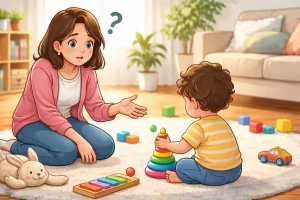
You call, “Hey, Maya!” once, twice, then again. Your child keeps stacking blocks like you are not even in the room. If you have found yourself searching toddler not respond to name playing, you are in very good company. This is one of the most common moments parents describe, because it can feel personal even when it is not. Most of the time, what you are seeing is a child who is deeply focused, not a child who is choosing to tune you out.
Play is where toddlers do some of their biggest thinking. When they are “in it,” shifting attention can be genuinely hard. The reassuring part is that name response is a learnable skill, and it often grows fastest when we stop treating it like a test and start noticing the moments when your child is most available.
Why Your Toddler May Not Respond to Their Name During Play (and It Is Not About Respect)
Adults can usually keep one ear open while we keep doing what we are doing. Toddlers are still building that ability. When your child is playing, their brain may be using most of its energy on planning, problem-solving, and body control. That can look like ignoring, but it is often intense concentration.
A few everyday reasons play makes name response harder:
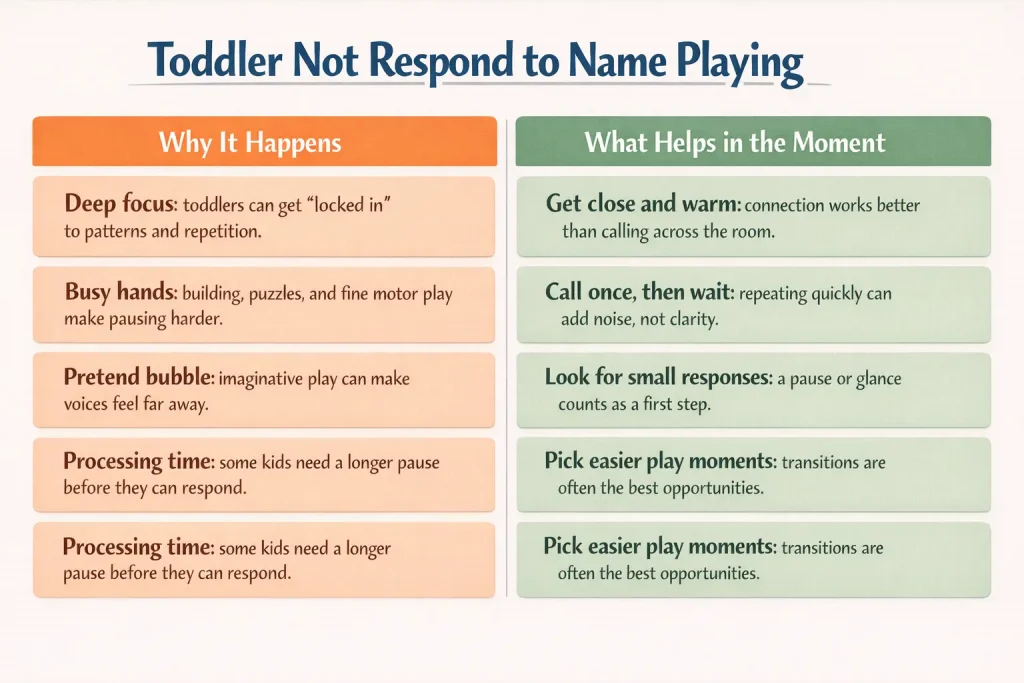
- Some play is “sticky.” Repetitive play like lining up cars, watching wheels spin, or fitting pieces into a puzzle can pull attention in a way that makes it tough to shift gears. Your child is not being stubborn. Their attention is locked onto the pattern.
- Their body is busy. When hands are working hard, like building, drawing, or opening and closing containers, it can be harder to pause and turn. Motor effort and attention are closely linked at this age.
- They are in a pretend “bubble.” Imaginative play can be so absorbing that your voice feels far away. This is especially true if they are narrating in their head or quietly talking to toys.
- They may not realize you are talking to them. In a noisy home, with siblings, TV, fans, or kitchen sounds, your child may hear your voice but not register that their name is the important part.
- They need more processing time. Some toddlers simply need a longer pause between hearing their name and responding. When we repeat quickly, it can actually make the moment harder, because they are still processing the first call.
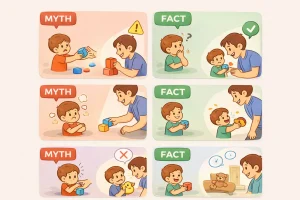
If you are also thinking about the bigger picture of toddler not responding to name, it can help to remember that “responding” does not always mean turning instantly with eye contact. A tiny pause, a brief glance, a shoulder shift, or a small smile can all be early signs that the message landed.
Read More: It Can Be Normal If Your Toddler Hears You but Does Not Look Up to Their Name
What Responding Can Look Like When Your Child is Busy Playing
Many parents picture name response as a quick turn and a clear “Yes?” That is a lovely goal, but it is not the only valid response, especially mid-play.
In real life, early responses often look like:
- A pause in movement, even for a second
- A quick look up, then back to the toy
- A small sound, hum, or “mm”
- A grin or raised eyebrows
- Turning their body but not fully making eye contact
- Reaching toward you or bringing the toy closer as if to share
These small signals matter because they show your child is starting to notice that your voice is relevant, even when they are engaged elsewhere. Over time, those brief moments often become more consistent and more obvious. You might notice they respond faster in one routine first, then in more places as the skill settles in.
If you feel unsure, try asking yourself one gentle question: “Did anything change in their body when I said their name?” Sometimes the answer is yes, and that is progress even if it is subtle.
Is It Normal for a Toddler To Ignore Their Name When They Are Focused?
Yes, it can be very normal for toddlers to miss or delay a response when they are absorbed in play. Attention is not a switch they can flip on command yet. It is a skill that develops with time, co-regulation, and lots of low-pressure practice.
It is also normal for name response to vary by situation. A child might respond quickly at snack time but not during blocks. They might respond to one parent more than another, simply because of voice tone, timing, or how close the adult is. They may respond better in a quiet room than in a busy one.
Some days are also just harder. Hunger, tiredness, teething, big feelings, or a new environment can all make it tougher to shift attention. When parents tell me, “They only ignore me when they are playing,” I often think, “That is exactly when shifting attention is hardest.”
If you are noticing this pattern, you do not need to turn playtime into a constant practice session. A more helpful approach is to choose easier moments inside play, like when your child is between actions, reaching for a new toy, or looking for the next piece. Those tiny transitions are often where success lives.
Why Repeating Their Name During Play Often Backfires (and What To Do Instead)
When you are trying to get your child’s attention, repeating their name can feel like the obvious move. Most parents do it because they care and they want connection. The tricky part is that rapid repeats can accidentally teach your child that the first few calls do not matter.
Here is what can happen when a name is repeated many times:
- Your child stays in play because nothing changes. The sound becomes background noise.
- You start to feel ignored, so your tone tightens without you meaning to.
- Your child senses the pressure and digs deeper into the activity, especially if they are sensitive to demands.
- The moment turns into a power struggle, even though nobody wanted that.
- A gentler swap is to think “one clear call, then a pause.” That pause is not giving in. It is giving your toddler time to shift attention. Many children need a few seconds longer than adults expect, especially when they are mid-action.
If you do not get a response, it does not mean your child cannot do it. It often means the moment was too hard. You can try again later in an easier window, or you can move closer and connect in a quieter way.
This is also where your own nervous system matters. If you notice yourself getting frustrated, it is okay to reset. A calm face and a warm voice make it easier for your child to look up, because looking up feels safe and pleasant.
How To Support Name Response During Play Without Turning It Into a Test
Parents often ask, “How to get my child to respond to their name when they are playing?” The best support is usually subtle. It is less about making them comply and more about making connection easy.
A few principles that tend to help:
- Closeness beats volume. Calling from across the room asks your toddler to do two hard things at once: hear you clearly and shift attention. When you are nearer, your voice, face, and presence do more of the work.
- Warmth works. A friendly tone and relaxed body language invite a response. A sharp or urgent tone can make some toddlers freeze, avoid, or double down on play.
- Timing is everything. The easiest moments are often the tiny pauses inside play. When they finish placing a block, when they look for the next puzzle piece, when they switch toys. Those are natural “open doors” for attention.
- Celebrate the smallest turn. If your child glances up, softens their face, or pauses, that is your moment. A smile, a nod, or a simple “Hi” can make responding feel rewarding without making it a big performance.
- Keep expectations realistic. If your child is deeply engaged, a full head turn and eye contact might be too much right now. A brief glance can be a perfectly appropriate goal for that moment.
It can also help to notice which types of play make it hardest. Some children respond better during movement play like rolling a ball or bubbles, and struggle more during detailed fine motor play. That is not good or bad. It is useful information. It tells you where your child’s attention is most flexible right now.
When to consider extra support, and a gentle note if worries linger
If your toddler not respond to name playing but responds in other situations, that is often a sign that attention shifting is the main challenge, not connection. You can keep supporting it in everyday routines and watch for gradual change.
You might consider extra support if you are consistently trying warm, close, low-pressure moments and you still feel stuck, or if name response is rarely happening across many settings and caregivers. Some families also seek help simply because the daily stress of repeating and not getting a response is wearing them down. That is a valid reason.
Because this topic touches communication and attention, I will add one gentle note: if concerns persist, some families consider developmental screening to better understand communication delays or possible autism-related differences. This is not about jumping to conclusions. It is about getting clarity and support that fits your child.
If you want structured guidance without pressure, options like a parent-guided tool such as the BASICS App can help you choose realistic moments to practice and notice progress you might otherwise miss.
The main thing I want you to hold onto is this: when your child is busy playing, their lack of response is very often a sign of deep focus, not a lack of love or respect. Keep aiming for connection. Small, consistent wins add up, and the toddler not respond to name playing pattern usually softens as attention skills grow.
About the Author:
Anuradha Karanam
Speech-language pathologist (7+ years of experience)
Anuradha Karanam is a skilled speech-language pathologist with over 6 years of experience. Fluent in Tamil, Telugu, Hindi, and English, she specializes in parent counseling, speech sound disorders, fluency assessment, and speech-language evaluations. Anuradha excels at working with children with developmental disorders, offering creative and effective therapy programs. Currently, at Wellness Hub, she holds a BASLP degree and is registered with the RCI (CRR No A85500). Her patience, ambition, and dedication make her a trusted expert in her field.
Book your Free Consultation Today
Parent/Caregiver Info:
Client’s Details:
* Error Message