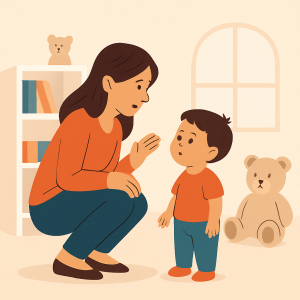
Why Waiting a Few Seconds Helps Your Child Take a Turn (And How Long to Wait)
Last Updated: March 3, 2026
There’s a moment many parents know well: your child reaches for the toy, you say “your turn,” and… nothing happens. The silence feels awkward. So you fill it. You repeat yourself, gently nudge the toy toward them, or take your turn quickly so the game doesn’t fall apart. Learning to use a turn-taking pause in this moment can feel surprisingly uncomfortable at first.
That impulse makes sense. Most of us are trying to keep play moving, avoid frustration, and help our child “get it right.” But when it comes to turn-taking, rolling a ball back and forth, sharing a favorite toy, or doing a simple back-and-forth routine, one of the most helpful things you can offer is something that feels surprisingly hard: a small pause.
Not a long wait. Not a standoff. Just a few calm seconds that give your child time to notice, process, and choose to join the exchange.
Why parents fill the silence and why it’s so normal
Silence can feel like a problem to solve. In the middle of play, it can also feel like a sign your child isn’t interested, doesn’t understand, or needs more help. Many parents jump in because they’re trying to be supportive and keep things positive.
And sometimes jumping in does help especially when a child is tired, overwhelmed, or the activity is too tricky at that moment. But often, when we rush to fill the gap, we accidentally remove the very space a child needs to participate.
Turn-taking isn’t just about manners or “sharing nicely.” It’s a social rhythm: I go, you go, we stay connected for a few exchanges. That rhythm takes time to build, and a consistent turn-taking pause helps protect that space.
What the turn-taking pause actually gives your child
A brief turn-taking pause does a few important things at once.
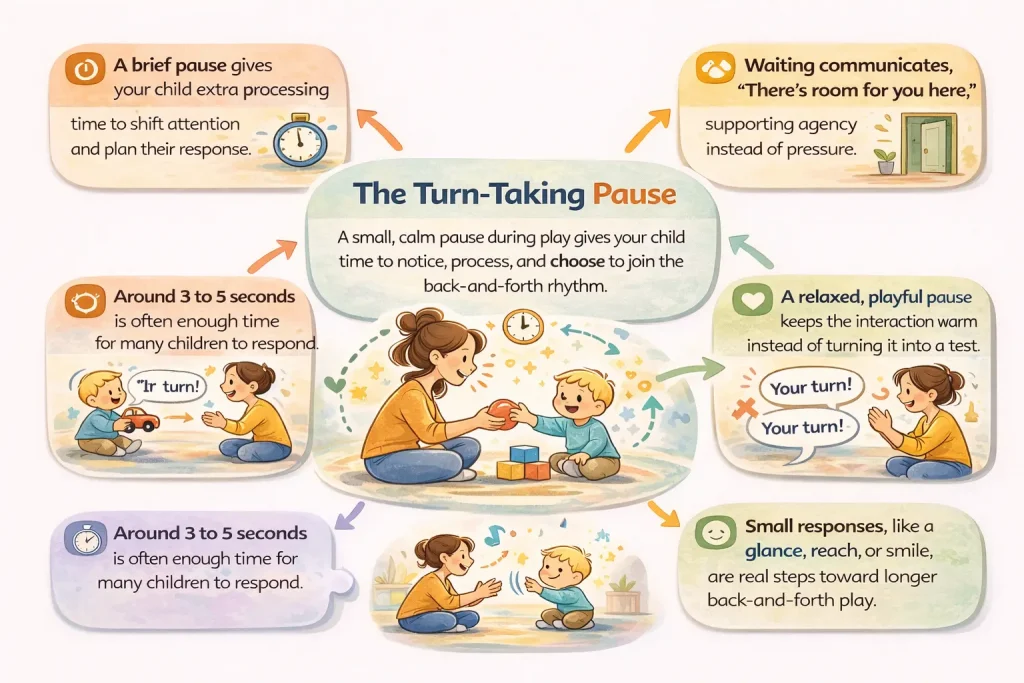
First, it gives your child processing time. Young children often need an extra beat to understand what’s happening, shift attention, and plan what to do next. Even if they know the routine, switching from watching you to taking their own turn can take a moment.
Second, it gives your child a sense of agency. When the adult moves too quickly, by handing, prompting, correcting, turn-taking can start to feel like a performance. A pause quietly communicates, “There’s room for you here,” without demanding anything.
Third, it keeps the interaction warm instead of test-like. When you wait with a relaxed face and playful energy, you’re not asking your child to prove something. You’re simply holding the door open for connection. Over time, these little pauses can support longer back-and-forth moments, three, four, five exchanges and beyond, because your child starts to feel the rhythm and trust that there’s time to join in.
Also read: 10+ Simple Home Activities That Build Turn-Taking (No Prep, No Pressure)
How long should a turn-taking pause be?
Most families do well with a short, predictable pause often around 3 to 5 seconds. That can feel longer than you expect at the moment, especially when you’re used to keeping play moving. But it’s usually enough time for a child to look, think, and respond in their own way.
If your child is very young, very excited, or easily distracted, you might notice that 2 to 3 seconds is their “sweet spot” right now. If your child tends to take longer to warm up or shift attention, 5 to 7 seconds might be more comfortable.
The goal isn’t to count perfectly. It’s to create a small pocket of space, long enough to invite your child in, short enough to keep the interaction light. A helpful way to think about it is this: wait long enough that your child has a real chance to respond, but not so long that the moment turns tense.
Read more: What Counts as Turn-Taking? Small Signs Your Child Is Learning (Even If It’s Messy)
What a “helpful wait” looks like and what it doesn’t
A helpful wait feels like you’re still with your child. You’re present, engaged, and expectant in a friendly way. Your face says, “This is fun,” not “I’m waiting for you to perform.”
During a helpful pause, you might naturally hold the toy still, keep your body open, and let your expression do some of the talking, like soft eye contact, a small smile, a calm, playful presence. Many children respond to that invitation more than they respond to repeated words.
An unhelpful wait can feel like pressure. It’s the kind of pause where the adult goes very still, stares, or keeps repeating “your turn… your turn… your turn,” while the child senses something is expected. Even when the words are gentle, the mood can shift into a quiz.
If you notice your child looking away, getting silly, or wandering off right when it’s “their turn,” it may not be defiance or disinterest. It may be that the moment has started to feel heavy. A softer pause can bring the playfulness back.
Why repeating “your turn” can backfire
“Your turn” is a perfectly fine phrase, many families use it and children learn it over time. The tricky part is when it becomes a chant that fills the space your child needs.
When we repeat the words quickly, children often hear a stream of language without enough time to act. Or they may start to tune it out because it’s not connected to a meaningful moment, they’re still figuring out what to do with it.
Often, a single cheerful “my turn” and “your turn,” paired with a brief turn-taking pause, lands better than multiple reminders. The words work best when they’re part of a fun pattern, not a prompt that escalates.
Keeping turn-taking playful in everyday moments
Turn-taking doesn’t have to live in “sharing lessons.” It shows up naturally in tiny routines: passing a snack, taking turns turning book pages, rolling a ball, stacking blocks, doing a silly clap pattern, or trading a favorite toy back and forth.
In these moments, the pause is like a little drumbeat that keeps the interaction going. You do your part, then you leave space for your child’s part. And your child’s “turn” doesn’t have to look perfect. A glance, a reach, a push, a vocal sound, a smile, those are all meaningful ways of joining the exchange.
If your child takes a turn in a small way, it counts. Turn-taking is built from these small, real moments, not from flawless sharing.
What if my child doesn’t take the turn after I wait?
Sometimes your child won’t respond, even with a well-timed turn-taking pause. That doesn’t mean the pause “didn’t work.” It may simply mean your child needs more support at that moment, or the activity isn’t the right fit right then.
A few gentle realities can be true at once: your child is learning, you’re offering space, and today might still be a day when they need you to carry more of the interaction. If the pause doesn’t lead to a turn, it can help to keep the mood easy. You might take another turn yourself in a playful way, or simplify the moment so it feels doable again. The biggest win is preserving the sense that being together is enjoyable, not that someone failed.
Over time, as your child experiences many low-pressure opportunities, you may notice more willingness to join the back-and-forth and stay in it for longer stretches.
What progress can look like even before “perfect” turn-taking
Parents often imagine success as a clean exchange: you roll the ball, they roll it back, you repeat for several turns. That’s a lovely goal, but early progress is usually quieter.
You might notice your child pausing when you pause. Watching your hand. Smiling because they sense the pattern. Reaching a second later than usual. Offering the toy for a split second. Staying close for one more exchange before moving on.
These are real steps toward the bigger rhythm of sharing and taking turns during play and simple routines. And they’re worth noticing, because your child is learning that interaction can be predictable, safe, and fun.
When extra support feels helpful
If turn-taking feels consistently hard, maybe play becomes tense, or you’re not sure how to keep the back-and-forth going without constant prompting, it can be reassuring to have a little guidance.
Some parents like using tools such as BASICS, which offers simple, everyday ways to support communication development and social connection at home. It’s not about drilling skills; it’s about helping you notice what to try in real life, in a way that fits your family.
A calm reminder to take with you
If you tend to rush the silence, you’re not doing anything wrong. You’re responding to your child with care.
But in turn-taking, a small turn-taking pause is often the kindest support. It gives your child time to process, space to choose, and a chance to feel the shared joy of “me, then you.” And when you hold that pause with warmth, like smiling, staying playful, keeping it light, you’re not just waiting for a turn.
You’re building the rhythm of connection.
About the Author:
Rajini Darugupally
M.Sc., Speech-Language Pathologist (9+ years of experience)
Rajini is a passionate and dedicated Speech-Language Pathologist with over 9+ years of experience, specializing in both developmental speech and language disorders in children and rehabilitation in adults. Driven by a desire to empower each individual to find their voice, Rajini brings a wealth of experience and a warm, genuine approach to therapy. Currently, at Wellness Hub, she thrives in a team environment that values innovation, compassion, and achieving results for their clients. Connect with Rajini to learn more about how she can help you or your loved one find their voice.
Book your Free Consultation Today
Parent/Caregiver Info:
Client’s Details:
* Error Message