How to Get More Sound “Back-and-Forth” Without Pressuring Your Child
Last Updated: March 2, 2026
You make a silly sound. A coo, a squeal, a raspberry, an animal noise.
And then… nothing.
No copy. No sound in return. Maybe your child keeps playing as if they didn’t notice. Or they glance at you for a second and move on.
If you’ve ever wondered, “Should I keep trying, or am I just bothering them?” you’re not alone. Many parents imagine sound imitation in children as a simple copy-and-repeat game. But for many children—especially in the beginning—sound imitation doesn’t start with copying. It starts with connection.
The good news is that back-and-forth can still be happening, even when the response is tiny. A look, a pause, a smile, or a soft breathy noise can all be real turns. When you treat those moments as meaningful, you make it easier for your child to join in again.
Why sound imitation in children matters more than perfect copying
Imitating playful sounds—coos, squeals, raspberries, animal noises—isn’t just a cute trick. It’s one of the earliest ways children explore communication. When your child experiments with their voice and you respond warmly, they begin to learn an important idea: “My sounds affect you.”
That’s the beginning of a conversation.
Conversation isn’t about perfect repetition. It’s about rhythm. One person does something, the other responds, and the exchange continues. When you focus on building that rhythm instead of getting an exact copy, you create a low-pressure space where your child can feel successful.
“I make a sound and get nothing back.” Is that normal?
It can be. Early sound play often looks quieter and more subtle than parents expect. Sometimes your child is listening but not ready to respond yet. Sometimes they’re interested but need extra time. And sometimes they take it in and try it later, perhaps when you least expect it, like during bath time or right before sleep.
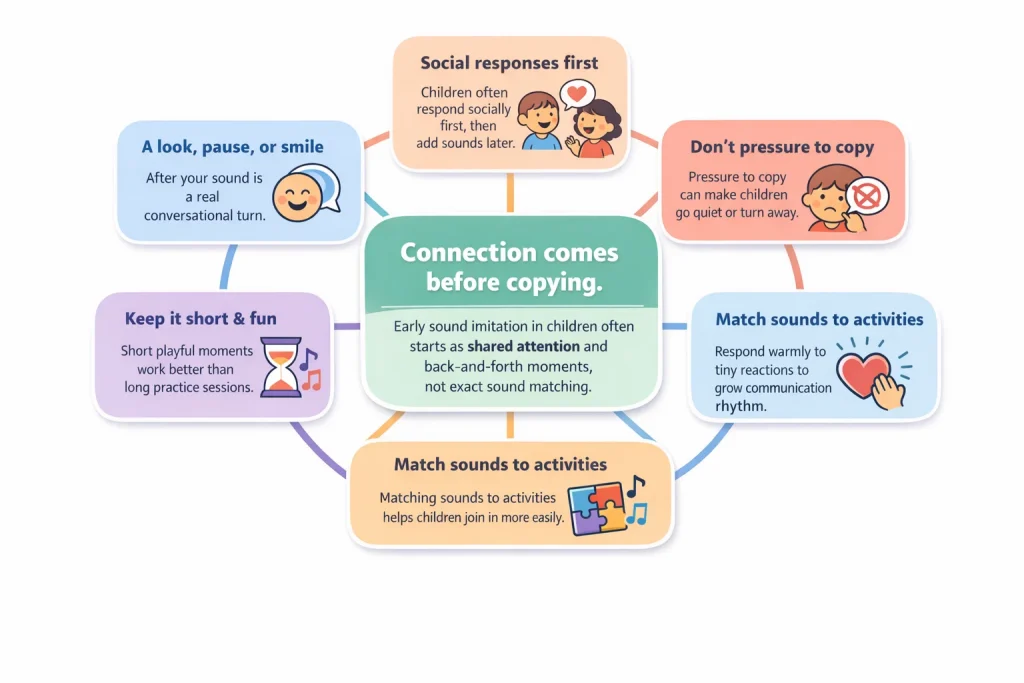
Many children don’t begin with vocal imitation at all. They often start with social responses first—eye contact, a grin, a body wiggle, or leaning closer—before sounds become more consistent.
If you’re getting a look, a pause, or a moment of attention, you’re not getting “nothing.” You’re getting the earliest version of a turn.
What counts as a “turn” in sound play?
Parents often assume the only response that counts is their child making the same sound back. But in early communication, a turn can be any clear sign of engagement.
A turn might look like:
- A quick glance toward your face
- A pause in play
- A smile or laugh
- Moving closer to you
- A small sound that isn’t the same as yours (a hum, squeak, breath, or squeal)
- A look that seems to say, “Do that again”
When you respond to these moments as if they matter, you’re teaching your child the flow of interaction: you go, I go, you go, I go. That rhythm is the foundation that later supports clearer sound imitation.
The pressure trap: why repeating the sound over and over can backfire
When you really want a response, it’s natural to try harder. You repeat the sound. You lean in. You wait with hopeful eyes. You try again maybe louder this time.
But to a child, that can begin to feel like a demand, even when it’s loving. Some children respond to this pressure by going quiet, turning away, or getting silly to escape the expectation.
This isn’t misbehavior. It’s communication.
Often, the most inviting back-and-forth happens when the sound is offered like a playful idea rather than a test. Think, “Here’s something fun,” instead of, “Now you do it.”
What helps back-and-forth feel easier for your child
Sound play tends to grow when it feels predictable, light, and connected to something your child already enjoys.
Many parents notice more success when:
- The moment is face-to-face (during diaper changes, cuddles, or bath time)
- The sound matches the activity (a “vroom” with cars, a “pop” with bubbles, a “moo” with a cow)
- There is a pause after the sound, leaving space for a response
- Any response is met warmly, even a tiny one
- The exchange stays short and playful rather than stretching too long
You don’t need long practice sessions. Small moments throughout the day often work better because they feel natural and safe.
How to keep the rhythm going when your child responds with only a look
This is a very common situation: your child looks at you but doesn’t make a sound. Parents wonder whether to stop or try again. A helpful way to think about this is to treat the look as your child’s turn in the conversation.
If your child looks at you after you make a sound, respond as if they “answered.” Your face, voice, and timing can say, “I heard you.” That response teaches the back-and-forth pattern.
Over time, many children begin to add more first a smile, then a small noise, then a clearer playful sound. But the bridge is built by honoring those early, quiet turns.
What progress usually looks like so you don’t miss it
With playful sound imitation, progress is often slow and easy to overlook. It rarely looks like a sudden leap from silence to perfect copying.
You may notice that:
- Your child watches your mouth more closely
- They pause longer after you make a sound
- They make more spontaneous noises during play
- They look at you after vocalizing, waiting for your reaction
- You share more little sound moments with laughter
These are strong signs that your child is becoming more comfortable using their voice socially, and that your back-and-forth rhythm is growing.
Also read: 10+ Easy Home Activities That Encourage Sound Imitation and Playful Noises
When you’re not sure what to do next
Sometimes the hardest part isn’t your child’s response it’s your own uncertainty. You don’t want to push. You don’t want to stop trying. You just want to know you’re supporting communication in a way that feels good for both of you.
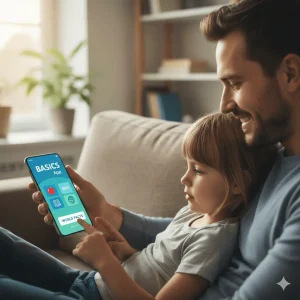
If you’d like gentle guidance, Speech and Autism therapy apps like BASICS can offer support. It helps parents focus on playful sound imitation in children and turn-taking through everyday moments, using simple examples that keep the emphasis on connection rather than pressure. It’s not something you must use just an option if you want extra reassurance.
A calm reminder to take with you
If your child isn’t copying your sounds yet, it doesn’t mean you’re doing anything wrong. And it doesn’t mean your child isn’t interested in communicating.
Back-and-forth starts small. Connection comes before copying.
When you offer playful sounds in warm, everyday moments, and treat a look, a pause, or a tiny noise as a real response, you are already building the rhythm of conversation. Over time, that rhythm is what invites your child’s voice to join in more and more.
About the Author:
Rajini Darugupally
M.Sc., Speech-Language Pathologist (9+ years of experience)
Rajini is a passionate and dedicated Speech-Language Pathologist with over 9+ years of experience, specializing in both developmental speech and language disorders in children and rehabilitation in adults. Driven by a desire to empower each individual to find their voice, Rajini brings a wealth of experience and a warm, genuine approach to therapy. Currently, at Wellness Hub, she thrives in a team environment that values innovation, compassion, and achieving results for their clients. Connect with Rajini to learn more about how she can help you or your loved one find their voice.
Book your Free Consultation Today
Parent/Caregiver Info:
Client’s Details:
* Error Message