


Taking Care of Myself – Social Story for Physical and Emotional Well-being
₹80
₹160
50% off
0 (0 ratings)
Grade Levels
Kindergarten - Grade 3 (Ages 5-9)
Content Overview
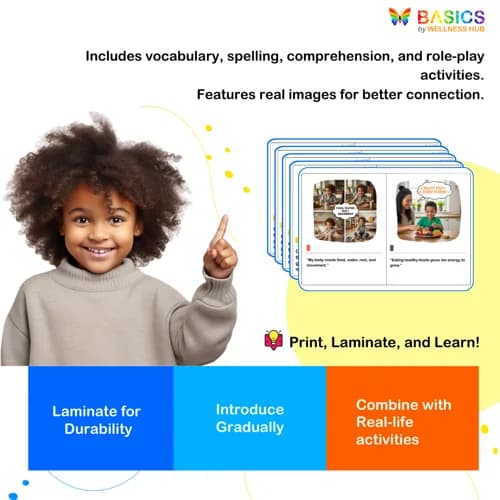
Format: Printable PDF, Total Pages: 11, Features: 16 segments with real images, vocabulary, spelling, comprehension, role-play activities
Categories
Share


About the Product
Introduction
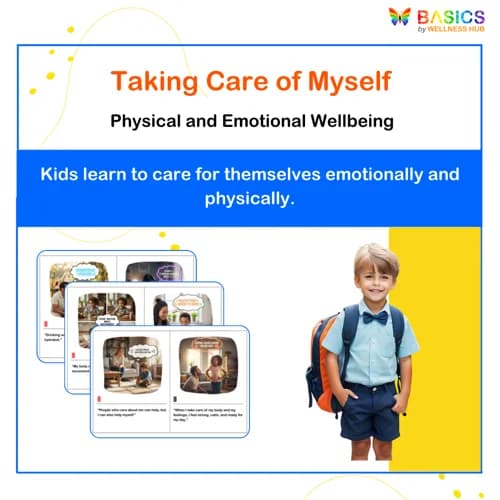
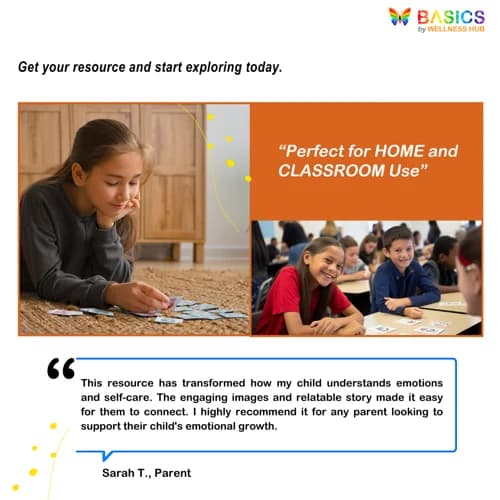
Helping children understand and manage their physical and emotional well-being is crucial for their overall development. The "Taking Care of Myself: Social Story PDF" is a supportive educational tool designed to teach children about self-care through relatable scenarios and engaging activities. This resource uses real-life images and first-person narratives to help children connect with the content, making it easier for them to apply these lessons in their daily lives. Ideal for use in therapy sessions, classrooms, and at home, this social story encourages children to take proactive steps in caring for themselves both physically and emotionally.
Product Details
- Format: Printable PDF
- Total Pages: 11
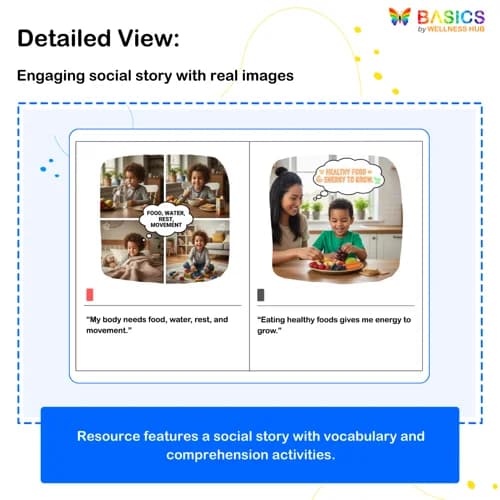
- Social Story: 8 pages with 16 segments, each featuring a real picture and a sentence in first-person narrative
- Vocabulary & Spelling: Page 9 includes 5 vocabulary words with multiple-choice definitions and 5 spelling words with correct and incorrect options
- Comprehension: Page 10 offers comprehension and open-ended questions to reinforce understanding
- Role-Play Activities: Page 11 provides role-play scenarios to practice skills learned from the social story
- Purpose: Designed for children to learn self-care skills, suitable for speech therapy, special education, and home learning environments
Educational Benefits
1. Promotes Self-Awareness and Independence
- Helps children recognize the importance of taking care of their physical and emotional needs.
- Encourages the development of routines that foster independence and self-reliance.
2. Enhances Emotional Intelligence
- Teaches children to identify and express their emotions in a healthy way.
- Supports the development of empathy by helping children understand their own feelings and those of others.
3. Builds Vocabulary and Language Skills
- Introduces new vocabulary related to self-care, enhancing language development.
- Improves spelling and comprehension through interactive exercises.
4. Supports Cognitive Development
- Encourages critical thinking and decision-making through comprehension and open-ended questions.
- Enhances problem-solving skills by presenting real-life scenarios and solutions.
5. Engages Visual and Kinesthetic Learners
- Uses real images to provide visual context and aid understanding.
- Incorporates role-play activities to reinforce learning through active participation.
Instructions for Use
Step 1: Read the Social Story
- Begin by reading the social story with the child, focusing on each segment.
- Discuss the images and sentences, ensuring the child understands the concepts being presented.
- Ask questions to encourage engagement, such as "What does this picture show?" or "How do you think this person feels?"
Step 2: Vocabulary and Spelling Practice
- Turn to page 9 and review the vocabulary words and their definitions.
- Guide the child in choosing the correct meaning for each word.
- Practice spelling by selecting the correct spelling for each word.
Step 3: Comprehension and Discussion
- Use page 10 to reinforce understanding through comprehension questions.
- Encourage the child to answer open-ended questions, promoting deeper thinking and discussion.
- Discuss how the scenarios relate to the child's own experiences and feelings.
Step 4: Role-Play Activities
- Engage in role-play scenarios from page 11 to practice self-care skills.
- Use props or real-life situations to make the activities more relatable and fun.
- Encourage the child to express their thoughts and feelings during the role-play.
Step 5: Reinforce Learning
- Revisit the social story regularly to reinforce the concepts learned.
- Encourage the child to apply these self-care skills in their daily routine.
- Provide positive feedback and support as the child practices taking care of themselves physically and emotionally.
Activities Using the Resource
1. Picture and Sentence Matching
Objective: Enhance understanding of self-care concepts through visual and verbal association.
How to Play:
- Print and cut out the segments from the social story.
- Mix up the pictures and sentences, then ask the child to match them correctly.
- Discuss each match, asking questions like "Why is this important for taking care of myself?"
Skill Development:
- Visual literacy
- Sentence comprehension
- Self-awareness
2. Vocabulary and Spelling Relay
Objective: Reinforce vocabulary and spelling in an engaging, active way.
How to Play:
- Write vocabulary words on index cards and place them on one side of the room.
- On the opposite side, place cards with definitions and correct spellings.
- Child races to match each word with its definition and correct spelling.
Skill Development:
- Word recognition
- Spelling accuracy
- Physical coordination
3. Emotion Expression Role-Play
Objective: Practice identifying and expressing emotions in a safe environment.
How to Play:
- Use role-play scenarios from the social story (e.g., feeling sad and seeking comfort).
- Encourage the child to act out the scenario and express their feelings.
- Discuss alternative ways to handle emotions and practice them.
Skill Development:
- Emotional expression
- Empathy building
- Problem-solving
4. Comprehension Charades
Objective: Test comprehension and encourage creative expression.
How to Play:
- Write comprehension questions from page 10 on slips of paper.
- Child draws a question and acts out the answer without speaking.
- Others guess the answer, promoting discussion on the scenario.
Skill Development:
- Comprehension
- Non-verbal communication
- Critical thinking
5. Self-Care Routine Chart
Objective: Apply learned concepts to real-life routines.
How to Play:
- Create a chart with daily self-care activities (e.g., brushing teeth, expressing feelings).
- Child places a sticker each time they complete an activity.
- Review the chart weekly to discuss progress and set new goals.
Skill Development:
- Routine establishment
- Independence
- Goal setting
6. Open-Ended Question Journal
Objective: Encourage reflection and deeper understanding of self-care.
How to Play:
- Use open-ended questions from page 10 as journal prompts.
- Child writes or draws their responses, focusing on personal experiences.
- Share and discuss entries to foster communication and insight.
Skill Development:
- Reflective thinking
- Written expression
- Personal insight
Frequently Asked Questions
Q1: How can I use the "Taking Care of Myself" social story effectively with my child?
A1: Start by reading the social story together, focusing on each segment's picture and sentence. Discuss the images and ask questions to ensure understanding. Use the vocabulary and spelling exercises on page 9 to reinforce language skills, and engage in role-play activities from page 11 to practice self-care skills in a fun, interactive way.
Q2: Is this social story suitable for children with special needs?
A2: Yes, the resource is designed to support children with various needs, including those in speech therapy and special education. The use of real images and first-person narratives helps children connect with the content, making it easier to understand and apply the lessons in their daily lives.
Q3: Can this resource be used in a classroom setting?
A3: Absolutely. Teachers can incorporate the social story into lessons about self-care and emotional intelligence. The vocabulary, spelling, and comprehension activities can be used in group settings to promote discussion and reinforce learning. Role-play activities are excellent for interactive learning and peer collaboration.
Q4: How often should we revisit the social story?
A4: Regular revisits are beneficial. Incorporate the social story into your child's routine to reinforce the concepts learned. Encourage your child to apply self-care skills daily and provide positive feedback as they practice taking care of themselves physically and emotionally.
Q5: What is Wellness Hub's policy on resource licensing and usage?
A5: Resources from Wellness Hub are intended for personal and educational use. Redistribution or commercial use is not permitted. For more detailed licensing information, please contact Wellness Hub directly.
Q6: How can I access additional support or resources from Wellness Hub?
A6: Wellness Hub offers a variety of resources and support options, including therapy sessions and a library of home therapy materials. You can explore their offerings on their website or contact their support team for personalized assistance.
Q7: What is the delivery method for Wellness Hub's resources?
A7: Resources are delivered digitally as printable PDFs. Once purchased, you can download and print the materials for immediate use. This format ensures easy access and convenience for users.
Q8: What is Wellness Hub's refund policy for digital resources?
A8: Due to the nature of digital products, Wellness Hub typically does not offer refunds once a resource has been downloaded. However, if you encounter any issues, their customer support team is available to assist and ensure your satisfaction.
Q9: How does Wellness Hub ensure the quality of its therapy services?
A9: Wellness Hub employs qualified therapists and uses evidence-based practices to ensure high-quality care. They focus on caregiver involvement, privacy, and regular progress tracking to make therapy effective and personalized.
Q10: Can I schedule a consultation with Wellness Hub to discuss therapy options?
A10: Yes, Wellness Hub offers a free initial consultation to discuss your child's needs and explore suitable therapy options. This consultation helps tailor a therapy plan that aligns with your goals and preferences.
Usage Rights and Restrictions
Allowed Usage:
- Personal use by parents, teachers, and therapists.
- Printable for classroom, home, or therapy settings.
- Can be used in group or one-on-one learning sessions.
Not Allowed:
- Reselling, redistributing, or modifying the resource for commercial use.
- Sharing publicly (e.g., on blogs, social media, or websites) without permission.
- Uploading the file to public sharing platforms.
If you need a bulk license for schools or therapy centers, please contact us.
Conclusion
The "Taking Care of Myself: Social Story PDF" is an empowering resource designed to help children learn and practice self-care skills in a supportive and engaging way. By using real-life images and first-person narratives, this resource effectively connects with children, making the lessons relatable and easy to apply in their daily lives. It is ideal for parents, teachers, and therapists who aim to foster independence, emotional intelligence, and language development in children. Whether in a classroom, therapy session, or at home, this social story provides a comprehensive approach to teaching self-care, ensuring children are equipped with the tools they need to thrive both physically and emotionally.