




Yes or No? Bigger Questions — 50 Printable Yes/No Question Cards about Friends, Feelings and Choices
₹80
₹160
You save ₹80
4.9 (51 ratings)
Grade Levels
Pre-K – Kindergarten (Ages 4–8)
Content Overview
Format: PDF | Pages: 23 | Features: 50 photo cards for answering yes/no questions, builds communication and social skills
Categories
Share


About the Product
Introduction
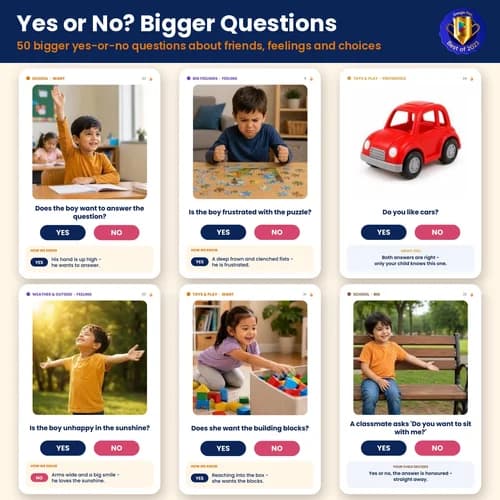
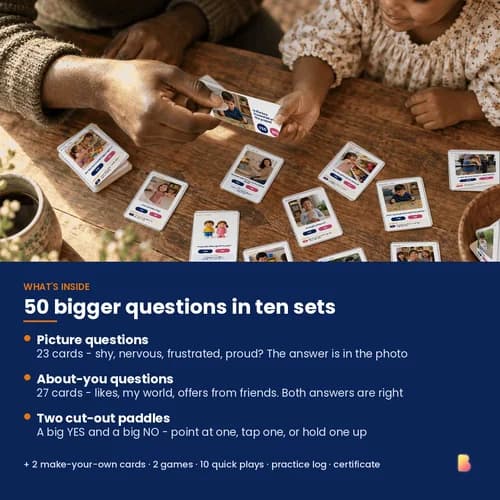
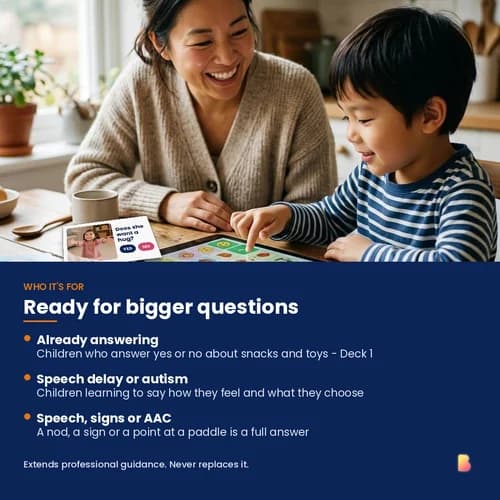
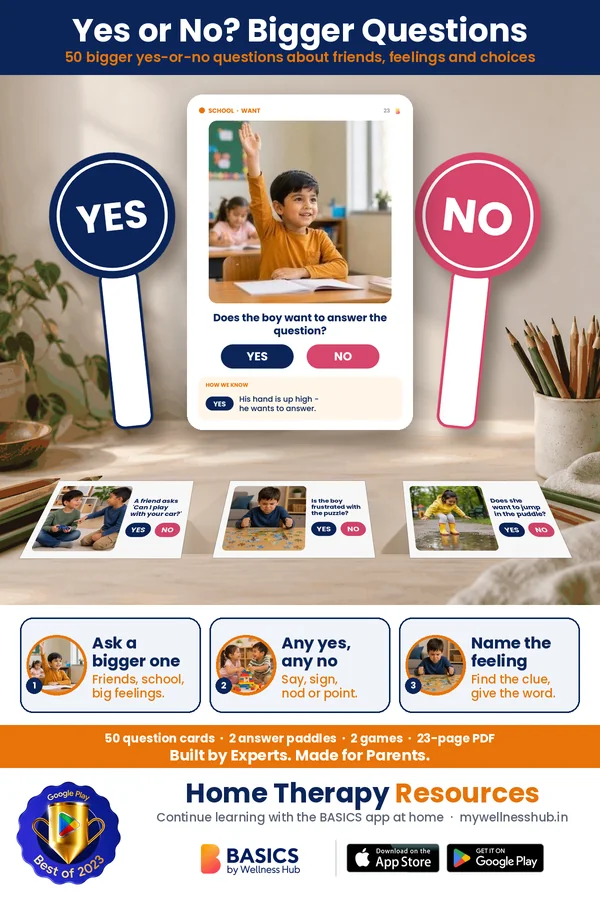
The Yes or No? Bigger Questions Picture Cards PDF offers 50 real-photo question cards and two cut-out YES and NO paddles, designed for children ready to answer more complex yes/no questions. This digital resource is perfect for kids who already respond to everyday yes/no prompts and are ready to explore deeper topics like friendships, big feelings, and personal choices. Ideal for children with speech delay, autism, or those using AAC or sign language, these cards help build confidence in communication.
Children practice reading bigger feelings from a face and a body, as well as reading what someone wants. They also learn to express preferences, accept or refuse offers, and advocate for themselves with a clear yes or no. Each card features a single yes/no question, a consistent layout, and visual clues, supporting skills like answering yes/no questions and understanding emotions through body language.
Use these cards at home, in classrooms, or during therapy sessions to encourage self-advocacy and social interaction. The resource supports expressive communication and helps children practice accepting and refusing offers from friends and grown-ups in a safe, structured way.
Product Details
- Resource Name: Yes or No? Bigger Questions Picture Cards PDF
- Format: Printable and screen-ready PDF
- Total Pages: 23
- Grade Level: Pre-K, Kindergarten, Elementary
- Designed For: Children with speech delay, autism, AAC users, and early learners
- Printing Notes: Print single- or double-sided; laminate for durability
- Best Used In: Home, classroom, speech therapy, special education
- Sets / Flashcards / Activities: 50 picture question cards, 2 cut-out YES/NO paddles, 2 make-your-own cards, 2 complete game instructions
- Visuals / Illustrations: Real-life photographs on every card
Educational Benefits
1. Builds Yes/No Question Answering Skills
- Children practice responding to a wide range of yes/no questions.
- Consistent card format supports understanding and confidence.
- primary_keyword helps children master this foundational communication skill.
2. Enhances Emotional Recognition and Expression
- Real-life photographs show faces and bodies expressing big feelings.
- Children learn to identify emotions like shy, frustrated, or proud.
- This skill supports empathy and social awareness.
3. Develops Self-Advocacy and Assertiveness
- Kids learn to express preferences and say no clearly.
- Practicing "no" responses builds confidence in self-advocacy.
- Self-advocacy is modeled and honored throughout activities.
4. Encourages Social Communication and Turn-Taking
- Children answer questions about friends, choices, and offers.
- Supports interaction with peers and adults in structured play.
- Promotes positive social exchanges and listening skills.
5. Supports AAC and Alternative Communication Methods
- Resource welcomes nods, signs, taps, or pointing at paddles.
- Children using AAC or sign language participate fully.
- Visual supports make activities accessible for all learners.
Instructions for Use
Step 1: Print and Prepare the Cards
- Print the PDF single- or double-sided for your setting.
- Cut out the 50 picture cards and both YES/NO paddles.
- Laminate for durability and easy cleaning.
Step 2: Introduce Yes/No Question Practice
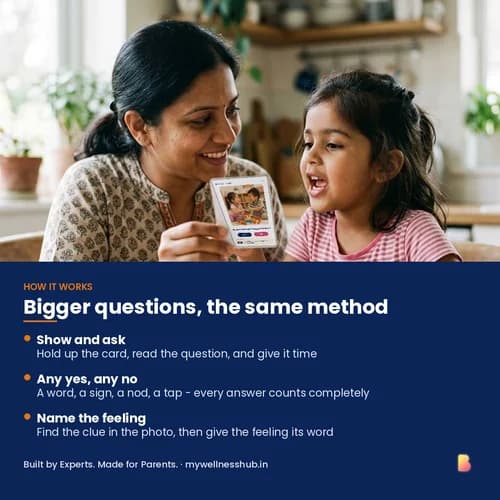
- Show a card and read the question aloud to the child.
- Encourage any yes/no response: word, sign, nod, or pointing.
- Answering yes/no questions is the focus in this step.
Step 3: Model Emotional Recognition
- Discuss the photo and ask the child to name the feeling.
- Point out body language or facial clues in the image.
- Reading bigger feelings is practiced naturally here.
Step 4: Encourage Preference and Choice-Making
- Present "about-you" cards for the child to express likes or dislikes.
- Reinforce that both yes and no are valid answers.
- Celebrate all forms of self-expression.
Step 5: Play Interactive Games
- Use the included Paddle Vote or Twenty Noes game instructions.
- Invite turn-taking and group participation for social learning.
- Games make practicing these skills fun and memorable.
Step 6: Track Progress and Reflect Together
- Use the practice log to note responses and honored "no" answers.
- Review which types of questions are easiest or need more practice.
- Encourage self-advocacy and celebrate communication growth.
Activities Using the Resource
1. Yes or No Paddle Response Game
Objective: To build confidence answering yes/no questions using the Yes or No? Bigger Questions Picture Cards.
How to Play:
- Show a picture card and read the question aloud.
- Child responds by pointing, tapping, or holding up the YES or NO paddle.
- Discuss the photo clue that supports the answer together.
Skill Development:
- Strengthens yes/no question answering
- Encourages visual clue identification
- Builds expressive communication
2. Feelings and Body Language Match
Objective: To improve reading emotions from faces and bodies in real-life situations.
How to Play:
- Select cards showing big feelings (e.g., frustrated, shy, proud).
- Ask the child to match the card to a named feeling or describe what the person feels.
- Use the card's body language as a clue for discussion.
Skill Development:
- Enhances emotional recognition
- Boosts observation and inference skills
- Supports empathy development
3. Expressing Preferences with Picture Cards
Objective: To help children express likes and dislikes using visual prompts.
How to Play:
- Present an "about-you" card (e.g., "Do you like cars?").
- Child answers with a paddle, sign, or spoken word.
- Reinforce that both yes and no are valid, celebrated answers.
Skill Development:
- Develops self-advocacy
- Encourages preference expression
- Fosters decision-making
4. Accepting and Refusing Social Offers
Objective: To practice accepting or refusing offers from friends and adults in a safe setting.
How to Play:
- Use cards with social scenarios (e.g., "Can I play with your car?").
- Child responds using any communication method.
- Discuss how to honor and respect a "no" answer.
Skill Development:
- Builds assertiveness
- Teaches social boundaries
- Promotes respectful communication
5. Clue Hunt: What Proves the Answer?
Objective: To support logical reasoning by finding visual evidence for yes/no answers.
How to Play:
- Show a card and ask, "What in the picture tells you the answer?"
- Child points out facial expressions, gestures, or objects as clues.
- Review together and reinforce the reasoning process.
Skill Development:
- Strengthens visual analysis
- Encourages evidence-based thinking
- Improves attention to detail
6. Turn-Taking Conversation Circle
Objective: To foster social interaction and turn-taking using the Yes or No? Bigger Questions Picture Cards.
How to Play:
- In a group, each child takes a turn choosing and presenting a card.
- Peers answer with paddles, signs, or words, then discuss their choices.
- Rotate roles so everyone practices asking and answering.
Skill Development:
- Promotes group participation
- Builds conversational turn-taking
- Supports peer-to-peer communication
Frequently Asked Questions
Q1: What ages or grade levels are the Yes or No? Bigger Questions Picture Cards best for?
A1: These cards are designed for children in Pre-K, Kindergarten, and early elementary grades, typically ages 4–9. The real-life photos and varied question types support both younger and older children ready for more complex yes/no questions. Adjust the pace and card selection to match each child's developmental level.
Q2: Can I use these picture cards with small groups or classroom activities?
A2: Yes, these cards are ideal for group settings such as classrooms, therapy groups, or social skills circles. The included games and paddles encourage turn-taking and peer interaction. Try the Paddle Vote or Conversation Circle activities for engaging group practice.
Q3: Are these cards suitable for speech therapy or occupational therapy sessions?
A3: Absolutely, the resource is widely used in both speech and occupational therapy. Each card targets yes/no question answering, emotional recognition, and self-advocacy, which are common therapy goals. Therapists can adapt activities to individual needs, including AAC or sign use.
Q4: What is the best way to print and prepare the cards and paddles?
A4: Print the PDF single- or double-sided on thick paper for durability, then cut out the cards and paddles. Laminating the pieces makes them reusable and easy to clean. Store the cards in a box or pouch for quick access during sessions.
Q5: How does this resource support children with special needs or those using AAC?
A5: The cards are designed for full AAC parity, welcoming responses by word, sign, nod, tap, or pointing. Visual clues and consistent layouts help children with autism, speech delay, or communication challenges participate fully. Encourage all forms of yes/no responses and celebrate self-advocacy.
Q6: Can I use the Yes or No? Bigger Questions Picture Cards on a tablet or computer without printing?
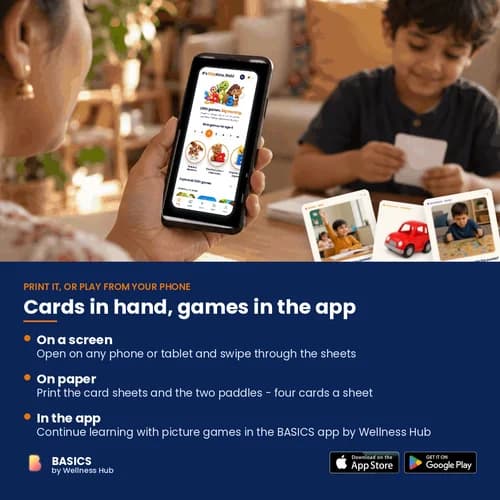
A6: Yes, the PDF is screen-ready for use on tablets, computers, or interactive whiteboards. Display cards digitally and have children respond by pointing, tapping, or using the paddles onscreen. This flexibility supports both in-person and teletherapy sessions.
Q7: What specific skills and learning goals do these cards target?
A7: The cards develop yes/no question answering, emotional recognition, preference expression, and self-advocacy. Children also learn to read feelings from faces and bodies, accept or refuse offers, and communicate choices confidently. These skills build a foundation for social communication and independence.
Q8: What are the licensing and usage rights for this PDF resource?
A8: Your purchase grants you a single-user license for personal, classroom, or therapy use. Sharing, redistributing, or posting the file online is not permitted. For multi-user or school-wide licensing, please contact Wellness Hub for options.
Q9: How do I receive and download the Yes or No? Bigger Questions Picture Cards PDF after purchase?
A9: After completing your purchase, you will receive an instant download link via email. The PDF is ready for immediate use on any device or for printing. Check your spam folder if you do not see the email within a few minutes.
Q10: What is Wellness Hub's refund or exchange policy for digital resources?
A10: Wellness Hub does not offer refunds or exchanges on digital PDF downloads due to their instant-access nature. If you have trouble accessing your file or believe there is an error, contact customer support for assistance. They are committed to ensuring you have a positive experience with every resource.
Usage Rights and Restrictions
Allowed Usage:
- Personal use by parents, teachers, and therapists.
- Printable for classroom, home, or therapy settings.
- Can be used in group or one-on-one learning sessions.
Not Allowed:
- Reselling, redistributing, or modifying the resource for commercial use.
- Sharing publicly (e.g., on blogs, social media, or websites) without permission.
- Uploading the file to public sharing platforms.
If you need a bulk license for schools or therapy centers, please contact us.
Conclusion
The Yes or No? Bigger Questions Picture Cards PDF empowers children to build confidence in communication as they tackle more meaningful yes/no questions about friendships, feelings, and personal choices. Designed for early learners, AAC users, and children with speech delay or autism, it offers real-life photo prompts and clear visual supports to guide every response.
Children develop emotional recognition and self-advocacy while practicing social communication in home, classroom, or therapy settings. The included paddles and diverse question types encourage children to express preferences, read body language, and respond to offers with both clarity and confidence.
Download the Yes or No? Bigger Questions Picture Cards PDF today and help your child or student master self-advocacy while building essential communication skills for real-world interactions.