


Who Is Doing What Tile Kit — Printable Sentence Mat with 71 Word Tiles and 90 Scene Cards for Subject–Verb Sentences
₹80
₹160
You save ₹80
4.9 (44 ratings)
Grade Levels
Pre-K – Kindergarten (Ages 3–6)
Content Overview
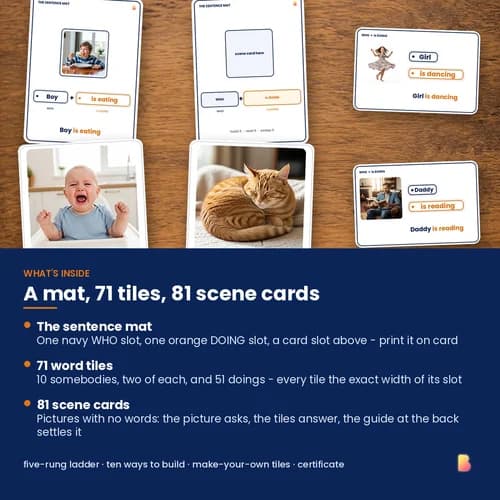
Format: PDF | Pages: 20 | Features: Sentence mat, 71 word tiles, 81 scene cards, builds subject + verb skills
Categories
Share


About the Product
Introduction
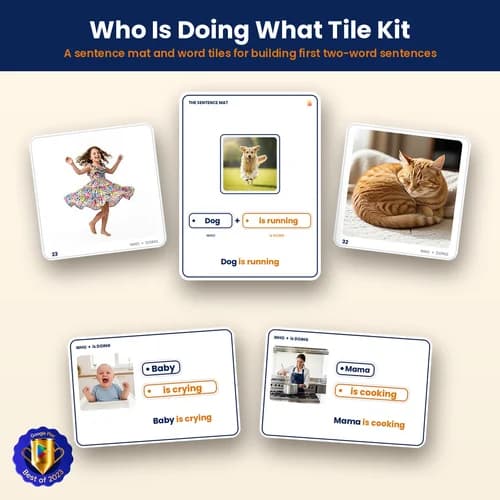
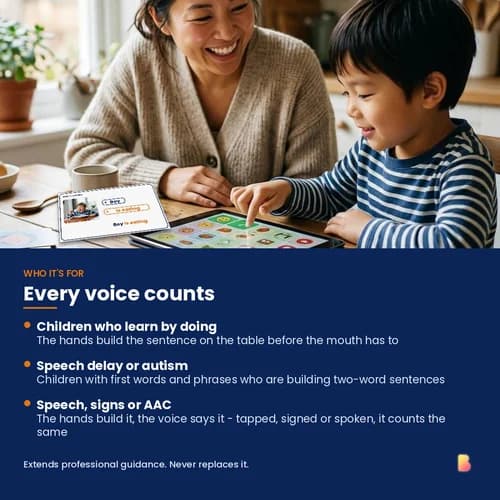
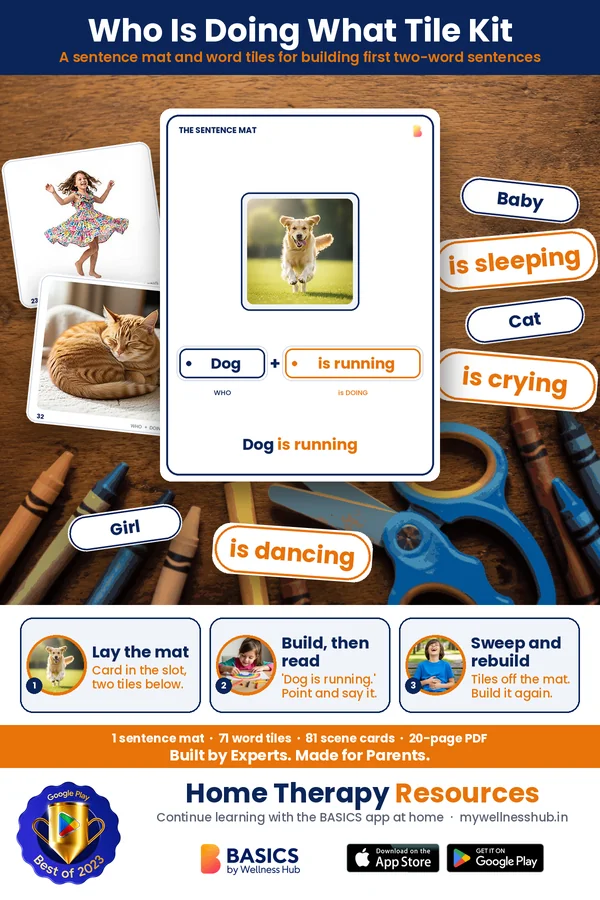
The Who Is Doing What Tile Kit PDF is a hands-on, printable resource designed to help young children build their first sentences by combining familiar people with everyday actions. Perfect for early learners, children with speech delay or autism, and those using signs or AAC, this 20-page kit includes a sentence mat, 71 word tiles, and 81 wordless scene cards for interactive sentence construction. Children physically match WHO and DOING tiles to real-life scenes, making language learning active, visual, and engaging.
With a focus on word order, children practice subject + verb sentence construction as they match tiles to scenes and generate their own sentences. The kit supports fine-motor manipulation and independent sentence generation, helping learners develop action vocabulary and sentence comprehension. Progression through five scaffolded steps encourages mastery, while playful games and gentle prompts keep learning positive and motivating.
The kit fits seamlessly into home, classroom, and therapy settings, supporting picture-to-sentence matching and interactive sentence building. Children can work one-on-one with parents, teachers, or therapists, or use the kit independently for extra practice. The mat's color-coded slots and real-life photos make it easy to adapt for speech therapy, special education, or everyday language enrichment.
Product Details
- Resource Name: Who Is Doing What Tile Kit PDF
- Format: Printable and screen-ready PDF
- Total Pages: 20
- Grade Level: Pre-K, Kindergarten, Early Elementary
- Designed For: Early language learners, speech delay, autism, AAC users
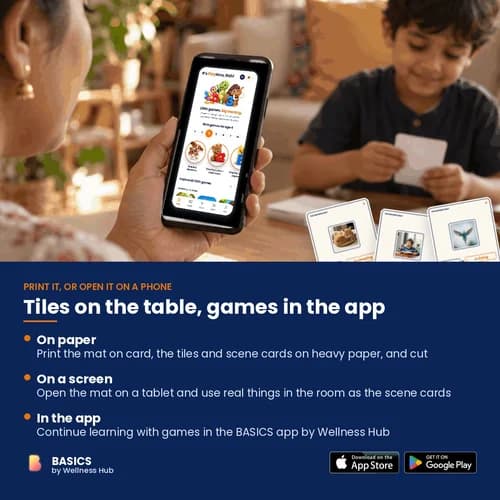
- Printing Notes: Print pages 3–14 single-sided on heavy paper for hands-on use
- Best Used In: Home, classroom, speech therapy
- Sets / Flashcards / Activities: 1 sentence mat, 71 word tiles (20 WHO, 51 DOING), 81 scene cards, 10 building games
- Visuals / Illustrations: Wordless photographic scene cards, color-coded tiles, example builds
Educational Benefits
1. Subject + Verb Sentence Construction Mastery
- Children practice combining WHO and DOING tiles to form complete sentences.
- This hands-on approach builds a strong foundation in basic sentence structure.
- The primary_keyword supports early grammar skills in a playful, visual way.
2. Action Vocabulary Expansion
- Learners encounter 51 different verbs through repeated, meaningful use.
- Matching actions to real-life photos strengthens understanding and recall.
- Children build a robust vocabulary for everyday communication.
3. Picture-to-Sentence Matching Skills
- Kids match wordless scene cards to the correct sentence tiles.
- This process boosts comprehension and reinforces visual-to-verbal connections.
- It supports children who benefit from strong visual cues.
4. Fine-Motor Manipulation and Coordination
- Handling tiles and placing them on the mat develops precise finger movements.
- This benefit is especially valuable for children with developing motor skills.
- Fine-motor practice supports handwriting and other classroom tasks.
5. Independent Sentence Generation
- Children progress from copying sentences to building their own.
- The kit encourages creativity and confidence in language use.
- Learners gain autonomy as they construct new sentences from provided tiles.
Instructions for Use
Step 1: Print and Prepare the Kit
- Print pages 3–14 single-sided on heavy paper for durability.
- Cut out the WHO and DOING tiles, and scene cards along the lines.
- Laminate pieces for longer-lasting, wipe-clean use.
Step 2: Set Up the Sentence Mat
- Lay out the sentence mat on a flat surface.
- Place the mat so the picture slot and color-coded tile slots are visible.
- Organize WHO and DOING tiles nearby for easy access.
Step 3: Introduce the Picture-to-Sentence Matching
- Show a wordless scene card and discuss what is happening.
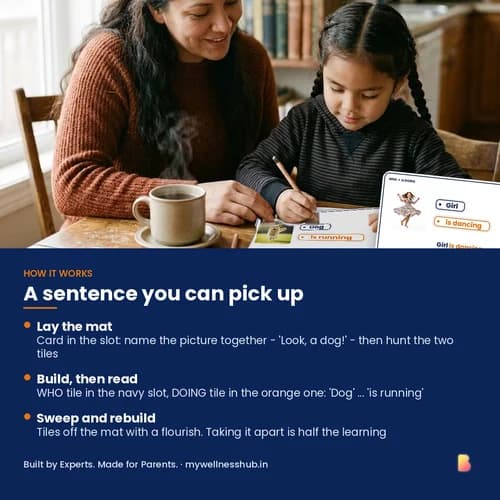
- Guide the child to find the matching WHO tile (e.g., Dog) and DOING tile (e.g., is running).
- Picture-to-sentence matching helps reinforce understanding.
Step 4: Model Subject + Verb Sentence Construction
- Demonstrate placing the WHO tile in the navy slot and the DOING tile in the orange slot.
- Say the full sentence aloud together, modeling clear speech.
- Subject + verb sentence construction is practiced naturally here.
Step 5: Encourage Independent Building
- Invite the child to choose a scene card and build the sentence alone.
- Prompt them to say the sentence after building.
- Offer gentle support or playful corrections as needed.
Step 6: Play Building Games for Extra Practice
- Use included games like Tile Race or Guess My Card to make learning fun.
- Rotate activities to maintain engagement and reinforce skills.
- Celebrate each new sentence built for positive reinforcement.
Activities Using the Resource
1. Picture-to-Sentence Tile Matching Game
Objective: To develop subject + verb sentence construction using the Who Is Doing What Tile Kit.
How to Play:
- Lay out the sentence mat and a wordless scene card.
- Ask the child to select matching WHO and DOING tiles for the scene.
- Place tiles in the correct order and read the sentence aloud together.
Skill Development:
- Builds subject + verb sentence structure.
- Strengthens picture-to-sentence matching.
- Encourages verbal repetition and confidence.
2. Action Vocabulary Sorting Challenge
Objective: To expand action vocabulary by categorizing and identifying verbs.
How to Play:
- Spread out all DOING tiles from the kit.
- Sort tiles into groups based on similar actions (e.g., movement, eating).
- Discuss each group and act out selected verbs.
Skill Development:
- Increases action word recognition.
- Boosts categorization and sorting skills.
- Supports expressive language through movement.
3. Fine-Motor Tile Placement Race
Objective: To improve fine-motor manipulation and coordination using the kit's tiles.
How to Play:
- Time the child as they pick up and place WHO and DOING tiles on the mat.
- Encourage using a pincer grip for each tile.
- Repeat and try to beat their best time.
Skill Development:
- Enhances fine-motor control.
- Promotes hand-eye coordination.
- Develops speed and accuracy in manipulation.
4. Build Your Own Sentence Activity
Objective: To foster independent sentence generation with the Who Is Doing What Tile Kit.
How to Play:
- Invite the child to choose any WHO and DOING tile combination.
- Place tiles on the mat and describe the new sentence.
- Draw a matching scene or act it out for extra practice.
Skill Development:
- Encourages creative sentence building.
- Supports independent language use.
- Connects spoken language to real-life actions.
5. Scene Card Memory Match
Objective: To reinforce word order and sentence comprehension through memory play.
How to Play:
- Place scene cards face down and mix up WHO and DOING tiles.
- Flip a card, then find and build the matching sentence from memory.
- Say the sentence aloud before moving to the next card.
Skill Development:
- Strengthens memory for sentence structure.
- Reinforces correct word order.
- Improves comprehension of visual cues.
6. AAC and Sign Language Sentence Practice
Objective: To support sentence construction for children using AAC or signs.
How to Play:
- Present a scene card and build the sentence with tiles.
- Have the child say, sign, or use their device to express the sentence.
- Repeat with different scenes to ensure variety.
Skill Development:
- Promotes AAC and sign language use in context.
- Builds confidence in alternative communication.
- Integrates visual, tactile, and verbal learning.
Frequently Asked Questions
Q1: What age range is the Who Is Doing What Tile Kit PDF best for?
A1: The kit is designed for children ages 3–7, including preschoolers, kindergarteners, and early elementary students. Its visual supports and hands-on tiles make it accessible for both early talkers and those just beginning to combine words. Children outside this range may also benefit if they are developing subject + verb sentence construction.
Q2: Can I use the kit for small group or classroom activities?
A2: Yes, the resource works well for small groups and classroom centers. The sentence mat and tiles encourage turn-taking, collaborative building, and peer modeling. For group use, print extra mats or assign roles like "tile picker" and "sentence reader" to keep everyone engaged.
Q3: Is the kit suitable for speech therapy sessions with children who have autism?
A3: Absolutely. The visual scene cards, color-coded tiles, and clear structure support children with autism in understanding and producing sentences. Therapists can adapt the pace, use AAC or sign language, and incorporate the kit into individualized therapy goals.
Q4: What are the best printing and laminating tips for this kit?
A4: Print pages 3–14 single-sided on heavy paper or cardstock for durability. Laminate all tiles, scene cards, and the mat before cutting to ensure long-lasting, wipe-clean pieces. Use a paper trimmer for straight edges, and store pieces in labeled envelopes or boxes for easy access.
Q5: How does the kit support children with speech delay or those who use AAC?
A5: The Who Is Doing What Tile Kit PDF provides strong visual cues and tactile sentence building, making it ideal for children with speech delay or AAC users. The color-coded slots and matching process reinforce subject + verb structure and action vocabulary. Encourage children to say, sign, or use their device to express each built sentence for full participation.
Q6: Can I use the kit on a tablet or screen without printing?
A6: Yes, the kit is screen-ready and can be used digitally on tablets or computers. Display the sentence mat and scene cards on-screen and have children point, drag, or verbally identify the correct tiles. For hands-on learners, printed tiles offer important fine-motor practice, but digital use is effective for modeling and group activities.
Q7: What specific language skills will my child develop using this kit?
A7: Children will build subject + verb sentences, expand action vocabulary, and master word order. The kit also strengthens picture-to-sentence matching, sentence comprehension, and independent sentence generation. Fine-motor manipulation and visual attention are reinforced through hands-on tile placement.
Q8: What are the licensing and usage rights for the Who Is Doing What Tile Kit PDF?
A8: Purchase includes a single-user license for personal, classroom, or therapy use. Sharing, redistributing, or posting the file online is not permitted. For school-wide or clinic-wide licensing, contact Wellness Hub for bulk access options.
Q9: How do I receive and download the PDF after purchase?
A9: After purchase, you receive an instant download link via email from Wellness Hub. The PDF is compatible with all major devices and can be saved, printed, or used on-screen. If you have trouble accessing your file, Wellness Hub's customer support can assist promptly.
Q10: What is Wellness Hub's refund or exchange policy for digital resources?
A10: Wellness Hub does not offer refunds or exchanges on digital downloads due to the nature of the product. If your file is damaged or you experience technical issues, contact support for a replacement. The team is committed to ensuring your satisfaction with every resource.
Usage Rights and Restrictions
Allowed Usage:
- Personal use by parents, teachers, and therapists.
- Printable for classroom, home, or therapy settings.
- Can be used in group or one-on-one learning sessions.
Not Allowed:
- Reselling, redistributing, or modifying the resource for commercial use.
- Sharing publicly (e.g., on blogs, social media, or websites) without permission.
- Uploading the file to public sharing platforms.
If you need a bulk license for schools or therapy centers, please contact us.
Conclusion
The Who Is Doing What Tile Kit PDF empowers early language learners, children with speech delay, and AAC users to build their first sentences with confidence. By focusing on sentence comprehension and encouraging independent sentence generation, this hands-on kit supports language growth in home, classroom, and therapy settings. Children develop essential communication skills while enjoying playful, interactive learning.
Building sentence comprehension helps children understand and express ideas clearly, while the kit's design fosters independence and creativity. Whether practicing with a parent, teacher, or therapist, learners gain valuable experience in constructing subject + verb sentences and matching actions to familiar people.
Start your language journey today—download the Who Is Doing What Tile Kit PDF and give your child the tools to master sentence building, sentence comprehension, and independent expression in any learning environment.