

Too Close or Just Right? Judge Deck — 60 Printable Personal Space Cards with Paddles and Space Mat
₹80
₹160
You save ₹80
4.8 (45 ratings)
Grade Levels
Grade 1 – Grade 2 (Ages 6–9)
Content Overview
Format: PDF | Pages: 25 | Features: 60 photo cards for social skills and personal space awareness
Categories
Share


About the Product
Introduction
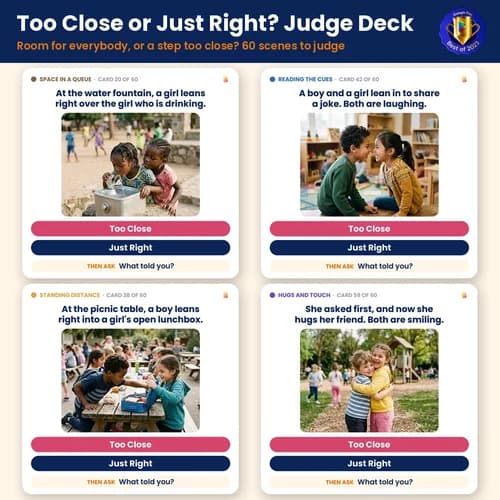
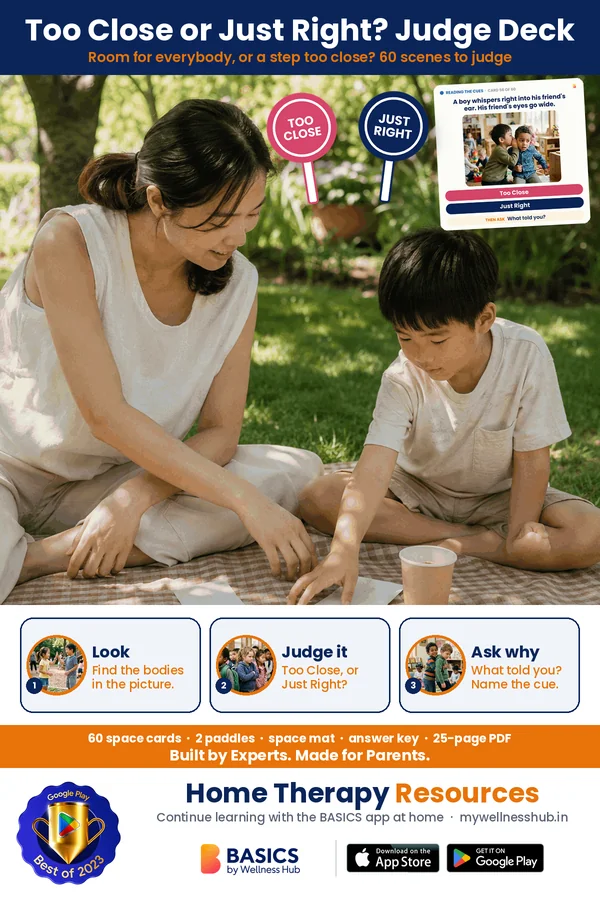
Too Close or Just Right? Personal Space Photo Cards is a 25-page printable and screen-ready PDF designed for children who need clear, visual guidance about personal boundaries. This resource uses 60 real-life photo cards to teach kids how to judge friendly distance, recognize when someone is too close, and understand that the right answer depends on who is present and what is happening. Each card features a photograph and a simple description, with two color-coded paddles—Too Close and Just Right—so children can practice making social judgments in a safe, structured way.
Children will build practical skills like reading body cues, including noticing a lean back, a step away, or a stiff body, and judging distance for different people in various situations. By practicing these skills, learners can improve their ability to recognize social comfort zones, respond appropriately in queues, doorways, and turns, and ask before touching or hugging. The cards also encourage children to say when someone is too close to them, promoting self-advocacy and social confidence.
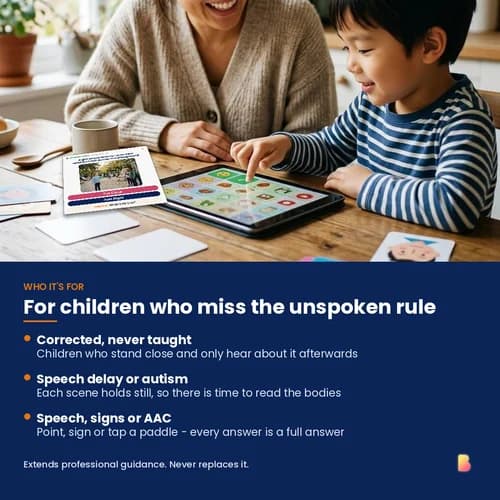
Perfect for home, classroom, and therapy settings, these cards support children with speech delay, autism, or those who use signs or AAC to communicate. The Different People section helps kids apply personal space rules in real-world contexts, while the included paddles and space mat make every session interactive and hands-on. This resource is ideal for building social understanding and respectful boundaries in everyday life.
Product Details
- Resource Name: Too Close or Just Right? Personal Space Photo Cards
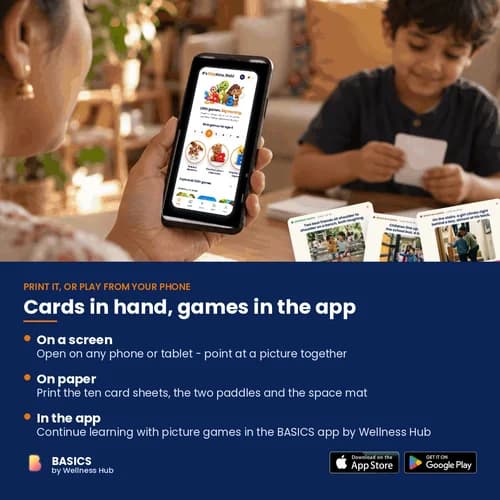
- Format: Printable and screen-ready PDF
- Total Pages: 25
- Grade Level: Elementary and up
- Designed For: Children learning personal space, including those with autism, speech delay, or AAC users
- Printing Notes: Color recommended for best results; paddles and mat can be laminated for durability
- Best Used In: Home, classroom, therapy, and social skills groups
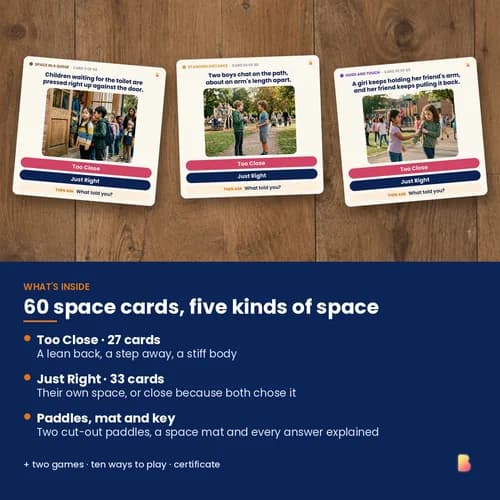
- Sets / Flashcards / Activities: 60 photo cards, 2 cut-out paddles, 1 space mat, 2 games, practice log, certificate
- Visuals / Illustrations: Real-life photographs, color-coded sections, and clear visual supports
Educational Benefits
1. Social Boundaries and Distance Recognition
- Teaches children to judge safe and friendly distances in various settings.
- Promotes awareness of how space needs change with different people and moments.
- Helps prevent misunderstandings and social discomfort in daily interactions.
2. Reading Nonverbal Body Cues
- Strengthens the ability to notice subtle signals like leaning back, stepping away, or stiff posture.
- Builds observation skills for interpreting others' comfort levels.
- Encourages children to look for cues before deciding if space is just right.
3. Self-Advocacy and Assertive Communication
- Empowers children to express when someone is too close to them.
- Supports practicing "just right" boundaries using the primary_keyword in real-life scenarios.
- Fosters confidence in stating personal needs respectfully.
4. Inclusive Communication for AAC and Sign Users
- Ensures full participation for children who communicate with signs or AAC devices.
- Allows answers by pointing, tapping, or lifting paddles—no speech required.
- Promotes equal access to social learning for all communication styles.
5. Everyday Application and Generalization
- Encourages transfer of skills to queues, doors, turns, and greetings.
- Reinforces judging distance for the person, not just the rule.
- Supports ongoing practice with a log and certificate to celebrate progress.
Instructions for Use
Step 1: Print and Prepare the Materials
- Print the PDF in color for clear section cues and visuals.
- Cut out the 60 photo cards, paddles, and space mat.
- Laminate for durability if using regularly. ✔ Lamination extends product life.
Step 2: Introduce the Deck and Sample Card
- Show the labelled sample card to explain how each card works.
- Discuss the five color-coded kinds of space for context.
- Highlight reading body cues as a key skill during this step.
Step 3: Model Judging with Paddles
- Demonstrate how to use the Too Close and Just Right paddles.
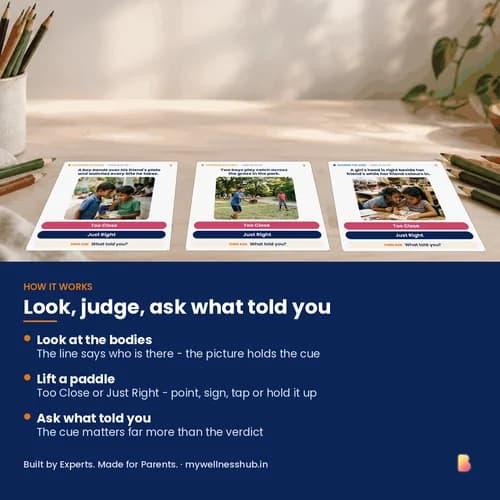
- Hold up a card, read the description, and let the child choose a paddle.
- Encourage them to explain their choice using the space mat for reference.
Step 4: Facilitate Turn-Taking Games
- Play The Mat Sort or Who Is It? to practice with multiple children.
- Rotate who judges each card to build confidence and group skills.
- Use the answer key for guidance and to prompt discussion.
Step 5: Encourage Reflection and Discussion
- Ask "What told you?" after each paddle choice to focus on body cues.
- Discuss why the answer might change for different people or situations.
- Reinforce that a child's own comfort always matters.
Step 6: Track Progress and Celebrate Success
- Use the practice log to record sessions and note improvements.
- Award the Certificate of Just-Right Judging for motivation.
- Display the certificate to recognize achievement and boost self-esteem.
Activities Using the Resource
1. Personal Space Photo Card Sorting Game
Objective: To help children use personal space photo cards to distinguish between "too close" and "just right" boundaries.
How to Play:
- Lay out a mix of cards from different color-coded space types.
- Child selects a card, reads the description, and places it on the space mat's Too Close or Just Right side.
- Discuss what body cues (like a lean back or step away) helped them decide.
Skill Development:
- Improves judgment of social boundaries using visual cues.
- Builds confidence in using the primary_keyword for real-life situations.
- Strengthens observation of physical distance in varied contexts.
2. Standing Distance Practice with Paddles
Objective: To practice recognizing appropriate standing distance by interpreting body language and cues.
How to Play:
- Choose several Standing Distance cards (color-coded).
- Hold up each card and have the child use the paddle to show their answer.
- Ask the child to point out clues (e.g., stiff body, relaxed posture) in the photo.
Skill Development:
- Enhances reading of nonverbal body cues.
- Promotes visual scanning for social information.
- Reinforces decision-making based on real scenarios.
3. Reading the Cues Discussion Circle
Objective: To develop skills in identifying subtle social signals that indicate comfort or discomfort.
How to Play:
- Select cards from the Reading the Cues set.
- Each participant describes what they see in the photo and what cues suggest "just right" or "too close."
- Use the answer key to compare and discuss different perspectives.
Skill Development:
- Strengthens interpretation of facial expressions and gestures.
- Encourages group discussion and perspective-taking.
- Builds expressive language around social observations.
4. Queue and Turn-Taking Role Play
Objective: To support understanding of personal space in lines and while waiting for turns.
How to Play:
- Use Space in a Queue cards to set up a pretend line with toys or classmates.
- Show a card and have the child act out the scene, adjusting their distance as shown.
- Reflect on how the distance changes with different people in the queue.
Skill Development:
- Teaches spatial awareness in public and group settings.
- Encourages flexible thinking about boundaries.
- Develops practical skills for everyday routines.
5. Different People, Different Spaces Sorting
Objective: To teach that personal space rules change depending on who is present.
How to Play:
- Gather cards from the Different People section.
- Child sorts cards into groups based on who is pictured (friend, stranger, adult, peer).
- Discuss why the "just right" distance might be different for each group.
Skill Development:
- Builds understanding of social context.
- Promotes flexible application of the primary_keyword.
- Encourages respectful boundaries with various people.
6. Hugs and Touch Social Story Creation
Objective: To reinforce appropriate touch and consent using real-life examples.
How to Play:
- Select Hugs and Touch cards and review each scenario.
- Child creates a short social story using the cards, describing what makes the touch "just right" or "too close."
- Share the story with a peer or adult for feedback.
Skill Development:
- Supports narrative skills about social rules.
- Reinforces consent and body autonomy.
- Encourages self-advocacy in touch situations.
Frequently Asked Questions
Q1: What age range is Too Close or Just Right? Personal Space Photo Cards designed for?
A1: This resource is best for elementary-aged children and up who need explicit teaching about personal space. The real-life photos and simple descriptions are accessible for ages 5–12, including older students needing extra support. Younger children may benefit from adult guidance during use.
Q2: Can these photo cards be used in a classroom group activity?
A2: Yes, the cards are ideal for small group or whole-class lessons on social boundaries. Activities like Mat Sort and group paddle voting encourage discussion and peer learning. Assign roles or rotate turns to keep all students engaged.
Q3: Are these cards suitable for speech therapy or occupational therapy sessions?
A3: Absolutely, these cards support therapy goals in both speech and occupational therapy settings. They help children practice reading body cues and making social judgments in structured scenarios. Therapists can use the paddles and mat to facilitate expressive language and self-advocacy.
Q4: How should I print and prepare the paddles and space mat for repeated use?
A4: Print the paddles and mat in color and laminate them for durability. Laminated materials withstand frequent handling and can be wiped clean between sessions. Store cut-out pieces in a labeled envelope or box for easy access.
Q5: Is this resource appropriate for children with autism or AAC users?
A5: Yes, the cards are designed with neurodiverse learners and AAC users in mind. Children can answer by pointing, tapping, or lifting paddles—no speech required. The visual supports and clear structure make it accessible for a wide range of abilities.
Q6: Can I use these photo cards digitally without printing?
A6: Yes, the PDF is screen-ready for use on tablets, computers, or interactive whiteboards. Children can indicate their answers verbally or by using digital annotation tools. This flexibility supports remote learning and teletherapy sessions.
Q7: What specific skills and learning goals do these photo cards target?
A7: The cards build skills in reading body cues, judging distance for the person, and recognizing when space is just right or too close. They promote self-advocacy, respectful boundaries, and flexible thinking about personal space. Regular use helps children generalize these skills to real-life situations.
Q8: What are the licensing and usage rights for Too Close or Just Right? Personal Space Photo Cards?
A8: Your purchase grants you a single-user license for personal, classroom, or therapy use. You may print or display the resource for your own students or clients but not share it publicly or commercially. For multi-site or organizational licensing, contact Wellness Hub directly.
Q9: How do I receive my digital download after purchase?
A9: After completing your purchase, you will receive an instant download link via email. The PDF is ready for immediate use on any compatible device. Check your spam or promotions folder if the email does not arrive promptly.
Q10: What is Wellness Hub's refund or exchange policy for digital resources?
A10: Wellness Hub does not offer refunds or exchanges on digital PDF resources once downloaded. This policy ensures the security and integrity of digital content. If you experience technical issues or receive the wrong file, contact Wellness Hub support for prompt assistance.
Usage Rights and Restrictions
Allowed Usage:
- Personal use by parents, teachers, and therapists.
- Printable for classroom, home, or therapy settings.
- Can be used in group or one-on-one learning sessions.
Not Allowed:
- Reselling, redistributing, or modifying the resource for commercial use.
- Sharing publicly (e.g., on blogs, social media, or websites) without permission.
- Uploading the file to public sharing platforms.
If you need a bulk license for schools or therapy centers, please contact us.
Conclusion
Too Close or Just Right? Personal Space Photo Cards gives children a clear, visual way to understand social boundaries and build confidence in their daily interactions. Designed for learners who need direct support, it helps children recognize how personal space changes with different people and situations, making it easier to navigate friendships, group settings, and new environments.
By practicing with the reading body cues activities and using the included space mat, children develop stronger observation skills and learn to judge comfort zones for themselves and others. The resource supports respectful boundaries and flexible thinking, whether used at home, in the classroom, or during therapy sessions.
Start using Too Close or Just Right? Personal Space Photo Cards today to help your child master personal space skills and feel more comfortable and secure in every social setting.