

Too Close or Just Right? Act-It Deck — 40 Printable Personal Space Cards for Asking First and Speaking Up
₹80
₹160
You save ₹80
5 (56 ratings)
Grade Levels
Grade 1 – Grade 2 (Ages 6–9)
Content Overview
Format: PDF | Pages: 20 | Features: 40 photo cards to build social skills and personal space awareness
Categories
Share


About the Product
Introduction
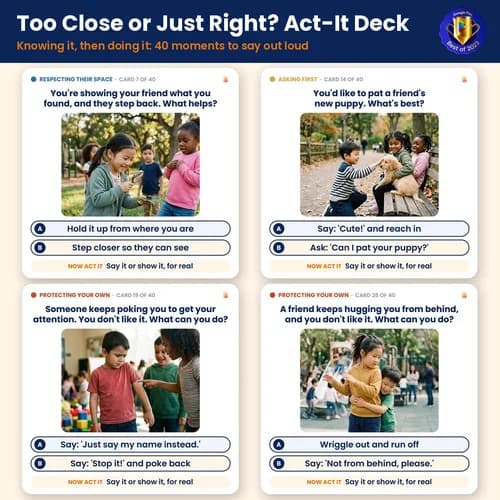
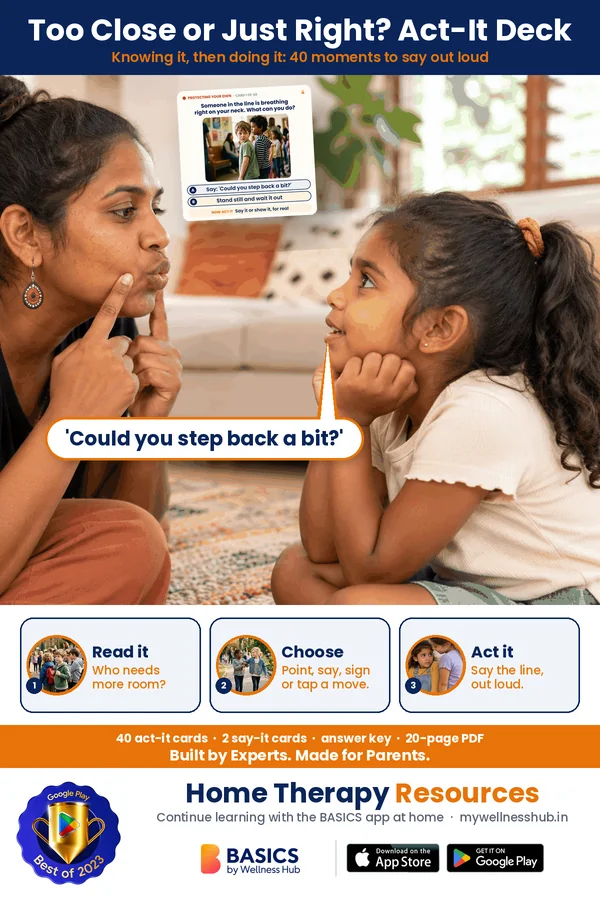
Personal space photo cards help children learn how to respond when a situation feels uncomfortable, especially when they need to speak up kindly and clearly. This 20-page printable and screen-ready PDF is designed for children who may notice a crowded moment but struggle to act or speak out, including those with speech delay or autism. Each of the 40 cards features a real-life photo, a question, and two possible moves—one that helps and one that often happens instead—making social learning practical and relatable.
Skills like asking for room and accepting somebody else's no are woven into every scenario, encouraging children to practice real-world responses. Children learn to use the right words in the right tone, whether asking for space, asking before touching, or giving room when someone signals discomfort. The resource supports measurable outcomes such as improved confidence in social situations and better understanding of respectful boundaries.
Therapists, teachers, and families can use these cards during social skills groups, one-on-one sessions, or at home to reinforce protecting your own space. The cards also support classroom discussions about respecting their space and asking first, making them versatile for a range of learning environments.
Product Details
- Resource Name: Too Close or Just Right? Speak Up Deck: Personal Space Photo Cards
- Format: Printable and screen-ready PDF
- Total Pages: 20
- Grade Level: Elementary and up
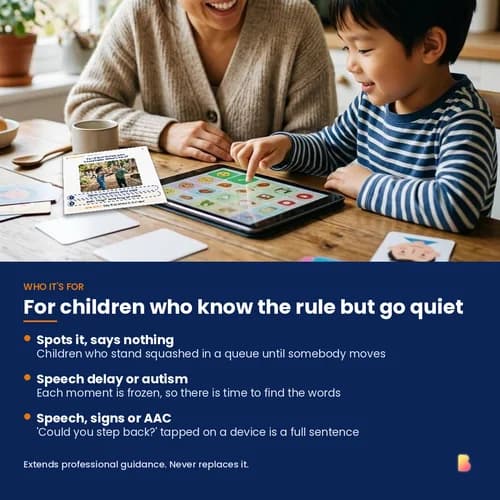
- Designed For: Children learning social boundaries, including those with speech delay or autism
- Printing Notes: Print single- or double-sided; laminate for durability
- Best Used In: Social skills groups, therapy sessions, classrooms, home practice
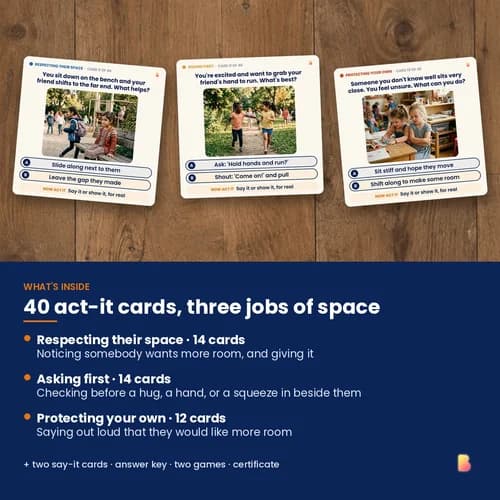
- Sets / Flashcards / Activities: 40 photo cards, 2 say-it cards, 2 games, practice log, certificate
- Visuals / Illustrations: Real-life photographs on every card
Educational Benefits
1. Social Communication Skills Growth
- Children practice using clear, friendly language in real situations.
- They learn to respond out loud when space feels uncomfortable.
- The cards support progress in the primary_keyword for all learners.
2. Tone and Self-Advocacy Awareness
- Kids discover how tone changes the meaning of their words.
- They practice asking for room warmly, not harshly or passively.
- This builds confidence to speak up and advocate for themselves.
3. Respectful Boundaries Understanding
- Learners see the impact of respecting their space and others'.
- They explore scenarios like stepping back or asking before touching.
- Children gain tools to recognize and honor personal boundaries.
4. AAC and Communication Inclusion
- The deck supports children who use signs or AAC to communicate.
- Every move can be practiced with words, signs, or devices equally.
- This ensures all children can participate and be understood.
5. Real-Life Problem Solving Practice
- Kids choose between helpful and common-but-unhelpful responses.
- They apply skills to situations like crowded lines or unwanted hugs.
- Protecting your own space is reinforced through everyday examples.
Instructions for Use
Step 1: Print and Prepare the Cards
- Print the PDF single- or double-sided for easy handling.
- Cut out the 40 photo cards and 2 say-it cards for use.
- Laminate for durability and repeated practice.
Step 2: Introduce the Sample Card
- Start with the labelled sample card to model the activity.
- Explain how each card shows a photo, a question, and two moves.
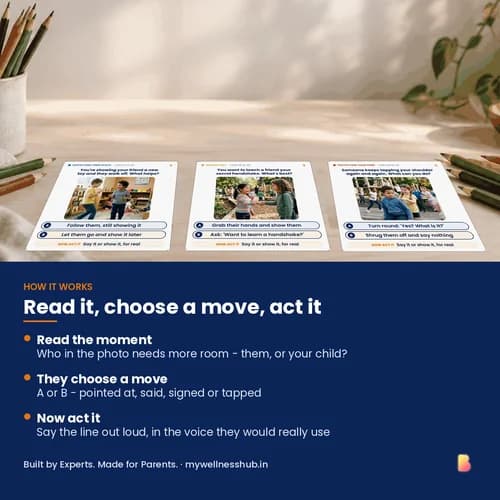
- Demonstrate reading the moment and choosing a response.
Step 3: Explore the Three Space Jobs
- Sort cards into Respecting Their Space, Asking First, and Protecting Your Own.
- Discuss examples of asking for room and accepting no.
- Encourage children to notice which skill each card highlights.
Step 4: Practice with Real-Life Scenarios
- Read a card aloud and ask the child to pick move A or B.
- Have them act out their choice using their own voice or AAC.
- lsi_terms[0] fits naturally as kids practice asking for room in context.
Step 5: Play the Included Games
- Use "Say the Line" or "The Asking Hour" for group or solo play.
- Incorporate lsi_terms[2] by focusing on giving room when a body says so.
- Keep sessions short and positive for best engagement.
Step 6: Track Progress and Celebrate Success
- Use the practice log to record new skills and moments.
- Award the Certificate of Speaking Up for Space for motivation.
- Review "The Things We Said" to reflect on growth together.
Activities Using the Resource
1. Personal Space Photo Card Scenarios
Objective: To practice the primary_keyword by choosing and expressing helpful responses in real-life situations.
How to Play:
- Present a photo card showing a social scenario.
- Read the question and review both move options (A and B).
- Child selects and acts out the move that helps, using words or AAC.
Skill Development:
- Builds social decision-making in context
- Strengthens asking for room skills
- Encourages expressive communication
2. Respecting Their Space Sorting Game
Objective: To identify and sort examples of respecting personal space in everyday interactions.
How to Play:
- Gather all cards labeled "Respecting Their Space."
- Mix with other cards and ask the child to sort them into correct categories.
- Discuss what makes each "Respecting Their Space" card different.
Skill Development:
- Improves category recognition
- Enhances understanding of boundaries
- Develops visual discrimination
3. Giving Room Role-Play Practice
Objective: To build confidence in giving room when a body says so, using real-life language.
How to Play:
- Choose a card where someone signals discomfort (e.g., stepping back).
- Child practices responding warmly and giving space.
- Switch roles and repeat, using different cards for variety.
Skill Development:
- Reinforces nonverbal cue recognition
- Practices giving room in social settings
- Fosters empathy and perspective-taking
4. Asking First Communication Challenge
Objective: To develop the ability to ask before touching or joining, using the primary_keyword in context.
How to Play:
- Select "Asking First" cards (e.g., before a hug or pat).
- Child practices asking permission aloud or with AAC.
- Discuss the importance of waiting for an answer.
Skill Development:
- Builds polite requesting skills
- Teaches turn-taking in communication
- Supports AAC and verbal expression
5. Tone of Voice Exploration
Objective: To explore how tone changes the meaning of a request or response.
How to Play:
- Pick a card with a common phrase (e.g., "Could you step back?").
- Child says the line in a kind, neutral, and harsh tone.
- Reflect on how each tone feels and what others might notice.
Skill Development:
- Increases tone awareness
- Encourages self-monitoring of speech
- Promotes respectful communication
6. Protecting Your Own Space Memory Match
Objective: To reinforce protecting your own space by recalling and matching scenarios and solutions.
How to Play:
- Lay out "Protecting Your Own" cards face down.
- Take turns flipping two cards to find matching scenarios and helpful moves.
- When a match is found, act out the solution together.
Skill Development:
- Strengthens memory and recall
- Encourages self-advocacy practice
- Supports collaborative problem-solving
Frequently Asked Questions
Q1: What ages and developmental levels are these personal space photo cards best for?
A1: These cards are designed for elementary-aged children and up, including those with speech delay or autism. The real-life photos and simple questions make them accessible for a wide range of language and social skill levels. Older learners working on self-advocacy and communication can also benefit from the scenarios.
Q2: Can I use these cards in a classroom group activity?
A2: Yes, the cards are ideal for classroom groups, social skills sessions, or circle time. Each card presents a scenario that can spark discussion, role-play, or group games. Try sorting cards by "Respecting Their Space," "Asking First," or "Protecting Your Own" for collaborative learning.
Q3: Are these photo cards appropriate for speech therapy or occupational therapy sessions?
A3: Absolutely, these cards support therapy goals such as expressive language, self-advocacy, and social communication. Therapists can use them to practice asking for room and responding to social cues in real time. The resource includes scenarios relevant to both speech and occupational therapy objectives.
Q4: What is the best way to print and prepare these cards for repeated use?
A4: Print the cards single- or double-sided on thick paper and laminate for durability. Cut out each card for hands-on activities, sorting, or games. Laminated cards can be wiped clean and used across multiple sessions or groups.
Q5: How does this resource support children with special needs or those using AAC?
A5: The cards are fully inclusive, supporting children who use speech, signs, or AAC devices. Every move can be practiced verbally or by tapping a phrase on a device, ensuring all children can participate. Visual cues and clear language help differentiate for diverse learners.
Q6: Can these cards be used on a tablet or computer without printing?
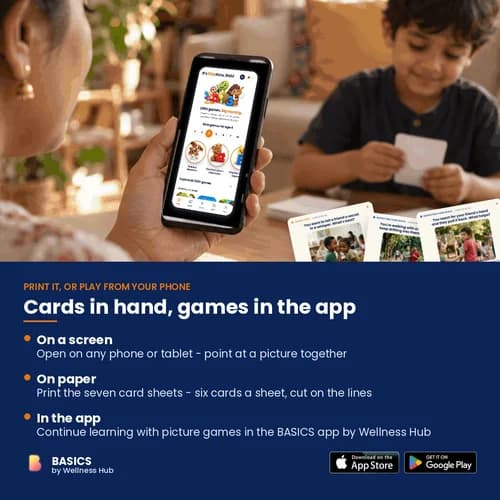
A6: Yes, the PDF is screen-ready for use on tablets, computers, or interactive whiteboards. Display cards digitally for group modeling, individual practice, or remote sessions. Children can point, respond aloud, or use AAC while viewing the cards on-screen.
Q7: What specific social skills and learning goals do these cards target?
A7: The resource targets asking for room, asking before touching, accepting "no," and giving room when a body says so. Children also practice using the right tone, reading social cues, and speaking up kindly in the moment. These skills help build confidence and respectful boundaries in real-life situations.
Q8: What are the licensing and usage rights for this PDF resource?
A8: Purchase includes a single-user license for personal, classroom, or therapy use. You may print and use the resource with your own students or clients but may not share or distribute it commercially. For multi-user or school-wide licensing, contact Wellness Hub directly.
Q9: How do I receive and access my digital download after purchase?
A9: After purchase, you will receive an email with a secure download link for the PDF. Download and save the file to your device for easy access and printing. If you have trouble accessing your file, Wellness Hub support is available to assist.
Q10: What is Wellness Hub's refund or exchange policy for digital resources?
A10: Wellness Hub does not offer refunds or exchanges for digital downloads once delivered. If you experience technical issues or receive the wrong file, customer support will help resolve the problem promptly. Please review product details before purchase to ensure it meets your needs.
Usage Rights and Restrictions
Allowed Usage:
- Personal use by parents, teachers, and therapists.
- Printable for classroom, home, or therapy settings.
- Can be used in group or one-on-one learning sessions.
Not Allowed:
- Reselling, redistributing, or modifying the resource for commercial use.
- Sharing publicly (e.g., on blogs, social media, or websites) without permission.
- Uploading the file to public sharing platforms.
If you need a bulk license for schools or therapy centers, please contact us.
Conclusion
Too Close or Just Right? Speak Up Deck: Personal Space Photo Cards empowers children to take positive action when a space feels uncomfortable, supporting those who need extra practice with social boundaries and communication. Designed for elementary-aged learners and up, it helps children who notice discomfort but may not know how to respond in the moment.
By focusing on tone and self-advocacy, this resource builds confidence in asking for room and accepting somebody else's no. Children learn to use warm, clear language in real-life situations, making it ideal for use at home, in classrooms, or during therapy sessions where protecting your own space is essential.
Start building essential social skills—download Too Close or Just Right? Speak Up Deck: Personal Space Photo Cards today and help your child or students practice respectful communication and self-advocacy in every setting.