

This One or That One Sort Mats — 30 Printable Opposites Sorting Mats and 130 Picture Cards for Describing Words
₹80
₹160
You save ₹80
4.9 (53 ratings)
Grade Levels
Pre-K – Kindergarten (Ages 4–6)
Content Overview
Format: PDF | Pages: 18 | Features: 30 sorting mats and 130 picture cards for adjectives and opposites
Categories
Share


About the Product
Introduction
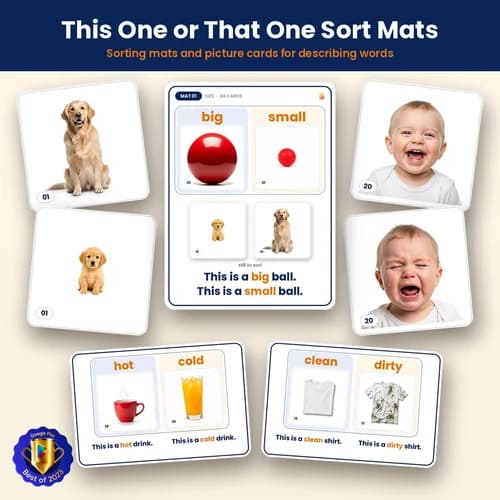
The Describing Words and Opposites Sorting Mats PDF Kit is a versatile, screen-ready resource designed for children who are ready to practice describing, comparing, and sorting. With 30 two-sided mats and 130 picture cards, this kit helps kids build expressive language skills by sorting images into categories like big/small, clean/dirty, and happy/sad. Each mat and card pair encourages children to use clear sentences, making it ideal for confident speakers, those with speech delay, or children using signs or AAC.
Children develop sorting and comparing skills as they decide where each picture card belongs, saying sentences such as "This is a big ball" or "This is a small ball." The kit supports mastery of adjectives and opposites, helping kids describe objects by size, state, feeling, texture, temperature, weight, and more. As children sort and speak, they gain confidence in using describing words in full sentences.
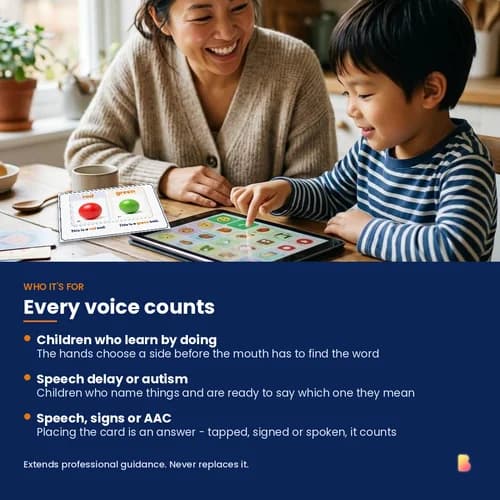
Perfect for home, classroom, and therapy settings, the mats and cards are easy to use on tablets, phones, or as printed materials. The resource supports children in speech therapy, special education, and inclusive classrooms, giving every child a way to answer by placing cards—even if they use alternative communication methods.
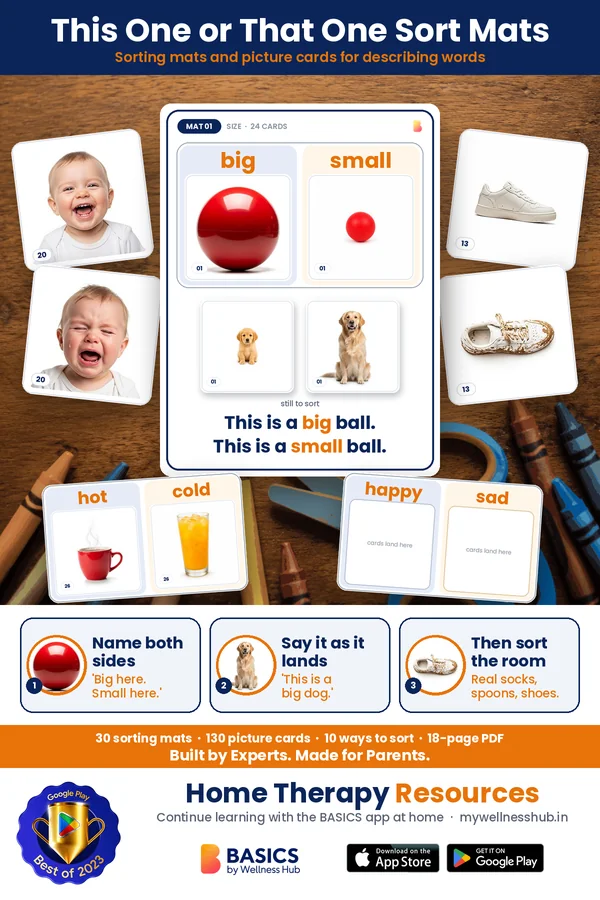
Product Details
- Resource Name: Describing Words and Opposites Sorting Mats PDF Kit
- Format: Printable and screen-ready PDF
- Total Pages: 18
- Grade Level: Pre-K, Kindergarten, Early Elementary
- Designed For: Speech therapy, special education, AAC users, early language learners
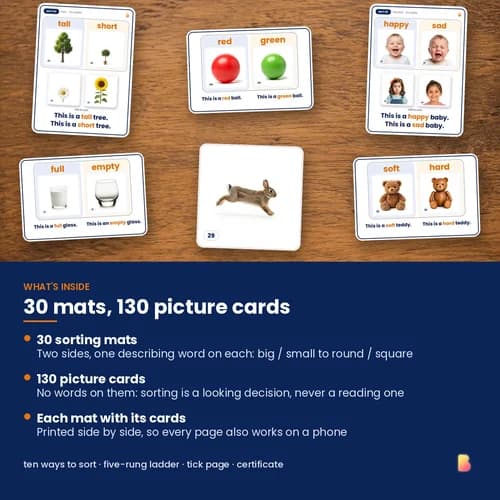
- Printing Notes: Each mat and its cards are grouped on the same page for easy use and organization
- Best Used In: Home, classroom, therapy sessions
- Sets: 5 themed sets (Size, Colour, How things are, Feelings, Touch/sound/weight/speed/shape)
- Flashcards: 130 picture cards (no words)
- Activities: 30 two-sided sorting mats
- Visuals / Illustrations: Clear, child-friendly images for each describing word pair
Educational Benefits
1. Adjective and Opposite Word Mastery
- Children gain confidence using adjectives and opposites in everyday language.
- Sorting mats provide hands-on practice with pairs like big/small and happy/sad.
- The primary_keyword supports expressive vocabulary in real-life contexts.
2. Comparing and Sorting Skill Building
- Kids strengthen comparing skills by deciding which side each card belongs on.
- They practice sorting by attributes such as size, colour, and state.
- This boosts logical thinking and visual discrimination abilities.
3. Sentence Structure and Communication
- Each activity encourages children to use describing word + noun in a sentence.
- Children practice full sentences aloud or with AAC, reinforcing grammar.
- Consistent sentence models help with early language development.
4. Inclusive AAC and Speech Delay Support
- Resource is fully accessible for children using AAC or alternative communication.
- Placing a card acts as a complete answer, supporting nonverbal learners.
- Children with speech delay benefit from visual cues and clear routines.
5. Real-World Application and Generalization
- Sorting mats encourage children to apply describing words to real objects.
- Activities extend beyond cards, using items from the room for practice.
- This helps children transfer new vocabulary to daily life and conversation.
Instructions for Use
Step 1: Print or Open the PDF Kit
- Print mats and cards on sturdy paper for hands-on use, or open on a device.
- Each mat and its cards are grouped together for easy access.
- Laminating extends durability for repeated sessions.
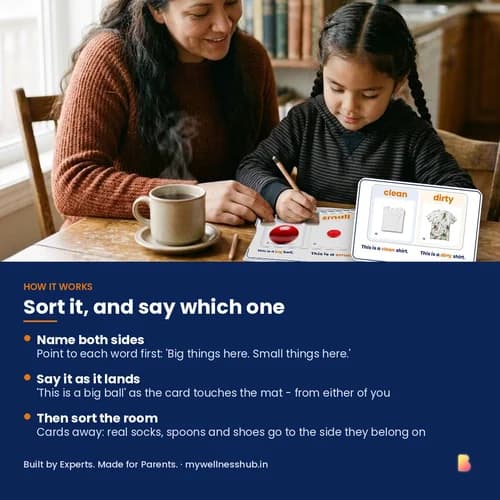
Step 2: Introduce and Name Both Sides
- Show a mat and clearly name both describing words, such as big and small.
- Let the child repeat or point to each word for understanding.
- This step supports adjectives and opposites learning.
Step 3: Model Sorting and Sentence Use
- Demonstrate placing a card on the correct side, saying the full sentence.
- For example: "This is a big ball" as the card lands.
- Encourage the child to imitate the sentence structure.
Step 4: Encourage Independent Sorting
- Invite the child to choose and place cards on their own.
- Prompt them to say or sign the matching sentence for each card.
- Sorting and comparing skills are reinforced in this step.
Step 5: Extend with Real Objects
- After cards, use real items from the room to sort by the same describing words.
- Ask the child to place or point and describe each object.
- This helps generalize skills beyond the activity.
Step 6: Track Progress and Celebrate
- Use the included tick page to mark pairs sorted successfully.
- Award the Certificate of Describing Power when milestones are met.
- Celebrate achievements to boost motivation and confidence.
Activities Using the Resource
1. Sorting Picture Cards by Opposites
Objective: To practice sorting and comparing using the primary_keyword and build understanding of contrasting adjectives.
How to Play:
- Select a mat (e.g., big/small) and its matching cards.
- Name both sides, then let the child place each card under the correct describing word.
- Encourage the child to say, "This is a big ball" or "This is a small ball" as they sort.
Skill Development:
- Builds adjective recognition and usage
- Reinforces sorting and comparing skills
- Strengthens sentence formation with describing words
2. Describing Real Objects with Sorting Mats
Objective: To apply the primary_keyword to real-life objects for generalization and expressive language.
How to Play:
- Choose a mat (e.g., clean/dirty) and gather real items from the room.
- Ask the child to pick an object and place it on the correct side of the mat.
- Have them describe the item aloud, using the model sentence.
Skill Development:
- Encourages real-world vocabulary transfer
- Supports expressive language through describing
- Develops sorting and comparing with tangible items
3. Feelings Sorting Game for Emotional Vocabulary
Objective: To help children identify and describe feelings using visual cues and sorting.
How to Play:
- Use the feelings mat (e.g., happy/sad) and its cards.
- Show each card and ask the child to sort it under the correct emotion.
- Prompt the child to say, "This is a happy face" or "This is a sad face."
Skill Development:
- Expands emotional vocabulary
- Improves visual discrimination of facial expressions
- Promotes clear use of adjectives in context
4. Texture and Weight Sorting Challenge
Objective: To build tactile awareness and descriptive language for touch and weight.
How to Play:
- Select a mat such as soft/hard or heavy/light with its cards.
- Let the child feel real objects or look at the cards, then sort them.
- Encourage them to describe each item as they place it.
Skill Development:
- Increases sensory vocabulary
- Enhances comparing and sorting by attribute
- Supports tactile exploration and language pairing
5. Colour Sorting with Picture Cards
Objective: To strengthen colour word knowledge and sorting skills.
How to Play:
- Pick a colour mat (e.g., red/blue) and its cards.
- Ask the child to sort each card by colour, naming the colour as they go.
- Reinforce the sentence structure: "This is a red apple."
Skill Development:
- Reinforces colour identification
- Promotes sorting and comparing by visual attribute
- Encourages full sentence use with adjectives
6. Describing Words and Opposites Mat Race
Objective: To boost speed and confidence in using the primary_keyword during sorting.
How to Play:
- Set out several mats (e.g., open/closed, full/empty) with cards.
- Time the child as they sort cards onto the correct sides, saying each sentence.
- Celebrate accuracy and speed, then switch mats for a new round.
Skill Development:
- Increases fluency with adjectives and opposites
- Builds quick decision-making in sorting tasks
- Strengthens confidence in expressive language
Frequently Asked Questions
Q1: What age group is the Describing Words and Opposites Sorting Mats PDF Kit designed for?
A1: The kit is best suited for children in Pre-K, Kindergarten, and early elementary grades (ages 3–7). Its visuals and simple sentence models make it accessible for both early speakers and those developing expressive language. Older children with speech delay or AAC needs also benefit from its adaptable format.
Q2: Can I use these sorting mats for group activities in a classroom?
A2: Yes, the resource is ideal for small group or whole-class activities. Each mat and its cards can be shared among students, encouraging turn-taking and collaborative sorting. For group sessions, assign roles such as "card placer" and "sentence reader" to maximize participation.
Q3: Are these mats suitable for speech therapy sessions with children who use AAC?
A3: Absolutely. The kit supports AAC users by allowing them to answer by placing cards, pointing, or using their device to say the sentence. Therapists can model responses and adapt the activity to each child's communication level.
Q4: What is the best way to print and organize the sorting mats and cards?
A4: Print each mat and its cards on sturdy paper, then cut and laminate for durability. Keep each mat with its corresponding cards using envelopes or zip pouches, as every card is marked with its mat number. For repeated use, store the full set in a binder or box for easy access.
Q5: How does this resource support children with special needs or those requiring differentiation?
A5: The kit is fully inclusive, supporting children with speech delay, autism, or those using AAC. Visual cues, clear routines, and the ability to answer by placing cards make it accessible for a wide range of abilities. Adjust the number of mats or cards used per session to match each child's learning pace.
Q6: Can I use the PDF kit on a tablet or computer without printing?
A6: Yes, the resource is screen-ready and works well on tablets, computers, or interactive whiteboards. Children can point to or drag cards on-screen, making it suitable for digital learning or teletherapy. For best results, use a PDF reader that allows annotation or highlighting.
Q7: What specific language and thinking skills will my child develop with this kit?
A7: The Describing Words and Opposites Sorting Mats PDF Kit builds skills in using adjectives, opposites, and comparing attributes such as size, colour, and state. Children practice sorting, sentence formation, and making choices between two options. These activities strengthen expressive language, logical thinking, and the ability to describe and compare objects.
Q8: What are the usage rights for the Describing Words and Opposites Sorting Mats PDF Kit?
A8: Your purchase grants you a single-user license for personal, classroom, or therapy use. You may print or use the PDF digitally for your own students or clients, but sharing, redistributing, or selling the file is not permitted. For school-wide or clinic-wide licensing, please contact Wellness Hub for options.
Q9: How do I receive my digital PDF kit after purchase?
A9: After completing your purchase, you will receive an instant download link via email. The PDF kit is ready for immediate use on any device or printer. If you do not receive the email, check your spam folder or contact Wellness Hub support for assistance.
Q10: What is Wellness Hub's refund or exchange policy for digital resources?
A10: Due to the nature of digital products, Wellness Hub does not offer refunds or exchanges once the PDF kit has been downloaded. If you encounter any issues with your file or have questions about the resource, their support team is available to help resolve concerns. Always review product details before purchasing to ensure it meets your needs.
Usage Rights and Restrictions
Allowed Usage:
- Personal use by parents, teachers, and therapists.
- Printable for classroom, home, or therapy settings.
- Can be used in group or one-on-one learning sessions.
Not Allowed:
- Reselling, redistributing, or modifying the resource for commercial use.
- Sharing publicly (e.g., on blogs, social media, or websites) without permission.
- Uploading the file to public sharing platforms.
If you need a bulk license for schools or therapy centers, please contact us.
Conclusion
The Describing Words and Opposites Sorting Mats PDF Kit empowers children to confidently use adjectives and opposites in everyday language. Designed for early learners, children with speech delay, and AAC users, it provides a hands-on, visual approach to sorting, comparing, and describing objects and feelings in clear sentences.
Kids build essential comparing skills and expressive vocabulary while working through activities at home, in classrooms, or during therapy sessions. The kit supports development in areas like sentence structure and logical thinking, with every mat encouraging the use of describing words and opposites in context.
Download the Describing Words and Opposites Sorting Mats PDF Kit today and help your child master describing words while building strong communication and comparing skills for lifelong learning.