

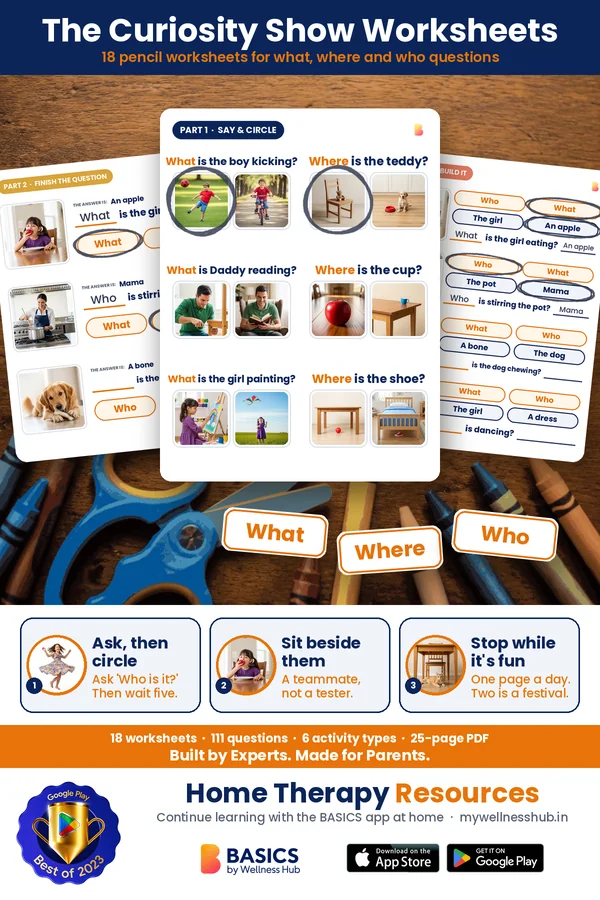
The Curiosity Show Worksheets — 18 Printable WH Question Worksheets (111 What, Where and Who Activities)
₹80
₹160
You save ₹80
4.8 (57 ratings)
Grade Levels
Pre-K – Kindergarten (Ages 4–7)
Content Overview
Format: PDF | Pages: 25 | Features: 18 worksheets for what, where, who questions; builds fine motor skills
Categories
Share


About the Product
Introduction
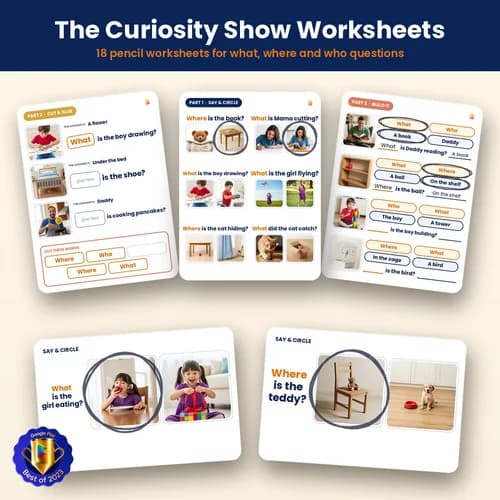
The What, Where, Who Question Words Worksheets PDF is a 25-page digital resource designed for children ready to practice answering and asking questions using what, where, and who. Perfect for early learners, children with speech delay, autism, or those using AAC, these worksheets offer structured, engaging table-time practice. The activities are suitable for pencil work or screen use, making it easy to adapt for home, classroom, or therapy settings.
Children will build confidence in matching a question word to the kind of answer it wants, such as identifying who is dancing or where the cat is. The worksheets guide students through recognizing the difference between question words, using behind and under for where questions, and forming did questions about recent actions. Learners also practice early pencil and scissor skills, as well as copying and writing their own questions.
Families, educators, and therapists can use these worksheets for small group lessons, individual support, or at-home reinforcement. The activities encourage participation and communication, whether a child points, circles, writes, or uses signs. Table-time tricks and a picture answer guide help adults support each learner, making every session positive and inviting.
Product Details
- Resource Name: What, Where, Who Question Words Worksheets PDF
- Format: Printable and screen-ready PDF
- Total Pages: 25
- Grade Level: Pre-K, Kindergarten, Grade 1
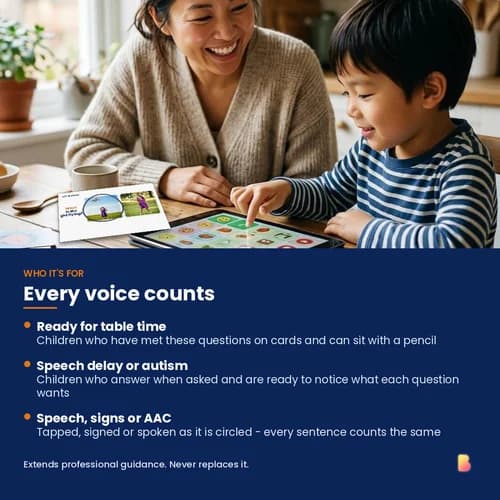
- Designed For: Early learners, speech delay, autism, AAC users
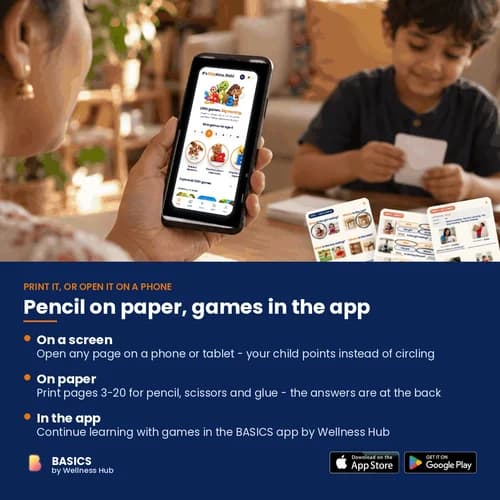
- Printing Notes: Print or use on tablet/phone (point instead of circle)
- Best Used In: Home, classroom, therapy
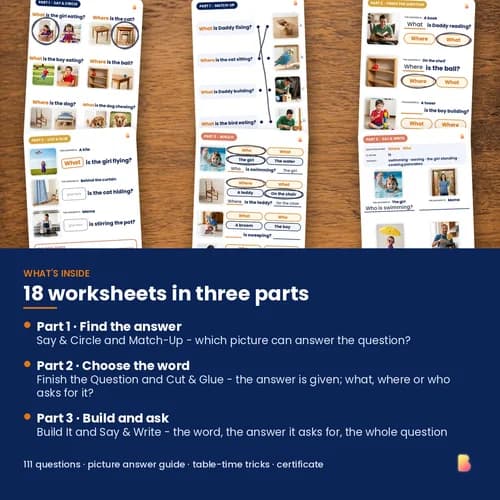
- Sets / Activities: 18 worksheets, 6 worksheet types in 3 parts
- Visuals / Illustrations: Color-coded question words, picture answer guide included
Educational Benefits
1. Question Word Recognition Skills
- Children learn to distinguish between what, where, and who in context.
- Consistent color-coding helps reinforce visual identification of each question word.
- The primary_keyword supports mastery of question word use in everyday language.
2. Early Literacy and Sentence Building
- Activities guide children to form and write simple questions independently.
- Copying and writing tasks encourage letter formation and sentence structure.
- Learners transition from answering to asking questions, building communication skills.
3. Visual Discrimination and Matching
- Students practice matching questions to appropriate picture answers.
- Say & Circle and Match-Up tasks strengthen attention to detail.
- These skills support reading comprehension and logical thinking.
4. Fine Motor and Scissor Skills
- Worksheets include circling, cutting, and gluing, building hand strength and control.
- Early pencil and scissor work is integrated into every part for practical development.
- Children using AAC or signs can participate by pointing or selecting answers.
5. Inclusive Communication Practice
- Full AAC parity ensures all children can engage, regardless of communication method.
- The resource supports speech delay, autism, and diverse learning needs.
- Families and educators can adapt activities for individual or group use.
Instructions for Use
Step 1: Print or Open the Worksheets
- Download and print the PDF, or open it on a tablet or phone.
- Select the worksheet type that matches your child's readiness.
- Use screen mode for pointing instead of circling.
Step 2: Introduce Question Words with Say & Circle
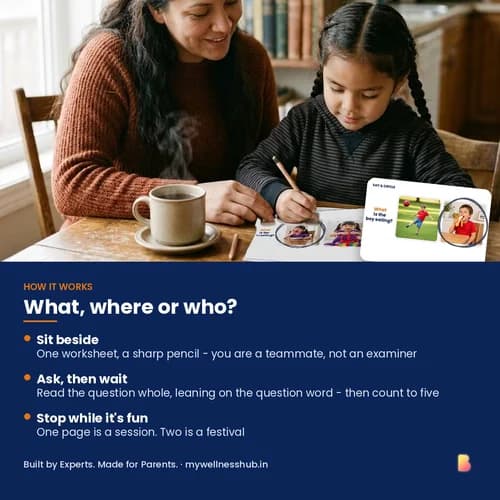
- Read each question aloud, emphasizing the question word.
- Encourage the child to circle or point to the correct answer.
- This step builds question word recognition naturally.
Step 3: Guide Through Match-Up Activities
- Present the Match-Up worksheet and read questions together.
- Ask the child to draw lines or point to match questions with answers.
- where questions appear in this step to reinforce place concepts.
Step 4: Support Cut & Glue Practice
- Help the child cut out and glue the correct question word for each answer.
- Model how to match what, where, or who to the answer type.
- Share scissors and supervise for safety.
Step 5: Practice Build It and Say & Write Tasks
- Let the child circle the question word and answer pair, then write the question.
- Encourage them to say the question aloud for speaking practice.
- who skills are reinforced as children identify people in answers.
Step 6: Use the Answer Guide and Table-Time Tricks
- Refer to the picture answer guide for support as needed.
- Apply the warm-up lap or say-it-wrong-on-purpose tricks to keep sessions fun.
- Praise effort and stop while the activity remains enjoyable.
Activities Using the Resource
1. Say & Circle with What, Where, Who
Objective: To build question word recognition and match each to its correct answer type using the What, Where, Who Question Words Worksheets PDF.
How to Play:
- Read each question aloud, emphasizing what, where, or who.
- Child circles or points to the picture that answers the question.
- Use color-coding to reinforce the difference between question words.
Skill Development:
- Identifies question words in context
- Improves visual discrimination
- Strengthens listening comprehension
2. Picture Match-Up for Answer Types
Objective: Develops the ability to connect questions with matching picture answers for what, where, and who.
How to Play:
- Present a worksheet with questions and answer images.
- Child draws lines or points to match each question to its answer.
- Focus on distinguishing between people, places, and things.
Skill Development:
- Enhances logical matching skills
- Supports understanding of answer types
- Boosts attention to visual details
3. Finish the Question Cut & Glue
Objective: Practice selecting and attaching the correct question word to a given answer.
How to Play:
- Show an answer (e.g., "In the box") and three question word options.
- Child circles, cuts, and glues the correct word (what, where, or who).
- Encourage verbal explanation of their choice.
Skill Development:
- Builds fine motor control through cutting and gluing
- Reinforces answer-type matching
- Encourages expressive language
4. Build It: Circle and Write the Question
Objective: To use the What, Where, Who Question Words Worksheets PDF for constructing and writing simple questions.
How to Play:
- Provide a worksheet with answer images and question word options.
- Child circles the correct question word and writes the full question.
- Say the question aloud before writing for speech support.
Skill Development:
- Develops sentence formation skills
- Practices handwriting and copying
- Connects spoken and written language
5. Say & Write with Word Bank
Objective: Strengthen independent question asking and writing using visual prompts.
How to Play:
- Show only the answer (e.g., "The cat is under the table").
- Child chooses the correct question word and writes the question from a word bank.
- Use prompts to help if needed, then read the question together.
Skill Development:
- Fosters independent question generation
- Supports reading and writing integration
- Promotes self-correction and editing
6. Answer Sorting Game
Objective: Improve ability to sort answers by matching them to what, where, or who questions.
How to Play:
- Mix answer cards for things, places, and people.
- Child sorts each answer into the correct question word group.
- Discuss why each answer fits its category.
Skill Development:
- Strengthens category sorting
- Deepens understanding of question-answer relationships
- Builds reasoning and explanation skills
Frequently Asked Questions
Q1: What age group is best for the What, Where, Who Question Words Worksheets PDF?
A1: This resource is ideal for children ages 4–7, including Pre-K, Kindergarten, and Grade 1. The activities are designed for early learners ready for structured question word practice. Children with emerging literacy or communication skills benefit most from this stage-appropriate content.
Q2: Can I use these worksheets for small group lessons in a classroom?
A2: Yes, these worksheets are suitable for small group instruction and classroom centers. The consistent structure makes it easy to guide several children through each activity together. Try rotating worksheet types or assigning roles for collaborative learning.
Q3: Are these worksheets appropriate for speech therapy sessions?
A3: Absolutely, these worksheets support speech therapy goals such as question word recognition and expressive language. The activities help children with speech delay or autism practice asking and answering what, where, and who questions. Therapists can adapt the pace and prompts to individual needs.
Q4: What is the best way to print and prepare the worksheets for repeated use?
A4: Print on standard A4 or letter-size paper and laminate for durability. Laminated sheets can be used with dry-erase markers or for repeated cut-and-glue practice. Store completed worksheets in a binder for easy review and progress tracking.
Q5: How do these worksheets support children with special needs or AAC users?
A5: The resource is fully inclusive, supporting children with speech delay, autism, or those who use AAC. Visual cues, color-coding, and consistent routines help all learners access the material. Encourage pointing, signing, or using a device to respond as needed.
Q6: Can these worksheets be used on a tablet or phone without printing?
A6: Yes, the PDF is screen-ready for use on tablets or smartphones. Children can point to answers or use annotation tools to circle and match on-screen. This digital option is perfect for teletherapy or on-the-go practice.
Q7: What specific skills and learning goals do these worksheets target?
A7: The What, Where, Who Question Words Worksheets PDF builds question word recognition, matching, and early writing skills. Children learn to distinguish what, where, and who, match questions to answer types, and practice copying and generating questions. The resource also develops early pencil, scissor, and reasoning skills.
Q8: What are the licensing and usage rights for this PDF resource?
A8: Purchase includes a single-user license for personal, classroom, or therapy use. You may print or use the file digitally for your students or clients. Redistribution, resale, or sharing outside your direct care is not permitted.
Q9: How do I receive and download the What, Where, Who Question Words Worksheets PDF after purchase?
A9: After purchase, you will receive an instant download link via email. The PDF is ready for immediate use on any device or printer. If you encounter issues, Wellness Hub's support team can assist promptly.
Q10: What is Wellness Hub's refund or exchange policy for digital resources?
A10: Wellness Hub does not offer refunds or exchanges on digital downloads due to the nature of the product. If you experience technical problems or receive the wrong file, contact support for a prompt resolution. Customer satisfaction and resource quality are top priorities.
Usage Rights and Restrictions
Allowed Usage:
- Personal use by parents, teachers, and therapists.
- Printable for classroom, home, or therapy settings.
- Can be used in group or one-on-one learning sessions.
Not Allowed:
- Reselling, redistributing, or modifying the resource for commercial use.
- Sharing publicly (e.g., on blogs, social media, or websites) without permission.
- Uploading the file to public sharing platforms.
If you need a bulk license for schools or therapy centers, please contact us.
Conclusion
The What, Where, Who Question Words Worksheets PDF offers a structured and engaging way for children to master question words and build confidence in early communication. Designed for young learners, including those with speech delay or autism, it provides visual and hands-on practice that supports both independent and guided learning.
Children develop strong matching skills and early writing abilities as they work through each page. The resource encourages growth in expressive language and supports a range of learning contexts, from home and classroom to therapy sessions.
Download the What, Where, Who Question Words Worksheets PDF today and empower your child to ask and answer questions with clarity and confidence. Give them the tools they need for successful communication and a love of learning.