



The Curiosity Show Cards — 61 Printable WH Question Flashcards for What, Where and Who
₹80
₹160
You save ₹80
4.8 (46 ratings)
Grade Levels
Pre-K – Kindergarten (Ages 4–7)
Content Overview
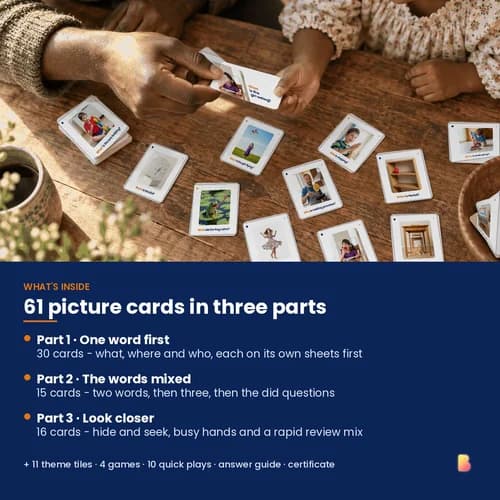
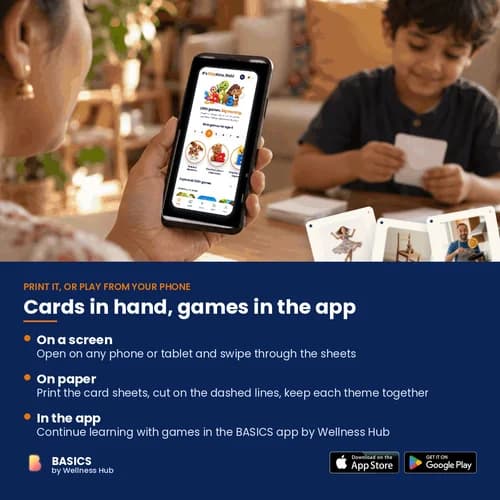
Format: PDF | Pages: 23 | Features: 61 picture cards for answering what, where, who questions
Categories
Share


About the Product
Introduction
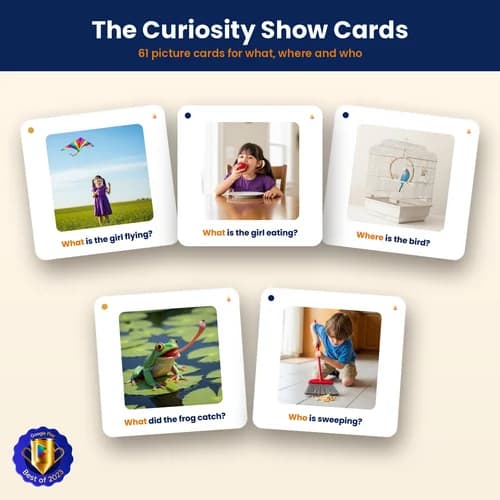
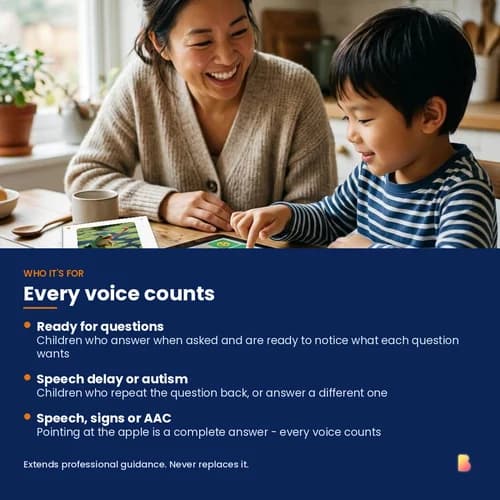
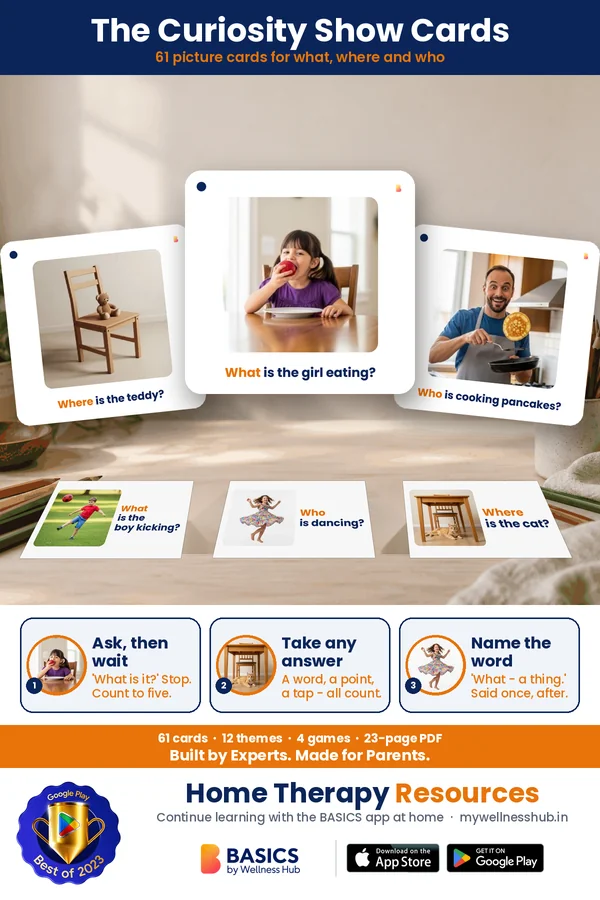
The What, Where, Who Question Cards PDF is a 23-page digital resource designed for children learning to answer and ask questions about things, places, and people. Each of the 61 picture cards features a clear illustration and a simple question, with the question word highlighted in orange to help children notice and tell the three question types apart. This resource is ideal for children with speech delay, autism, or those using AAC or sign language, supporting them as they move from answering to asking questions in daily life.
Children will practice telling the difference between what, where, and who questions, with special focus on where questions using behind and under. The cards also encourage children to answer did questions about recent actions and to recognize the unique role of each question word. Outcomes include increased confidence in answering questions, improved understanding of question types, and the first steps toward asking their own questions.
Perfect for home, classroom, or therapy sessions, these cards can be used flexibly for speech practice, language groups, or one-on-one learning. The included answer guide and suggested games make it easy for adults to support children's learning, while the simple, uncluttered design ensures accessibility for all learners.
Product Details
- Resource Name: What, Where, Who Question Cards PDF
- Format: Printable and screen-ready PDF
- Total Pages: 23
- Grade Level: PreK–Grade 2
- Designed For: Speech therapy, special education, AAC users, early language learners
- Printing Notes: Print single- or double-sided; laminate for durability
- Best Used In: Home, classroom, therapy sessions
- Sets / Flashcards / Activities: 61 picture question cards, 12 themed sets, 4 suggested games
- Visuals / Illustrations: Clear, child-friendly illustrations on every card
Educational Benefits
1. Builds Question Word Recognition
- Children learn to spot and differentiate what, where, and who in every question.
- Consistent color-coding helps them notice and remember each question word.
- This foundation supports clear understanding of question types.
2. Strengthens Answering Skills
- Kids practice responding to a wide range of questions about people, places, and things.
- Encourages flexible answers—spoken, signed, or pointed—supporting all communication styles.
- The primary_keyword helps children gain confidence in everyday conversations.
3. Develops Turn-Taking and Listening
- Cards prompt children to listen, wait, and take turns during question-and-answer exchanges.
- Practicing these skills fosters patience and cooperative play.
- Turn-taking is essential for group learning and social interaction.
4. Supports Generalization Across Settings
- Children apply skills from the cards to real-life situations at home, school, or in the community.
- The resource encourages carryover, helping kids use new language skills throughout their day.
- Parents and professionals can reinforce learning in any environment.
5. Enhances Visual Discrimination Abilities
- Clear illustrations help children match visual cues to the correct answer type.
- Visual support aids children with speech delay or autism as they engage with each card.
- This strengthens observation skills and supports lsi_terms[4] development.
Instructions for Use
Step 1: Print or Display the Cards
- Choose to print the PDF or use it on a tablet or computer screen.
- Laminate printed cards for repeated, hands-on use.
- Use single cards or full sets based on your learner's needs.
Step 2: Introduce One Question Type
- Begin with a small set focused on what, where, or who questions.
- Explain the chosen question word and highlight its color.
- Start with familiar topics to build comfort and understanding.
Step 3: Ask and Wait for a Response
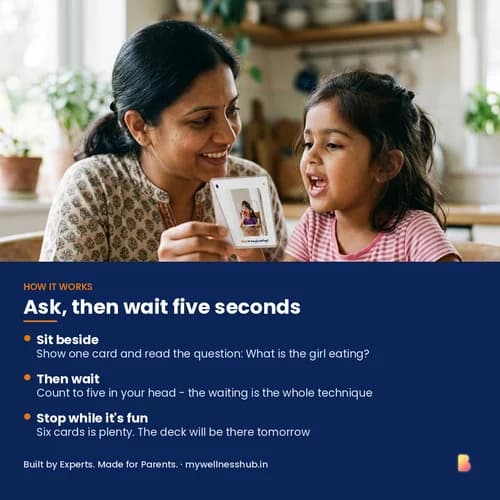
- Read the question aloud and count to five silently.
- Accept any answer—spoken, signed, pointed, or tapped—that fits the question.
- Encourage lsi_terms[0] by modeling simple, clear responses.
Step 4: Expand to Mixed Question Sets
- Gradually introduce cards with mixed question types for added challenge.
- Help children notice differences between what, where, and who questions.
- Support lsi_terms[2] by prompting children to identify question words.
Step 5: Play Suggested Games
- Try included games like Three Piles or Your Turn to Ask for variety.
- Games keep practice engaging and build turn-taking skills.
- Rotate activities to maintain interest and reinforce learning.
Step 6: Use the Answer Guide for Support
- Refer to the answer guide at the back for quick reference.
- Use small card images to check or model answers as needed.
- The guide helps adults support children without giving away answers.
Activities Using the Resource
1. Sorting What, Where, and Who Question Cards
Objective: To help children distinguish between what, where, and who questions using the What, Where, Who Question Cards PDF.
How to Play:
- Lay out a mixed group of question cards.
- Ask the child to sort them into three piles: what, where, and who.
- Review each pile together, highlighting the question word's color.
Skill Development:
- Builds question word recognition and sorting skills.
- Reinforces visual discrimination using card illustrations.
- Supports early categorization and attention to detail.
2. Picture Answer Matching Game
Objective: To strengthen answering skills by matching responses to illustrated questions.
How to Play:
- Select a set of cards and read each question aloud.
- Child points to, signs, or says the answer for each card.
- Use the answer guide to check and discuss responses.
Skill Development:
- Encourages expressive language and AAC use.
- Boosts receptive understanding of what, where, and who.
- Develops confidence in providing answers.
3. Hide and Seek with Where Questions
Objective: To practice answering where questions using behind and under concepts.
How to Play:
- Choose cards that ask about location (e.g., "Where is the cat?").
- Hide a small object behind or under something in the room.
- Ask the child to answer using the card's question and the object's location.
Skill Development:
- Teaches spatial language (behind, under) in real settings.
- Enhances observation and listening.
- Promotes generalization of language skills.
4. Turn-Taking Question Game
Objective: To develop turn-taking and listening with the What, Where, Who Question Cards PDF.
How to Play:
- Sit in a circle or across from the child.
- Take turns drawing a card and asking the question.
- Each participant answers in their preferred way (spoken, signed, pointed).
Skill Development:
- Practices social turn-taking and patience.
- Strengthens listening and response timing.
- Builds cooperative group skills.
5. Rapid Question Word Identification
Objective: To increase speed and accuracy in recognizing question words.
How to Play:
- Show a card for two seconds, then cover it.
- Ask the child to name the question word (what, where, or who).
- Give immediate feedback and repeat with several cards.
Skill Development:
- Improves quick visual scanning and word recognition.
- Trains attention and working memory.
- Supports fast, accurate identification of question types.
6. Ask Your Own Question Challenge
Objective: To encourage children to move from answering to asking their own questions.
How to Play:
- Show a picture card without reading the question.
- Prompt the child to create and ask a what, where, or who question about the picture.
- Celebrate all attempts and model possible questions if needed.
Skill Development:
- Fosters question generation and flexible thinking.
- Encourages expressive language and creativity.
- Supports the transition from answering to asking.
Frequently Asked Questions
Q1: What age group and grade level are the What, Where, Who Question Cards PDF best for?
A1: The What, Where, Who Question Cards PDF is designed for children ages 3–8, covering PreK through Grade 2. The simple questions and engaging illustrations suit early learners and those developing foundational language skills. Children outside this range may also benefit if they are working on these specific question types.
Q2: Can these cards be used for group activities in a classroom or therapy setting?
A2: Yes, these cards are ideal for both small group and whole-class activities. Their flexible format supports turn-taking, sorting games, and interactive question-and-answer sessions. Try using them in circle time, language groups, or as a warm-up for speech therapy.
Q3: Are the cards suitable for speech or occupational therapy sessions?
A3: Yes, these cards are highly effective for speech and occupational therapy. They target answering skills, question word recognition, and support children using AAC or sign language. Therapists can use them for receptive and expressive language goals, as well as for practicing social communication.
Q4: How should I print and laminate the cards for durability?
A4: Print the cards on thick paper or cardstock for best results, then laminate before cutting them apart. Laminated cards withstand frequent handling and are easy to clean. Store them in labeled envelopes or boxes by theme for quick access during sessions.
Q5: Are the cards appropriate for children with special needs or learning differences?
A5: Yes, the cards are specifically designed to support children with autism, speech delay, and those using AAC. The clear visuals, uncluttered design, and color-coded question words help make them accessible for diverse learners. You can adapt how you present the cards or accept answers in any form—spoken, signed, or pointed.
Q6: Can I use the PDF on a tablet or computer without printing?
A6: Yes, the PDF is screen-ready and can be displayed on tablets, computers, or interactive whiteboards. Children can point to or tap answers directly on the screen. This option is especially useful for teletherapy or travel.
Q7: What specific skills and learning goals do these cards target?
A7: The resource targets answering what, where, and who questions, distinguishing between question types, and recognizing question words. It also develops turn-taking, listening, and the ability to ask questions. Children practice identifying people, places, and things, and learn to answer where questions involving behind and under.
Q8: What are the licensing and usage rights for the What, Where, Who Question Cards PDF?
A8: Purchase grants a single-user license for personal, classroom, or therapy use. You may print and use the cards with your own students or clients, but sharing or distributing the file to others is not allowed. For school-wide or clinic-wide use, please contact Wellness Hub for extended licensing options.
Q9: How do I download and access the What, Where, Who Question Cards PDF after purchase?
A9: After completing your purchase, you will receive a secure download link via email. The PDF can be saved to your device for immediate use. If you have trouble accessing your file, Wellness Hub's support team is available to assist.
Q10: What is Wellness Hub's refund or exchange policy for digital PDF resources?
A10: Wellness Hub does not offer refunds or exchanges on digital PDF resources once downloaded. This policy ensures the integrity of digital content and licensing. If you experience technical issues or receive the wrong file, contact support for prompt resolution.
Usage Rights and Restrictions
Allowed Usage:
- Personal use by parents, teachers, and therapists.
- Printable for classroom, home, or therapy settings.
- Can be used in group or one-on-one learning sessions.
Not Allowed:
- Reselling, redistributing, or modifying the resource for commercial use.
- Sharing publicly (e.g., on blogs, social media, or websites) without permission.
- Uploading the file to public sharing platforms.
If you need a bulk license for schools or therapy centers, please contact us.
Conclusion
The What, Where, Who Question Cards PDF offers a focused, accessible way for young learners and children with speech or communication needs to master essential question words. Designed for PreK through Grade 2, it empowers children to recognize and respond to different types of questions, building a strong foundation for everyday communication and social interaction.
Children develop confidence as they practice turn-taking and expressive language in varied settings—at home, in classrooms, or during therapy. The resource's clear visuals and flexible format support skill-building for answering questions and help foster early question generation.
Download the What, Where, Who Question Cards PDF today and support your child's journey toward confident communication and improved expressive language. With regular use, children gain the skills to understand, answer, and begin asking questions about the world around them.