

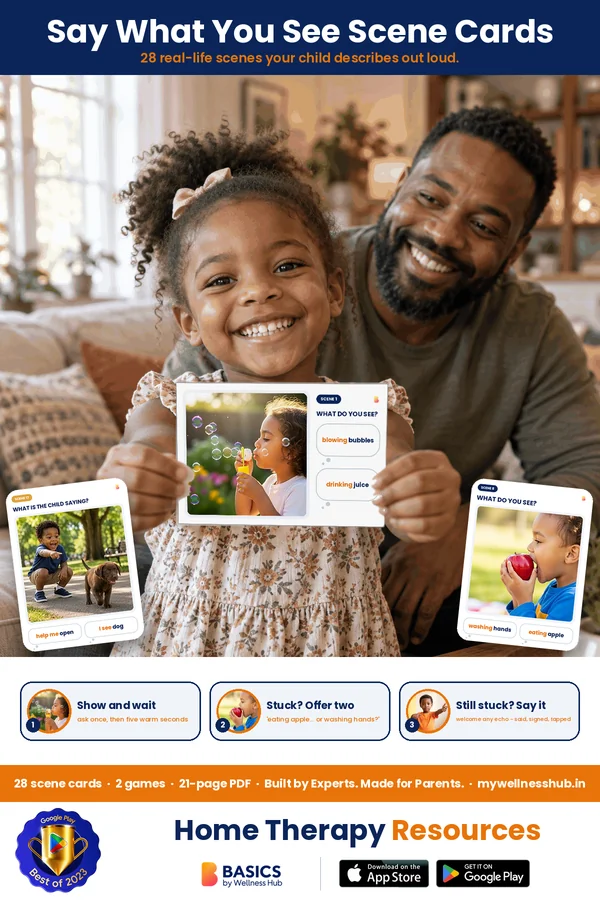
Say What You See Scene Cards — 28 Printable Scene Cards for Expressive Phrase and Sentence Practice
₹80
₹160
You save ₹80
4.8 (32 ratings)
Grade Levels
Pre-K – Kindergarten (Ages 3–6)
Content Overview
Format: PDF | Pages: 21 | Features: 28 real-life scene cards for expressive language and describing a picture
Categories
Share


About the Product
Introduction
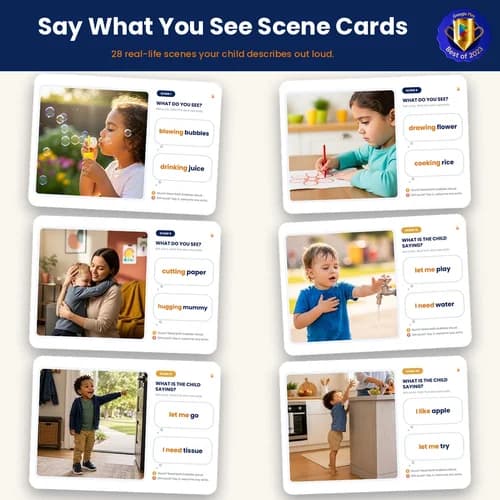
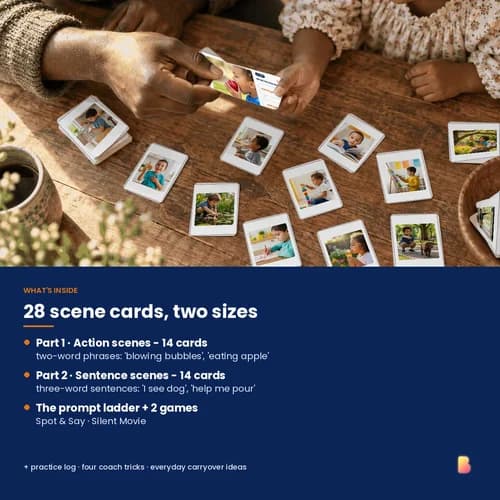
The Two-Word and Three-Word Scene Cards for Expressive Language PDF is a flexible digital resource designed for children ready to build on their early phrase skills. This 21-page printable and screen-friendly set features 28 large, real-life scene cards, making it ideal for kids with speech delay, autism, or those using signs or AAC. Each card encourages children to say two-word phrases or three-word sentences in their own voice, supporting natural language growth.
Children practice finding words without a prompt, expressive language, and describing a picture as they interact with each scene. The cards also help develop action words and three-word sentences with a starter, giving measurable progress in spontaneous speech. Using the unique Prompt Ladder method, kids gain confidence as they move from visual cues to independent phrase production.
These scene cards fit seamlessly into home routines, classroom speech sessions, and therapy settings. Families, teachers, and therapists can use them for imitation, choosing between two heard options, and carrying describing into daily life. The resource's real-life visuals and practical games make it easy to support language skills wherever learning happens.
Product Details
- Resource Name: Two-Word and Three-Word Scene Cards for Expressive Language PDF
- Format: Printable and screen-ready PDF
- Total Pages: 21
- Grade Level: Early childhood, Pre-K, Kindergarten, Special Education
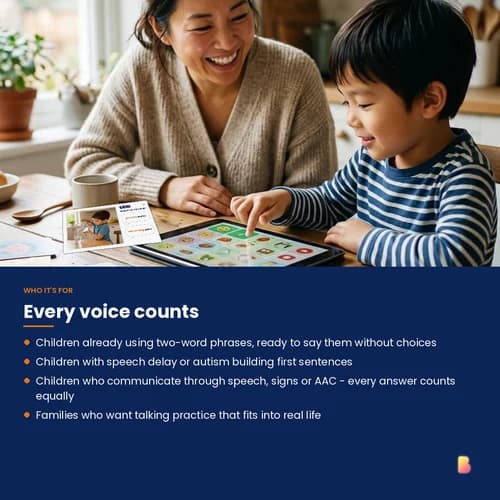
- Designed For: Children with speech delay, autism, AAC users, and early language learners
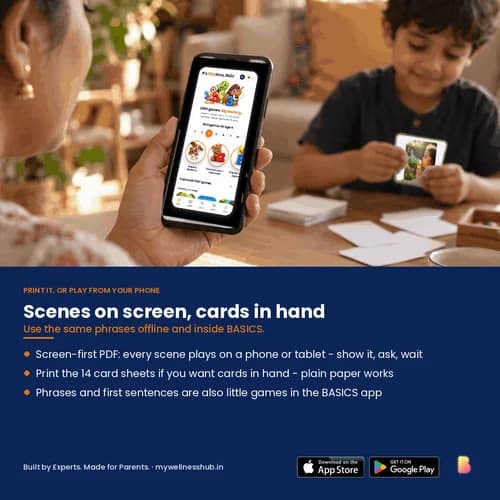
- Printing Notes: Optional—plays from screen or can be printed
- Best Used In: Home, classroom, speech therapy
- Sets / Flashcards / Activities: 28 scene cards, 2 games, practice log, Prompt Ladder pocket card
- Visuals / Illustrations: Large real-life scenes with phrase bubbles
Educational Benefits
1. Expressive Language Skill Building
- Supports children in forming two-word and three-word sentences independently.
- Encourages spontaneous speech by prompting children to describe real-life scenes.
- primary_keyword helps bridge the gap from prompted to natural phrase use.
2. Action Word Mastery
- Introduces a wide range of verbs through everyday action scenes.
- Strengthens vocabulary by connecting words to familiar activities.
- Promotes generalization of action words into daily routines.
3. Picture Description and Observation
- Boosts observation skills as children describe details in each scene.
- Fosters critical thinking by encouraging children to notice and verbalize what's happening.
- Enhances the ability to communicate about real-world events.
4. Carryover to Daily Communication
- Prepares children to use new phrases beyond practice sessions.
- Encourages language use in natural settings, supporting carryover into home and school life.
- Families and educators can model and reinforce phrases during daily routines.
5. AAC and Sign Language Parity
- Ensures full accessibility for AAC users and signers.
- All activities can be adapted for nonverbal communication methods.
- Promotes inclusion and equal participation for all learners.
Instructions for Use
Step 1: Download and Open the PDF
- Access the file on your device or print for hands-on use.
- Choose screen or paper based on your child's preference.
- Digital use is ideal for quick setup and portability.
Step 2: Introduce the Scene Cards
- Show one card at a time, focusing on the image and phrase bubbles.
- Use expressive language to model describing the picture.
- Encourage your child to look closely at the scene.
Step 3: Apply the Prompt Ladder Method
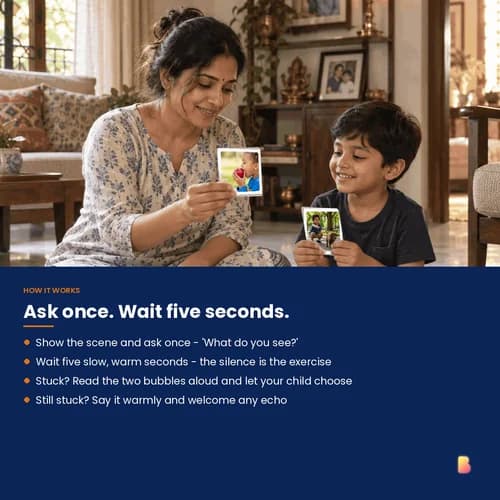
- Present the card and ask your child to say the phrase; wait five slow seconds.
- If there's no response, read both bubbles aloud for them to choose.
- If still quiet, say the phrase and welcome any attempt to imitate.
Step 4: Practice Action Words in Context
- Highlight action words shown in each scene.
- Invite your child to use these words in their own sentences.
- Action words practice helps strengthen verb usage naturally.
Step 5: Expand to Three-Word Sentences
- Use the sentence starter scenes to prompt longer phrases.
- Encourage your child to complete sentences like "I want apple."
- three-word sentences practice builds more complex language skills.
Step 6: Play Games and Track Progress
- Try the included Spot & Say or Silent Movie games for extra practice.
- Mark achievements on the practice log and celebrate successes.
- Use the Prompt Ladder pocket card for quick reference during sessions.
Activities Using the Resource
1. Describing Real-Life Scenes with Two-Word Phrases
Objective: To build expressive language by describing a picture using the primary_keyword.
How to Play:
- Show a card with an action scene (e.g., blowing bubbles, brushing teeth).
- Ask the child to say what is happening using two-word phrases.
- Use the Prompt Ladder if needed to support their response.
Skill Development:
- Builds spontaneous phrase generation
- Strengthens picture-to-word association
- Improves observation and description skills
2. Creating Three-Word Sentences with Sentence Starters
Objective: To encourage children to form three-word sentences using the primary_keyword for natural speech.
How to Play:
- Select a card with a sentence starter (e.g., "I want", "I see").
- Prompt the child to complete the sentence with the scene (e.g., "I want apple").
- Model and repeat as needed, then let the child try independently.
Skill Development:
- Expands sentence length and complexity
- Reinforces use of sentence starters
- Boosts expressive language confidence
3. Action Words Spot and Say Game
Objective: To strengthen action word vocabulary through quick identification and naming.
How to Play:
- Display several scene cards at once.
- Call out an action (from the scene, e.g., "kicking ball" or "pouring water").
- Have the child spot the correct card and say the action phrase aloud.
Skill Development:
- Increases verb recognition speed
- Enhances listening and attention
- Supports expressive vocabulary growth
4. Imitation and Echo Practice with Picture Cards
Objective: To improve phrase imitation and echoing skills for expressive language.
How to Play:
- Show a scene card and say the target phrase clearly.
- Encourage the child to repeat the phrase exactly.
- Offer praise and gentle correction as needed.
Skill Development:
- Develops accurate phrase repetition
- Builds auditory memory
- Supports articulation and fluency
5. Choosing Between Two Heard Options
Objective: To practice receptive language and decision-making using real-life scenes.
How to Play:
- Present a scene card and read both phrase bubbles aloud (one correct, one silly).
- Ask the child to choose which phrase matches the picture.
- Discuss why the chosen phrase is correct.
Skill Development:
- Improves auditory discrimination
- Strengthens decision-making
- Reinforces scene comprehension
6. Carryover to Daily Life Describing
Objective: To generalize describing a picture skills into daily routines and real-world settings.
How to Play:
- During daily activities, prompt the child to describe what they see or do (e.g., "eating apple," "brushing teeth").
- Use the same two-word or three-word phrases practiced with the cards.
- Celebrate each attempt to use new language in context.
Skill Development:
- Promotes real-world language use
- Encourages communication independence
- Fosters expressive language carryover
Frequently Asked Questions
Q1: What age or developmental stage is best for the Two-Word and Three-Word Scene Cards for Expressive Language PDF?
A1: This resource is designed for children who already use some two-word phrases and are ready to expand their expressive language. It is most suitable for early childhood, typically ages 3–7, including children with speech delay, autism, or those using AAC. For best results, ensure the child can combine at least two words before introducing these scene cards.
Q2: Can I use these scene cards with a small group in a classroom or therapy setting?
A2: Yes, these scene cards are effective for both individual and small group activities. Group use encourages peer modeling and turn-taking while practicing expressive language. Try games like Spot & Say or Silent Movie to engage multiple children at once.
Q3: Are these scene cards appropriate for speech therapy sessions targeting expressive language?
A3: Absolutely, this resource is specifically designed to support expressive language goals in speech therapy. The cards prompt spontaneous two-word and three-word sentences, and the Prompt Ladder method scaffolds responses. Therapists can track progress using the included practice log and adapt activities for each child's needs.
Q4: What is the best way to print and prepare the scene cards for repeated use?
A4: Print the PDF on thick paper or cardstock and laminate the cards for durability. Cut out the scene cards and the Prompt Ladder pocket card for easy handling during sessions. Laminated cards can be wiped clean and reused across multiple students or settings.
Q5: How does this resource support children with special needs or AAC users?
A5: The Two-Word and Three-Word Scene Cards for Expressive Language PDF offers full AAC parity and is accessible for sign language users. Visuals, clear phrase bubbles, and the Prompt Ladder method provide multiple entry points for diverse learners. You can model responses using speech, signs, or AAC devices to match each child's communication style.
Q6: Can I use the scene cards digitally without printing them?
A6: Yes, the PDF is screen-ready and can be used directly on tablets, computers, or interactive whiteboards. Digital use is ideal for teletherapy, classroom projection, or on-the-go practice. Simply open the file and display the scene cards for interactive sessions.
Q7: What expressive language skills and learning goals do these scene cards target?
A7: The resource targets expressive language, describing a picture, action words, and three-word sentences with a sentence starter. Children practice finding words without prompts, imitating phrases, and generalizing describing skills into daily life. Consistent use supports growth in spontaneous speech and confidence in communication.
Q8: What are the licensing and usage rights for this PDF resource from Wellness Hub?
A8: Your purchase grants you a single-user license for personal, classroom, or therapy use. Redistribution, resale, or sharing of the digital file beyond your direct students or clients is not permitted. For multi-user or institutional licensing, please contact Wellness Hub directly.
Q9: How do I receive and download my Two-Word and Three-Word Scene Cards for Expressive Language PDF?
A9: After purchase, you will receive an instant download link via email from Wellness Hub. The PDF can be saved to your device and accessed immediately. If you have any trouble downloading, customer support is available to assist.
Q10: What is Wellness Hub's refund or exchange policy for digital resources?
A10: Wellness Hub does not offer refunds or exchanges on digital PDF resources due to their downloadable nature. If you experience technical issues or receive the wrong file, contact support for prompt resolution. Please review all product details before purchasing to ensure it meets your needs.
Usage Rights and Restrictions
Allowed Usage:
- Personal use by parents, teachers, and therapists.
- Printable for classroom, home, or therapy settings.
- Can be used in group or one-on-one learning sessions.
Not Allowed:
- Reselling, redistributing, or modifying the resource for commercial use.
- Sharing publicly (e.g., on blogs, social media, or websites) without permission.
- Uploading the file to public sharing platforms.
If you need a bulk license for schools or therapy centers, please contact us.
Conclusion
The Two-Word and Three-Word Scene Cards for Expressive Language PDF empowers children who are ready to move beyond single words, supporting their journey to independent phrase and sentence use. Designed for young learners with speech delay, autism, or those using AAC, it provides real-life visuals and structured prompts to encourage confident communication.
Children build describing a picture skills and practice imitation in home, classroom, or therapy settings. The resource also supports choosing between two heard options, helping children strengthen decision-making and expressive language in daily routines.
Give your child or students a boost—download the Two-Word and Three-Word Scene Cards for Expressive Language PDF and make expressive language practice fun, engaging, and effective every day.