

Say It Step by Step: Short Phrases — 50 Printable Phrase-Building Picture Cards (1–5 Words) for Early Talkers
₹80
₹160
You save ₹80
5 (49 ratings)
Grade Levels
Pre-K – Kindergarten (Ages 3–6)
Content Overview
Format: PDF | Pages: 21 | Features: 50 everyday phrases, word chips, expressive phrase length, real-life photos
Categories
Share


About the Product
Introduction
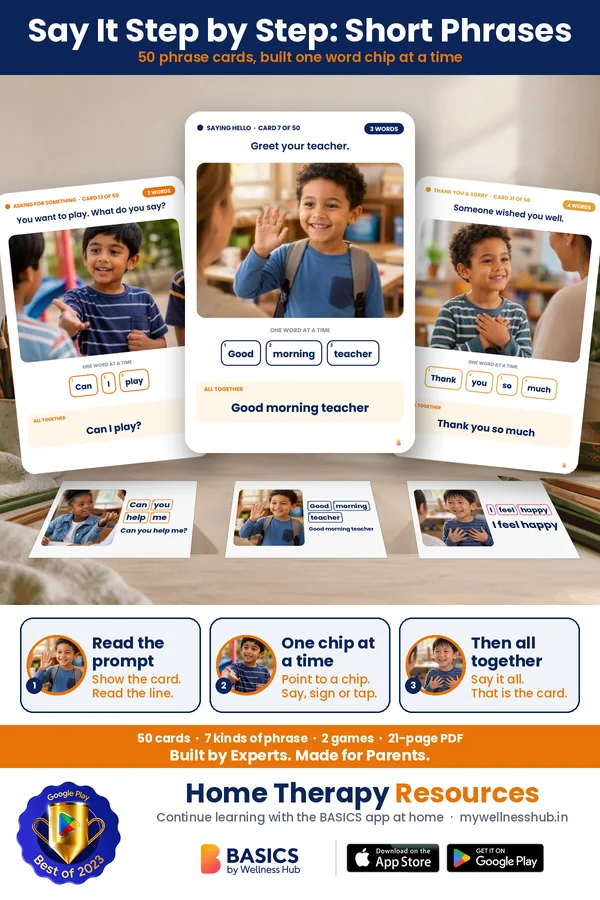
Building expressive phrase length is a key milestone for children moving from single words to full sentences. The Everyday Phrases Word Chip Cards PDF offers 50 real-life phrases, each broken into numbered word chips, making it easy for children with speech delay, autism, or those using AAC to practice combining words. This 21-page digital resource is perfect for young communicators ready to grow from single words to two, three, four, and five-word phrases in a supportive, error-free format.
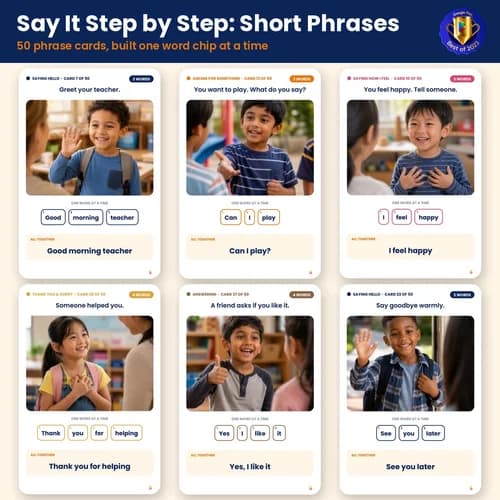
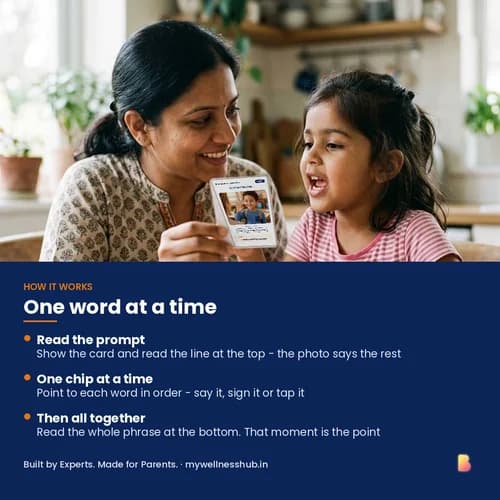
Children practice combining single words into phrases by pointing, saying, signing, or tapping each chip, then blending them into the full phrase. Skills addressed include using social phrases like greetings, thank you, and asking for something, as well as increasing phrase length and confidence in communication. With every card offering a clear prompt, photo, and visual word chips, children see and build each phrase step by step.
Families, teachers, and therapists can use these cards in home routines, classroom groups, or speech sessions to support social phrases themselves. The cards invite participation without pressure, offering gentle tips and flexible activities for every setting. This resource brings phrase-building to life for all learners, including those who communicate in unique ways.
Product Details
- Resource Name: Everyday Phrases Word Chip Cards PDF
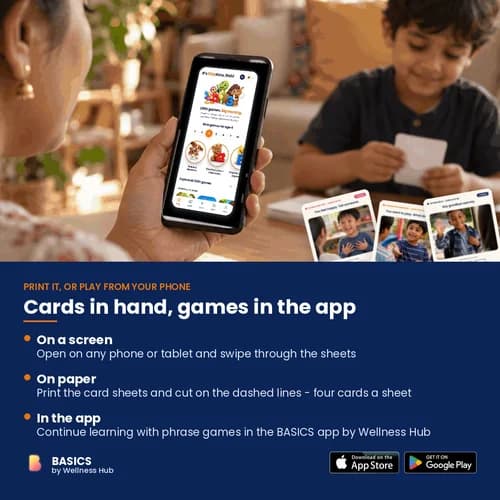
- Format: Printable and screen-ready PDF
- Total Pages: 21
- Grade Level: Pre-K, Kindergarten, Early Elementary
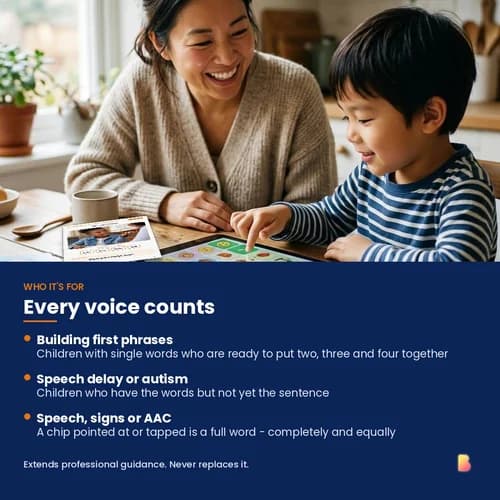
- Designed For: Children with speech delay, autism, AAC users, and early communicators
- Printing Notes: Print single- or double-sided; laminate for durability
- Best Used In: Home, classroom, speech therapy, special education
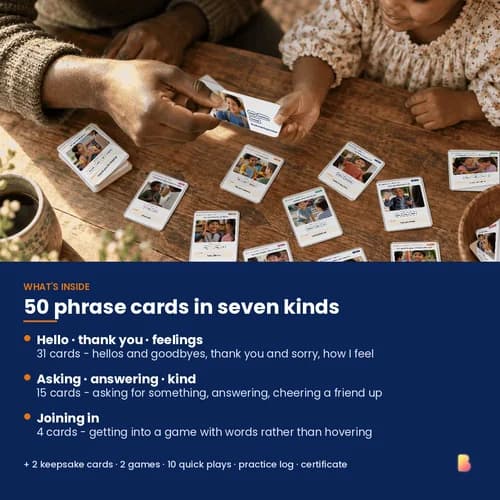
- Sets / Flashcards / Activities: 50 phrase cards, 2 keepsake cards, 2 games, 1 practice log, 1 certificate
- Visuals / Illustrations: Real-life photographs for every phrase card
Educational Benefits
1. Expressive Phrase Length Expansion
- Children learn to combine single words into longer, meaningful phrases.
- This builds confidence in moving from one-word to multi-word speech.
- Everyday Phrases Word Chip Cards PDF supports natural language growth.
2. Social Communication Skills Practice
- Kids gain real-world skills with greetings, thank you, and polite requests.
- Practicing these phrases helps children join in and respond to others.
- Social phrase routines become familiar and easier to use daily.
3. Visual and AAC-Friendly Learning
- Visual word chips and real-life photos support children who use AAC.
- Pointing, tapping, or signing each chip makes every word accessible.
- All learners can participate fully, regardless of speech ability.
4. Error-Free Sentence Building
- Each card shows the whole phrase and its word chips, so nothing is hidden.
- Children experience success without the risk of mistakes or confusion.
- This approach encourages independent practice and self-assurance.
5. Flexible, Gentle Communication Support
- Cards invite participation without pressure or time limits.
- Families and educators can adapt activities for any pace or setting.
- Phrase-building fits naturally into home, school, or therapy routines.
Instructions for Use
Step 1: Print and Prepare the Cards
- Download and print the PDF single- or double-sided as preferred.
- Cut out each phrase card for hands-on or visual use.
- Laminate for extra durability and repeated practice.
Step 2: Introduce the Phrase Types
- Show the child a card set, explaining categories like greetings or being kind.
- Highlight the expressive phrase length on each card.
- Use real-life photos to make connections with daily moments.
Step 3: Model the Word Chips
- Demonstrate pointing, saying, signing, or tapping each word chip in order.
- Encourage the child to imitate your actions for every phrase.
- Stay on the same word count until the child is comfortable.
Step 4: Invite the Child to Build Phrases
- Let the child point to, say, sign, or tap each chip, then blend the full phrase.
- Rotate through different cards instead of repeating the same one.
- Never rush the last step—allow the child time to finish.
Step 5: Play Games and Extend Practice
- Try included games like Take It in Turns or Cover the Last One.
- Use phrase-building activities to reinforce combining single words.
- Incorporate the practice log to track new words and progress.
Step 6: Carry Over to Everyday Routines
- Prompt the child to use new phrases during real-life situations.
- Encourage use of greetings, requests, and thank yous throughout the day.
- Celebrate successes with the Certificate of Big Words.
Activities Using the Resource
1. Phrase Building with Word Chips
Objective: To help children combine single words into phrases using the Everyday Phrases Word Chip Cards PDF.
How to Play:
- Select a card and lay out its word chips in order.
- Model pointing, saying, or signing each chip, then say the full phrase.
- Invite the child to build and say the phrase with support as needed.
Skill Development:
- Increases expressive phrase length step by step.
- Strengthens word order understanding.
- Builds confidence in combining words.
2. Social Greetings Practice Game
Objective: To develop social phrase skills by practicing greetings and polite expressions.
How to Play:
- Choose greeting cards (e.g., "Hi," "Good morning teacher").
- Take turns with the child using word chips to say each greeting.
- Use real-life photos to connect phrases to daily situations.
Skill Development:
- Enhances social communication routines.
- Encourages turn-taking and participation.
- Supports generalization to real interactions.
3. Feelings and Emotions Phrase Sort
Objective: To support children in expressing feelings using multi-word phrases.
How to Play:
- Gather cards related to emotions (e.g., "I feel happy").
- Ask the child to sort cards by feeling (happy, sad, okay).
- Practice building and saying each phrase using the chips.
Skill Development:
- Expands emotional vocabulary.
- Promotes expressive language for feelings.
- Improves sorting and categorization skills.
4. Request and Answer Role-Play
Objective: To practice asking for something and responding using the Everyday Phrases Word Chip Cards PDF.
How to Play:
- Select cards for requests and answers (e.g., "Can I play?").
- Role-play: adult asks, child answers, then switch roles.
- Use word chips to support each phrase during play.
Skill Development:
- Builds functional communication for requests.
- Reinforces turn-taking in conversation.
- Develops comprehension of everyday exchanges.
5. Thank You and Kindness Card Match
Objective: To reinforce polite language and acts of kindness through matching activities.
How to Play:
- Lay out thank you and kindness cards face up.
- Match each phrase to a photo showing the action (e.g., helping, sharing).
- Say or sign the phrase together using the chips.
Skill Development:
- Strengthens understanding of polite expressions.
- Connects language to social actions.
- Encourages empathy and positive behavior.
6. Everyday Phrase Carryover Challenge
Objective: To encourage use of new phrases in real-life routines.
How to Play:
- Pick a phrase card to use during the day (e.g., "Thank you for helping").
- Prompt the child to use the phrase at the right moment.
- Celebrate with a sticker or mark on the practice log.
Skill Development:
- Promotes real-world phrase use.
- Supports communication generalization.
- Builds motivation and self-monitoring.
Frequently Asked Questions
Q1: What ages and developmental stages are the Everyday Phrases Word Chip Cards PDF designed for?
A1: The Everyday Phrases Word Chip Cards PDF is ideal for children ages 3–8 who are moving from single words to short phrases. It supports early communicators, including those with speech delay, autism, or using AAC. Children ready to combine two, three, four, or five words will benefit most from this resource.
Q2: Can these cards be used in small group or classroom settings?
A2: Yes, these cards are suitable for small groups, classrooms, and therapy sessions. The visual word chips and real-life photos make them engaging for group activities and peer modeling. Try using them in circle time, morning meetings, or language centers for collaborative phrase-building.
Q3: Are the Everyday Phrases Word Chip Cards PDF appropriate for speech therapy sessions?
A3: Absolutely, this resource is designed for use in speech therapy to target expressive phrase length and social language. Therapists can model, prompt, and reinforce phrase-building using the visual chips and photographs. The error-free format encourages participation and reduces frustration during therapy.
Q4: What is the best way to print and prepare the cards for repeated use?
A4: Print the PDF single- or double-sided on thick paper or cardstock for durability. Laminating the cards allows for repeated use and easy cleaning, especially in therapy or classroom settings. Cut out each card and store them in labeled pouches or boxes for quick access.
Q5: How does this resource support children with special needs or those who use AAC?
A5: The cards are fully AAC-friendly, allowing children to point, tap, or sign each word chip as a complete response. Visual supports and error-free design help children with speech delay, autism, or motor challenges participate confidently. You can pair the cards with communication devices or sign language for full accessibility.
Q6: Can the Everyday Phrases Word Chip Cards PDF be used digitally without printing?
A6: Yes, the PDF is screen-ready and can be used on tablets, computers, or interactive whiteboards. Children can point to or tap the word chips on-screen and practice building phrases digitally. This is especially helpful for teletherapy, remote learning, or on-the-go practice.
Q7: What expressive language and social skills will children develop using this resource?
A7: Children will build expressive phrase length, learn to combine single words into phrases, and master key social phrases like greetings, thank you, and polite requests. The resource targets combining words, increasing phrase complexity, and using functional language in real-life situations. Regular practice supports confidence and independence in communication.
Q8: What are the licensing and usage rights for the Everyday Phrases Word Chip Cards PDF?
A8: Purchase grants a single-user license for personal, classroom, or therapy use. You may print and use the resource with your students or clients but may not share, resell, or distribute it to others. For multi-user or school-wide licenses, contact Wellness Hub for options.
Q9: How do I receive and download the Everyday Phrases Word Chip Cards PDF after purchase?
A9: After purchase, you will receive an instant download link via email from Wellness Hub. The PDF can be saved to your device and printed or used digitally as needed. If you encounter any issues with delivery, Wellness Hub's support team is available to assist.
Q10: What is Wellness Hub's refund or exchange policy for digital resources?
A10: Wellness Hub does not offer refunds or exchanges on digital PDF resources once downloaded. This policy ensures the integrity and security of digital content. If you have concerns or technical issues, contact Wellness Hub support for prompt assistance.
Usage Rights and Restrictions
Allowed Usage:
- Personal use by parents, teachers, and therapists.
- Printable for classroom, home, or therapy settings.
- Can be used in group or one-on-one learning sessions.
Not Allowed:
- Reselling, redistributing, or modifying the resource for commercial use.
- Sharing publicly (e.g., on blogs, social media, or websites) without permission.
- Uploading the file to public sharing platforms.
If you need a bulk license for schools or therapy centers, please contact us.
Conclusion
Everyday Phrases Word Chip Cards PDF is designed to help early communicators, including children with speech delay or autism, confidently build expressive language. With real-life photos and clear word chips, it supports children as they move from single words to full phrases, making communication more accessible and enjoyable for all.
By focusing on combining words and practicing social phrases, children develop expressive phrase length and kindness in daily routines. The resource fits seamlessly into home, classroom, or therapy settings, ensuring that every child can participate in a way that matches their needs and abilities.
Start using Everyday Phrases Word Chip Cards PDF today to support expressive phrase length and foster kindness in your child's communication journey. With each phrase built, you help lay the foundation for lifelong language and social success.