

Say It Step by Step: Longer Phrases — 50 Printable Phrase-Building Picture Cards (5–7 Words) for Growing Talkers
₹80
₹160
You save ₹80
4.8 (34 ratings)
Grade Levels
Pre-K – Kindergarten (Ages 4–7)
Content Overview
Format: PDF | Pages: 21 | Features: 50 everyday phrases, word chips, expressive phrase length, real-life photos
Categories
Share


About the Product
Introduction
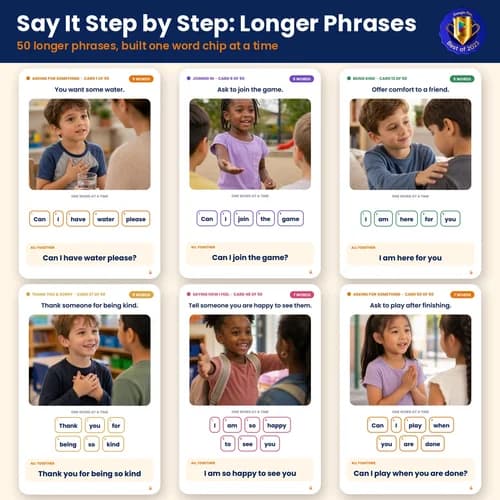
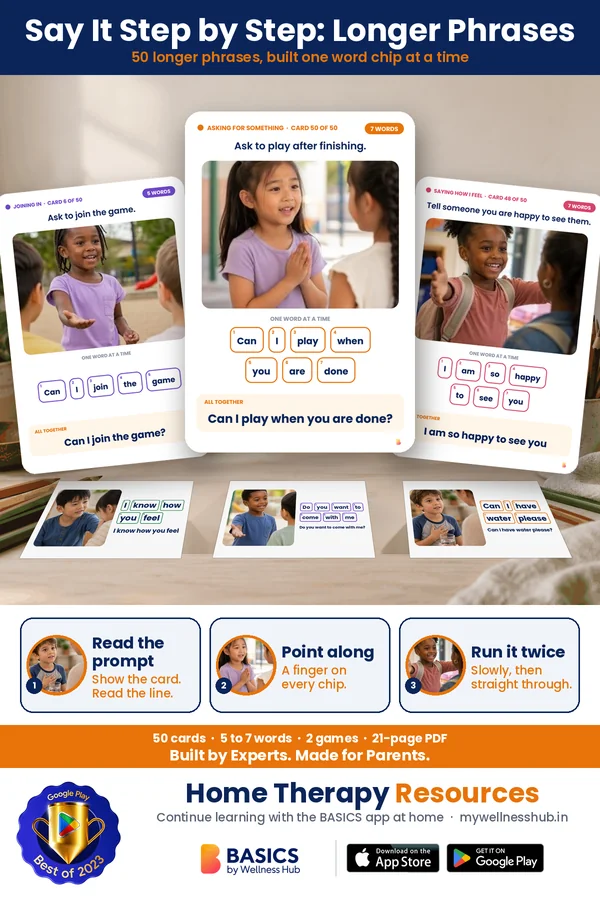
The Say It Step by Step: Everyday Phrases PDF is a 21-page digital resource designed for children ready to move from short phrases to longer, meaningful sentences. Perfect for kids with speech delay, autism, or those using signs or AAC, this tool features 50 everyday phrases split into numbered word chips with supportive photographs. Each card invites children to build expressive language skills in a way that is accessible, visual, and never a test.
Children practice holding a long phrase to its last word, building expressive phrase length, and mastering social phrases such as asking politely, saying thank you, and joining in. The resource encourages pointing to each word chip, helping kids strengthen memory for longer phrases and gain confidence in real-life communication. Outcomes include improved sentence structure, increased phrase length, and comfort with everyday social language.
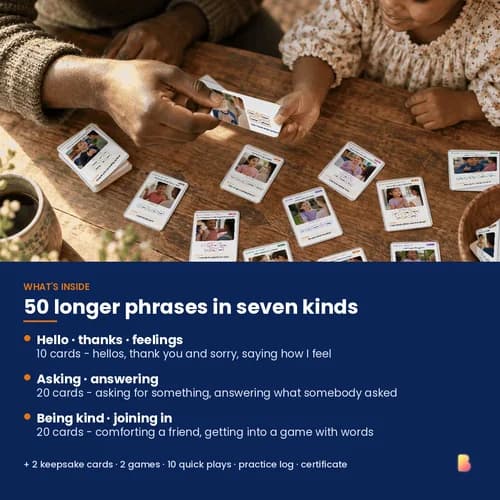
Use these cards in speech therapy, classrooms, or at home to support asking for something, answering, and being kind. The cards are ideal for group activities, one-on-one sessions, or independent practice, making them versatile for various learning and therapy contexts. The visual word chips and clear structure help children participate fully, no matter their communication method.
Product Details
- Resource Name: Say It Step by Step: Everyday Phrases PDF
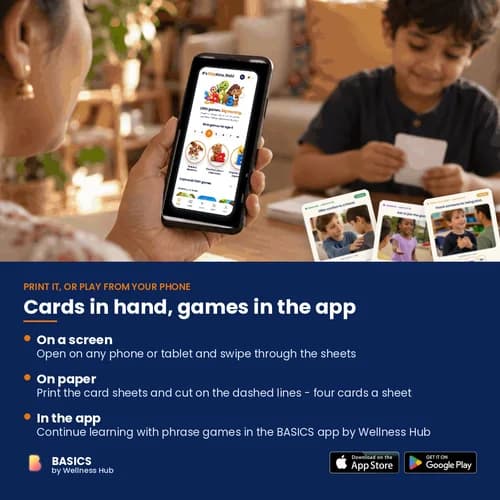
- Format: Printable and screen-ready PDF
- Total Pages: 21
- Grade Level: Pre-K, Kindergarten, Early Elementary
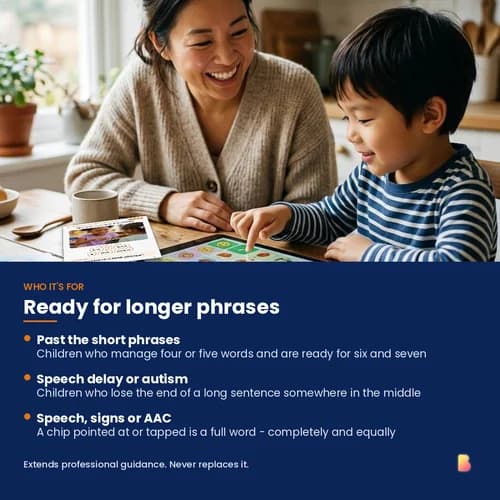
- Designed For: Children with speech delay, autism, AAC users, and early communicators
- Printing Notes: Print single-sided; cards can be laminated for reuse
- Best Used In: Speech therapy, classrooms, home practice
- Sets / Flashcards / Activities: 50 phrase cards, 2 keepsake cards, 2 games, practice log, certificate
- Visuals / Illustrations: Real-life photographs for every phrase card
Educational Benefits
1. Expressive Language Expansion
- Supports children in building expressive phrase length for clearer communication.
- Encourages use of complete sentences in daily interactions.
- Helps children move beyond short phrases to more complex language.
2. Social Communication Mastery
- Teaches essential social phrases for greetings, requests, and polite responses.
- Boosts confidence in joining conversations and expressing needs.
- primary_keyword enables real-life practice of everyday interactions.
3. Memory and Sequencing Skills
- Strengthens the ability to hold and recall longer phrases.
- Develops working memory by encouraging children to point to each word chip.
- Promotes accurate sentence sequencing for effective communication.
4. Visual and AAC Accessibility
- Ensures full AAC parity—each chip tapped or pointed at counts as a word.
- Visual word chips support children who communicate by signs or devices.
- Increases participation for nonverbal or minimally verbal learners.
5. Confidence in Real-World Situations
- Prepares children to use social language in classrooms, therapy, and at home.
- Encourages independence in asking, answering, and being kind.
- holding a long phrase to its last word builds self-assurance in communication.
Instructions for Use
Step 1: Print and Prepare the Cards
- Print the PDF single-sided on sturdy paper or cardstock.
- Cut out each phrase card for individual use.
- Laminate cards for durability and repeated practice.
Step 2: Introduce the Phrase Types
- Show children the seven kinds of phrases included in the set.
- Explain categories like asking for something and being kind.
- Use visuals to support understanding of each phrase type.
Step 3: Demonstrate Pointing to Word Chips
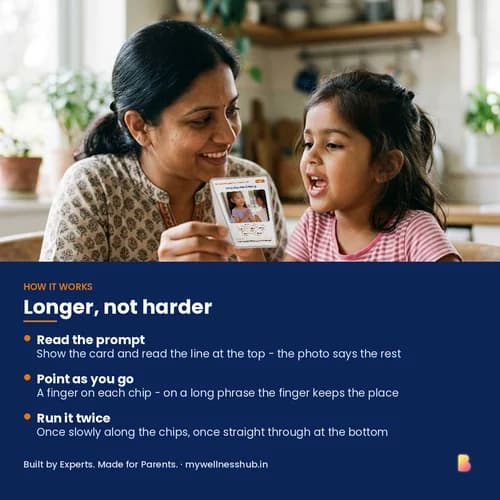
- Model how to point to each word chip while saying the phrase.
- Encourage children to use a finger or pointer for every chip.
- expressive phrase length practice starts with this step.
Step 4: Practice with the Prompt Line
- Read the prompt line aloud and invite the child to repeat.
- Have the child point along the chips, then say the phrase smoothly.
- Use the "run it twice" trick for extra support.
Step 5: Play Phrase-Building Games
- Engage children with included games like Two Halves and Ask For It.
- Rotate cards to keep practice fresh and motivating.
- holding a long phrase to its last word is the goal in these activities.
Step 6: Track Progress and Celebrate Success
- Use the practice log to record achievements and favorite phrases.
- Award the Certificate of Whole Phrases for motivation.
- Display progress to build pride and encourage ongoing use.
Activities Using the Resource
1. Everyday Phrase Chip Matching
Objective: To build expressive phrase length by matching word chips to complete a whole phrase.
How to Play:
- Lay out a phrase card and separate the word chips.
- Ask the child to arrange the chips in order, pointing to each as they go.
- Read the full phrase together, then repeat smoothly.
Skill Development:
- Sequencing multi-word phrases
- Visual scanning and word recognition
- Expressive language expansion
2. Social Request Practice Game
Objective: To practice the primary_keyword in real-life asking scenarios using visual cues.
How to Play:
- Select a card from the "Asking For Something" set.
- Have the child point to each chip while saying the phrase aloud.
- Role-play the request with a peer or adult using the completed phrase.
Skill Development:
- Social communication for requests
- Turn-taking and conversational skills
- Confidence in using polite language
3. Phrase Length Memory Challenge
Objective: Strengthen working memory by holding a long phrase to its last word.
How to Play:
- Show a phrase card and have the child point to each chip, then cover the card.
- Ask them to repeat the phrase from memory, using their finger to tap the table for each word.
- Reveal the card and check accuracy together.
Skill Development:
- Working memory for longer sentences
- Auditory recall and self-monitoring
- Attention to phrase structure
4. Answering with Complete Sentences
Objective: Encourage answering questions using the primary_keyword for fuller responses.
How to Play:
- Present a question card from the "Answering" set.
- Guide the child to point to each chip and say the answer phrase.
- Practice answering similar questions in new contexts.
Skill Development:
- Building complete sentence responses
- Generalizing language to new situations
- Listening and comprehension
5. Kindness Phrase Sorting Activity
Objective: Develop understanding of being kind through sorting and using kind phrases.
How to Play:
- Mix cards from the "Being Kind" and other phrase sets.
- Ask the child to sort out all the kindness phrases.
- Practice saying each kind phrase while pointing to the chips.
Skill Development:
- Recognizing social-emotional language
- Categorization and sorting skills
- Practicing empathy in communication
6. Carryover Phrase Hunt
Objective: Apply expressive phrase length skills to real-life moments throughout the day.
How to Play:
- Choose a phrase card to focus on during daily routines (e.g., "Thank you for being so kind").
- Encourage the child to use the phrase in a natural setting, pointing to each chip first.
- Celebrate when the phrase is used independently in context.
Skill Development:
- Real-world communication carryover
- Self-advocacy and independence
- Functional use of social language
Frequently Asked Questions
Q1: What ages or developmental levels are best for Say It Step by Step: Everyday Phrases PDF?
A1: This resource is ideal for children in Pre-K, Kindergarten, and early elementary grades who can manage short phrases and are ready for longer ones. It supports early communicators, including those with speech delay, autism, or using AAC. Children typically benefit most when they can combine three to five words and are ready to expand expressive phrase length.
Q2: Can I use these phrase cards in a classroom group activity?
A2: Yes, the cards are designed for flexible use in small groups or whole-class settings. Activities like phrase chip matching and role-play games encourage participation and social language practice. For best results, assign roles or rotate cards so every child gets a turn building and saying a complete phrase.
Q3: Are these cards suitable for speech therapy sessions with children who use AAC?
A3: Absolutely. The visual word chips and full AAC parity ensure every child can participate by pointing, tapping, or using their device. Therapists can model each phrase, encourage chip-by-chip participation, and celebrate every successful attempt at holding a long phrase to its last word.
Q4: What is the best way to print and prepare the phrase cards for repeated use?
A4: Print single-sided on sturdy paper or cardstock and laminate each card for durability. Laminated cards can be wiped clean and used with dry-erase markers for extra activities. Store cards in a binder or box for easy access during therapy or classroom routines.
Q5: How does this resource support children with special needs or varied learning profiles?
A5: The resource is highly visual and structured, making it accessible for children with autism, speech delays, or those who communicate by signs or AAC. It offers built-in differentiation through shorter versions and gentle tricks for success. Educators and caregivers can adapt the pace, provide extra modeling, or focus on specific phrase types as needed.
Q6: Can the phrase cards be used on a tablet or computer without printing?
A6: Yes, the PDF is screen-ready and can be displayed on tablets, computers, or interactive whiteboards. Children can point to or tap each word chip directly on the screen during practice. This digital option is especially useful for teletherapy or remote learning sessions.
Q7: What expressive language and social skills will my child develop with this resource?
A7: Children will increase expressive phrase length, improve memory for longer sentences, and master key social phrases for everyday situations. The cards target asking for something, answering, being kind, and joining in, supporting real-life communication. Regular use helps children gain confidence in holding a long phrase to its last word and using complete sentences.
Q8: What are the usage rights for Say It Step by Step: Everyday Phrases PDF?
A8: Purchase includes a single-user license for one educator, therapist, or family. You may print and use the resource for your own students or children, but sharing or distributing the file is not permitted. For group or school licensing, contact Wellness Hub for options.
Q9: How do I receive and download the PDF after purchase?
A9: After completing your purchase, you will receive an instant download link via email. The PDF is ready for immediate use on any device or for printing. If you have trouble accessing your file, Wellness Hub's support team is available to assist.
Q10: What is Wellness Hub's refund or exchange policy for digital resources?
A10: Due to the nature of digital products, Wellness Hub does not offer refunds or exchanges once a resource is downloaded. If you experience technical issues or receive the wrong file, contact customer support for prompt resolution. Wellness Hub is committed to ensuring you are satisfied with your purchase and will help resolve any concerns.
Usage Rights and Restrictions
Allowed Usage:
- Personal use by parents, teachers, and therapists.
- Printable for classroom, home, or therapy settings.
- Can be used in group or one-on-one learning sessions.
Not Allowed:
- Reselling, redistributing, or modifying the resource for commercial use.
- Sharing publicly (e.g., on blogs, social media, or websites) without permission.
- Uploading the file to public sharing platforms.
If you need a bulk license for schools or therapy centers, please contact us.
Conclusion
Say It Step by Step: Everyday Phrases PDF supports children ready to grow from short phrases to longer, meaningful sentences in daily life. Designed for early communicators, AAC users, and those with speech delay or autism, it gives every child a chance to build expressive language in a visual, accessible, and encouraging way.
Children develop confidence with social communication as they practice expressive phrase length and polite responses. The resource fits seamlessly into home routines, classroom activities, and therapy sessions, making it easy to target holding a long phrase to its last word while learning essential social phrases.
Start building real-world communication skills—download Say It Step by Step: Everyday Phrases PDF today and help your child master expressive language and social connection with every phrase.