


Picture Talk: Big World & Cosy Corners — 10 Printable Scene Posters from Farm to Bedtime for Speech Therapy
₹80
₹160
You save ₹80
5 (45 ratings)
Grade Levels
Pre-K – Kindergarten (Ages 4–7)
Content Overview
Format: PDF | Pages: 20 | Features: Busy scenes, joint attention, commenting, describing, 80 marked spots
Categories
Share


About the Product
Introduction
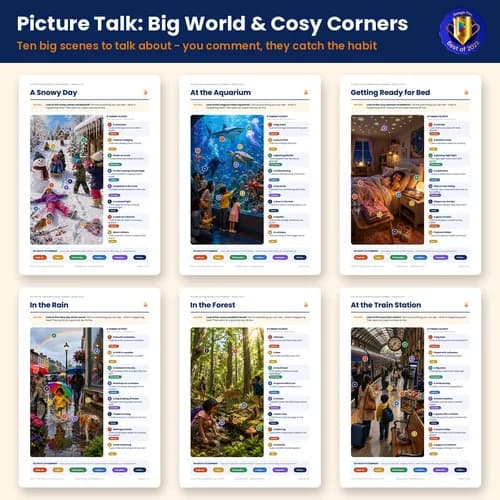
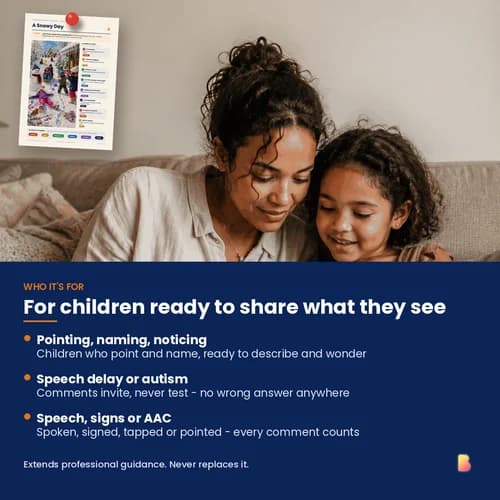
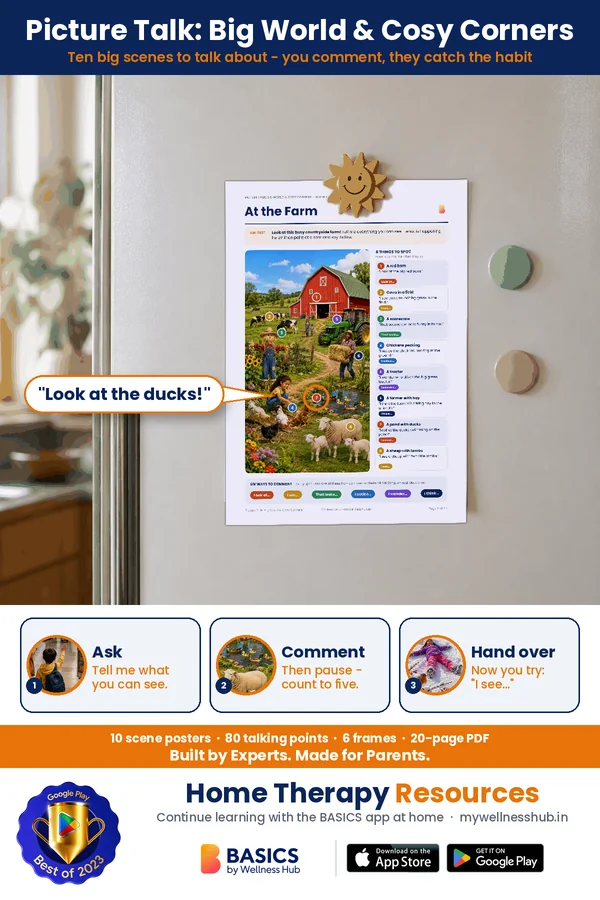
The Picture Talk: Busy Scene Commenting Posters PDF is a versatile digital resource designed for children who are ready to move beyond simple pointing and naming. This 20-page set features ten full-page busy scene posters, each carefully crafted to encourage commenting and conversation in a variety of everyday settings. Ideal for early learners, children with speech delay, autism, or those using AAC, this resource supports language growth through structured, engaging visual scenes.
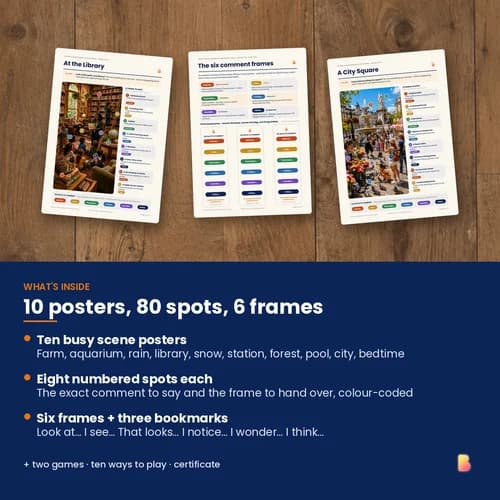
Children practice skills such as observing actions and interpreting feelings and reasons as they explore each scene. Each poster includes eight numbered spots with matching comments and six color-coded sentence frames, making it easy for children to practice joint attention, describing, and sharing what they see. The resource helps learners chain comments into a story, building confidence in expressive language and social interaction.
Families, teachers, and therapists can use these posters in home, classroom, or therapy sessions to foster meaningful commenting practice. The included games, bookmarks, and everyday carryover ideas ensure flexible use for group activities, one-on-one sessions, or independent exploration. The focus on observing actions makes this resource especially useful for supporting communication goals in a variety of educational and therapeutic contexts.
Product Details
- Resource Name: Picture Talk: Busy Scene Commenting Posters PDF
- Format: Printable and screen-ready PDF
- Total Pages: 20
- Grade Level: Pre-K, Kindergarten, Grade 1–3
- Designed For: Early learners, speech delay, autism, AAC users
- Printing Notes: Color recommended for best visual clarity
- Best Used In: Home, classroom, therapy sessions
- Sets: 10 full-page busy scene posters
- Visuals / Illustrations: Rich, detailed illustrations with eight numbered spots per scene
Educational Benefits
1. Joint Attention Skill Building
- Promotes shared focus between child and adult using engaging busy scenes.
- Encourages children to look where others point and comment together.
- Supports foundational social communication in natural contexts.
2. Expressive Language Expansion
- Provides structured opportunities to use six distinct comment frames.
- Helps children move from naming to describing, wondering, and interpreting.
- primary_keyword supports children in expressing ideas beyond simple labels.
3. Observing Actions in Context
- Strengthens the ability to notice and describe what people and animals are doing.
- Fosters attention to detail and understanding of everyday routines.
- Prepares children for more advanced narrative and comprehension tasks.
4. Describing and Interpreting Feelings
- Guides children to notice emotions and reasons behind actions in each scene.
- Encourages discussion about feelings and motivations, supporting social-emotional growth.
- Builds confidence in sharing personal interpretations with others.
5. AAC and Inclusive Communication Support
- Ensures full participation for children who use signs, AAC devices, or gestures.
- Every comment can be spoken, signed, tapped, or pointed for true accessibility.
- observing actions is naturally reinforced through multiple modes of communication.
Instructions for Use
Step 1: Print or Display the Posters
- Choose color printing for best results or open the PDF on a tablet or computer.
- Set up one busy scene poster at a time for focused commenting.
- Laminate posters for repeated classroom or therapy use.
Step 2: Introduce Comment Frames
- Show the six color-coded sentence frames included in the resource.
- Model using a frame, such as joint attention, to start a comment.
- Encourage the child to repeat or select a frame to try.
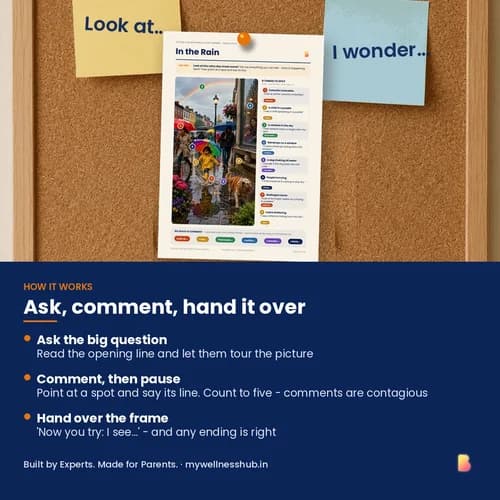
Step 3: Explore Numbered Spots Together
- Point to a numbered spot and read the matching comment aloud.
- Invite the child to observe and use describing skills for that spot.
- Use the rail beside each poster to guide language practice.
Step 4: Model and Pause for Participation
- Make three comments about the scene before asking a question.
- Pause after each comment to give the child time to respond.
- Use the "echo and add one" trick to support chaining comments.
Step 5: Play Included Games for Practice
- Try "I Spy, With Frames" or "The Story of the Scene" for interactive learning.
- Incorporate interpreting skills as children guess feelings or reasons.
- Rotate scenes to keep practice fresh and engaging.
Step 6: Track Progress and Carry Over
- Use the practice log and Comment Jar to celebrate new skills.
- Encourage everyday commenting at home, school, or in the community.
- Award the Certificate of Picture Talk for motivation and achievement.
Activities Using the Resource
1. Busy Scene Joint Attention Game
Objective: To build joint attention using the Picture Talk: Busy Scene Commenting Posters PDF in shared activities.
How to Play:
- Display a poster and point to a numbered spot together.
- Use the "Look at…" frame to direct the child's attention.
- Take turns commenting on what you both see at that spot.
Skill Development:
- Increases shared visual focus in social settings.
- Promotes turn-taking in communication.
- Strengthens receptive and expressive language skills.
2. Describing with Sentence Frames
Objective: To expand expressive language by using structured comment frames from the primary_keyword.
How to Play:
- Choose a scene and select a numbered spot.
- Model a comment using "That looks…" or "I see…" frames.
- Encourage the child to use a different frame for their own description.
Skill Development:
- Builds vocabulary for describing people, places, and actions.
- Encourages flexible sentence construction.
- Supports confidence in sharing observations.
3. Observing Actions in Busy Scenes
Objective: To practice observing actions and commenting using the resource's visual cues.
How to Play:
- Pick a poster with active scenes (e.g., At the Farm).
- Point to a spot showing an action and ask the child to describe what is happening.
- Use the "I notice…" frame to model action-based comments.
Skill Development:
- Enhances action word comprehension.
- Improves attention to detail in complex scenes.
- Develops observation and reporting skills.
4. Comment Chaining Story Game
Objective: To help children chain comments into a short story using the primary_keyword.
How to Play:
- Start with a comment about one spot using a sentence frame.
- Invite the child to continue, linking comments about other spots.
- Build a simple story together across the scene.
Skill Development:
- Fosters narrative sequencing.
- Encourages logical connections between ideas.
- Practices chaining sentences for storytelling.
5. Interpreting Feelings and Reasons
Objective: To support interpreting emotions and motivations in illustrated scenes.
How to Play:
- Select a spot where a character shows an emotion.
- Use the "I think…" frame to model interpreting feelings or reasons.
- Ask the child to share their own interpretation using a different frame.
Skill Development:
- Develops empathy and perspective-taking.
- Strengthens reasoning about cause and effect.
- Builds emotional vocabulary.
6. AAC Commenting Practice
Objective: To ensure inclusive commenting practice for AAC users with observing actions.
How to Play:
- Present a poster and choose a numbered spot.
- Encourage the child to use their AAC device, signs, or gestures to make a comment.
- Model both spoken and AAC-based comments for each frame.
Skill Development:
- Promotes multimodal communication.
- Builds confidence using AAC for real conversations.
- Reinforces observing and commenting in accessible ways.
Frequently Asked Questions
Q1: What age range and developmental level are the Picture Talk: Busy Scene Commenting Posters PDF designed for?
A1: These posters are best for children ages 4–9, especially those in Pre-K through Grade 3. They support early learners who are ready to move beyond pointing and naming, including children with speech delay, autism, or those using AAC. The resource is also effective for older students needing foundational practice with commenting and observing actions.
Q2: Can I use these busy scene posters with small groups or in a classroom setting?
A2: Yes, the resource is ideal for group activities in classrooms or therapy sessions. Each poster's eight numbered spots and color-coded frames make it easy to facilitate turn-taking and shared commenting. Try rotating posters among groups or assigning different frames to each student for collaborative practice.
Q3: Are these posters suitable for speech therapy or occupational therapy sessions?
A3: Absolutely, these posters are widely used in both speech and occupational therapy for practicing joint attention, describing, and interpreting. The structured comment frames and visual cues support targeted language goals and social communication skills. Therapists can adapt activities to individual or group needs, including for children using AAC.
Q4: What are the best printing and laminating recommendations for this PDF?
A4: Print the posters in color on thick paper for best results and visual clarity. Laminating each page increases durability for repeated use in classrooms or clinics. You can also cut out the bookmarks and sentence frames for hands-on activities.
Q5: How does this resource support children with special needs or those using AAC?
A5: The resource is fully accessible for children with special needs, including those who use signs or AAC devices. Every comment can be spoken, signed, tapped, or pointed to ensure inclusive participation. The structured frames and visual supports help all learners, especially those working on observing actions and expressive language.
Q6: Can I use the posters digitally without printing them?
A6: Yes, the PDF is screen-ready and works well on tablets, computers, or interactive whiteboards. Children can point, tap, or use digital annotation tools to interact with the scenes and comment frames. This flexibility supports both in-person and remote learning or teletherapy.
Q7: What specific skills and learning goals do the Picture Talk: Busy Scene Commenting Posters target?
A7: The posters target joint attention, commenting, describing, observing actions, interpreting feelings, and chaining comments into a story. Children practice six distinct comment frames to expand expressive language and social communication. The resource also helps develop narrative skills and logical connections between ideas.
Q8: What are the licensing and usage rights for this PDF resource?
A8: Purchase grants a single-user license for personal, classroom, or therapy use. You may print or display the resource for your students or clients but may not share, resell, or distribute it to others. For multi-user or school-wide licensing, contact Wellness Hub directly.
Q9: How do I receive and download the Picture Talk: Busy Scene Commenting Posters PDF after purchase?
A9: After purchase, you will receive an instant download link via email from Wellness Hub. The PDF can be saved to your device for immediate use and future access. If you encounter any issues, Wellness Hub's support team is available to assist you promptly.
Q10: What is Wellness Hub's refund or exchange policy for digital resources?
A10: Wellness Hub does not offer refunds or exchanges on digital PDF resources due to their downloadable nature. If you have trouble accessing your file or believe there is an error with your order, contact Wellness Hub support for resolution. They are committed to ensuring customer satisfaction and will help resolve any technical issues.
Usage Rights and Restrictions
Allowed Usage:
- Personal use by parents, teachers, and therapists.
- Printable for classroom, home, or therapy settings.
- Can be used in group or one-on-one learning sessions.
Not Allowed:
- Reselling, redistributing, or modifying the resource for commercial use.
- Sharing publicly (e.g., on blogs, social media, or websites) without permission.
- Uploading the file to public sharing platforms.
If you need a bulk license for schools or therapy centers, please contact us.
Conclusion
Picture Talk: Busy Scene Commenting Posters PDF offers a unique way for children to practice real conversation skills while exploring lively, everyday scenes. Designed for early learners, AAC users, and children with speech delay or autism, it supports growth in expressive language and social interaction through structured, engaging visuals and comment prompts.
Learners develop commenting and interpreting skills as they use the resource in home, classroom, or therapy settings. The focus on sentence frames and story-building encourages children to share observations, express ideas, and connect with others in meaningful ways.
Download Picture Talk: Busy Scene Commenting Posters PDF today and help your child build confidence in communication and describing skills that last a lifetime.