


One Becomes Many Cards — 116 Printable Singular and Plural Picture Flashcards in 44 Sets
₹80
₹160
You save ₹80
4.9 (34 ratings)
Grade Levels
Pre-K – Kindergarten (Ages 3–6)
Content Overview
Format: PDF | Pages: 24 | Features: 116 picture cards for plurals and counting, supports speech delay
Categories
Share


About the Product
Introduction
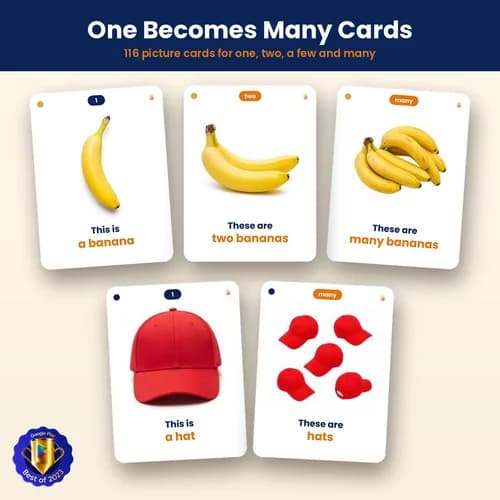
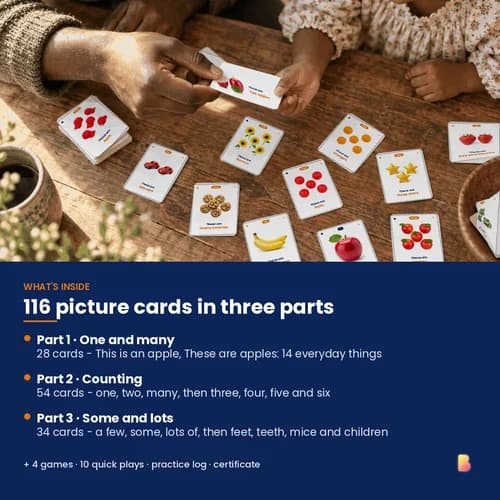
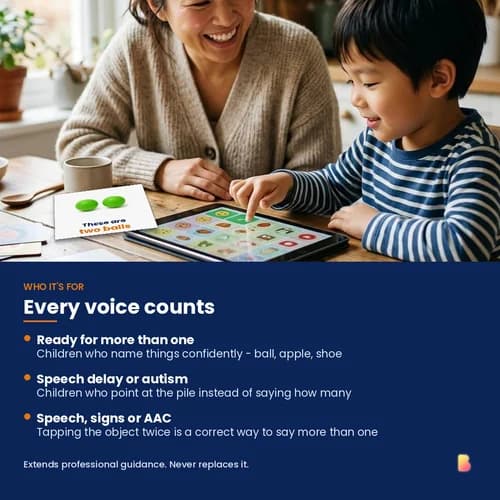
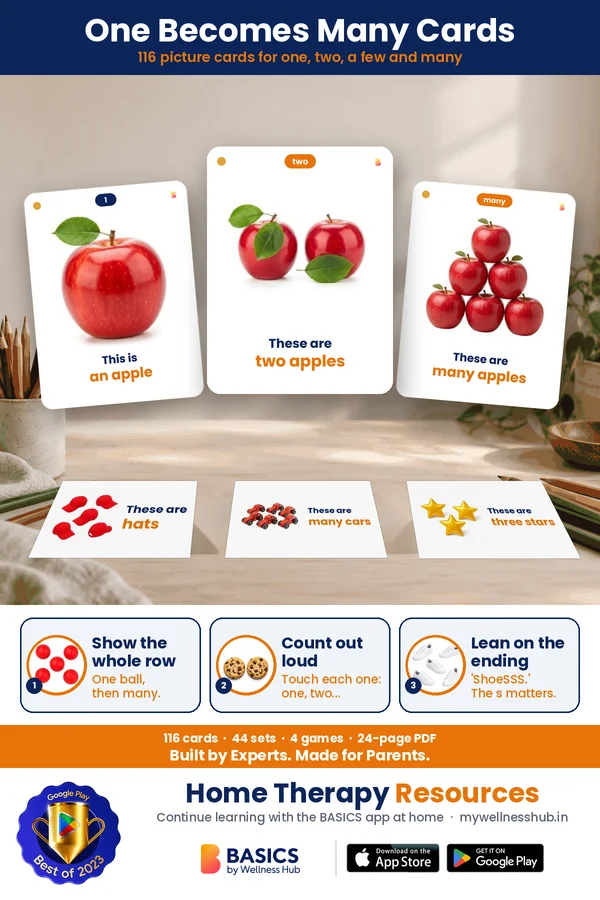
The Plurals and Counting Words Picture Cards PDF is a 24-page digital resource designed for children ready to move beyond naming objects to understanding the difference between one and more than one. With 116 illustrated cards, this set supports learners who are building language skills, including those with speech delay, autism, or who use AAC or sign language. Each card features a clear image, a counting prompt, and a color-coded sentence to highlight changes in number and word endings, making plurals and quantity concepts easy to grasp.
Children practice regular plural -s endings, as well as using phrases like this is, these are, and there are, through engaging activities. The resource also covers number words from two to six, descriptive phrases such as many, a few, some, and lots of, and introduces irregular plural forms like leaves and children. Learners gain measurable skills in sentence building, counting, and understanding the rules of plurals in everyday language.
Perfect for home, classroom, or therapy sessions, these cards support interactive learning and communication. The resource is ideal for speech therapy, inclusive education, and small group work, encouraging children to use counting words in real-life contexts. Flexible enough for individual practice or group games, it helps children generalize new language skills across settings.
Product Details
- Resource Name: Plurals and Counting Words Picture Cards PDF
- Format: Printable and screen-ready PDF
- Total Pages: 24
- Grade Level: Pre-K, Kindergarten, Early Elementary
- Designed For: Children with emerging language, speech delay, autism, AAC users, and sign language learners
- Printing Notes: Print single-sided; cards can be laminated for durability
- Best Used In: Home, classroom, speech therapy, special education
- Sets / Flashcards / Activities: 116 picture cards, 44 sets, 4 games, 10 play ideas
- Visuals / Illustrations: High-quality, child-friendly images with color-coded sentence prompts
Educational Benefits
1. Plural Recognition and Usage
- Children learn to distinguish between singular and plural forms in context.
- Practice with regular and irregular plurals builds flexible language skills.
- The primary_keyword supports confident use of words like leaves, children, and mice.
2. Sentence Structure and Grammar
- Learners build complete sentences using visual prompts and color-coded cues.
- Exposure to phrases like this is and these are enhances understanding of subject-verb agreement.
- Children gain confidence forming sentences for both one and many objects.
3. Counting and Quantity Concepts
- Students practice number words from two to six in real-life scenarios.
- Cards encourage counting aloud and matching numbers to objects.
- Understanding terms like many, a few, and lots of supports math readiness.
4. Visual Discrimination and Matching
- Children match cards in a row, comparing one, two, and many objects.
- Visual cues help learners notice differences in quantity and word endings.
- This strengthens attention to detail and supports early literacy.
5. AAC and Inclusive Communication
- The resource offers full AAC parity for diverse learners.
- Children using speech, sign, or devices can participate equally in activities.
- Supports communication growth for those with speech delay or autism.
Instructions for Use
Step 1: Print and Prepare the Cards
- Print the PDF single-sided on sturdy paper for best results.
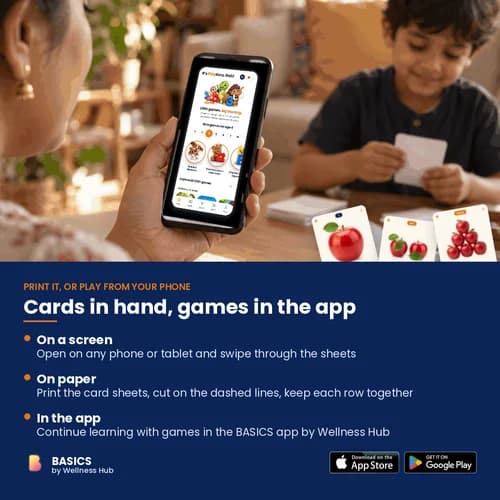
- Cut out each picture card along the lines for individual use.
- Laminate the cards for durability and repeated handling.
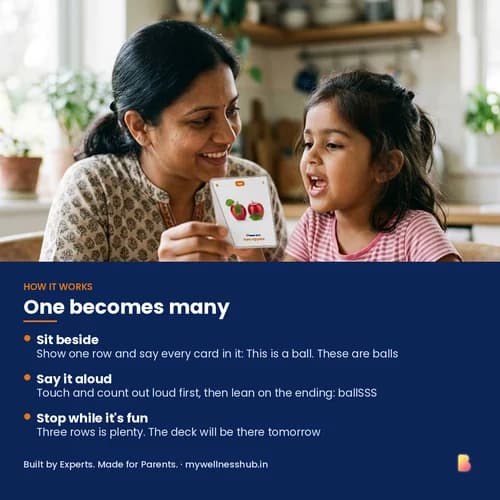
Step 2: Introduce Plural Concepts with a Row
- Lay out a row from a set: one, two, and many objects side by side.
- Point to each card and say the sentence aloud, emphasizing plural endings.
- Encourage the child to repeat and notice the change from one to many.
Step 3: Practice Counting and Number Words
- Select sets that use number words, such as two or five.
- Count the objects together, matching the spoken number to the picture.
- Highlight the lsi_terms[0] skill by focusing on correct number word usage.
Step 4: Play Interactive Games for Engagement
- Choose from the included games like Find the Partner or How Many Now?
- Mix and match cards for sorting, matching, or memory activities.
- Incorporate the lsi_terms[2] skill to reinforce sentence building in play.
Step 5: Support AAC and Sign Language Users
- Model each sentence using speech, signs, or AAC devices as appropriate.
- Encourage children to use their preferred communication method for each card.
- Provide visual and verbal cues to support understanding.
Step 6: Track Progress and Encourage Carryover
- Use the practice log and Certificate of Counting Power to celebrate success.
- Revisit cards daily with the say-it-all-day page for ongoing practice.
- Praise effort and progress to motivate continued learning.
Activities Using the Resource
1. Plural Picture Card Sorting Game
Objective: To build recognition of singular and plural forms using plurals and counting words picture cards.
How to Play:
- Lay out mixed cards from several sets (e.g., apple, apples, two apples).
- Ask the child to sort cards into "one" and "more than one" piles.
- Read each card aloud, emphasizing the plural -s or irregular ending.
Skill Development:
- Distinguishes between singular and plural forms.
- Improves visual discrimination of word endings.
- Strengthens auditory attention to language cues.
2. Counting Words Matching Activity
Objective: To match number words to quantities and reinforce correct usage of plurals and counting words picture cards.
How to Play:
- Select cards showing different quantities (e.g., two balls, five flowers).
- Give the child number word cards to match with each picture card.
- Count the objects together, saying the number and object aloud.
Skill Development:
- Connects number words to visual quantities.
- Practices counting and number identification.
- Builds understanding of quantity vocabulary.
3. Sentence Building with Visual Prompts
Objective: To construct complete sentences using visual cues and regular plural -s endings.
How to Play:
- Choose a set (e.g., shoe/shoes).
- Show the picture and prompt the child to say or sign the sentence shown.
- Encourage use of color-coded cues to highlight changes in the sentence.
Skill Development:
- Forms grammatically correct sentences.
- Increases awareness of plural endings.
- Enhances expressive language skills.
4. Irregular Plural Matching Challenge
Objective: To identify and use irregular plural forms in context.
How to Play:
- Select cards with irregular plurals (e.g., leaf/leaves, child/children).
- Ask the child to find the matching pairs and say both forms.
- Discuss how the word changes from one to many.
Skill Development:
- Recognizes irregular plural patterns.
- Expands vocabulary beyond regular -s endings.
- Sharpens memory for language exceptions.
5. Describing Quantity with Many, Few, and Lots
Objective: To use descriptive quantity words in sentences about objects.
How to Play:
- Present cards labeled with "many," "a few," or "lots of."
- Have the child describe each card using the correct phrase.
- Compare cards to discuss differences in quantity.
Skill Development:
- Uses descriptive quantity terms accurately.
- Develops comparative language.
- Supports early math vocabulary.
6. AAC and Sign Language Sentence Practice
Objective: To encourage inclusive communication using plurals and counting words picture cards.
How to Play:
- Show a card and model the sentence using speech, AAC device, or sign.
- Invite the child to repeat or select the sentence in their preferred mode.
- Provide feedback and celebrate successful communication.
Skill Development:
- Promotes AAC and sign language use.
- Builds confidence in alternative communication.
- Fosters participation for diverse learners.
Frequently Asked Questions
Q1: What age group is the Plurals and Counting Words Picture Cards PDF designed for?
A1: This resource is best for children in Pre-K, Kindergarten, and early elementary grades (ages 4–8). The visual supports and simple sentences suit both emerging speakers and early readers. It is especially helpful for children ready to move from naming objects to understanding plurals and quantity words.
Q2: Can I use these cards with small groups or in a classroom setting?
A2: Yes, these cards are ideal for small group instruction and classroom activities. The sets support interactive games, peer modeling, and group counting practice. Try using them for sorting, matching, or group sentence-building games to maximize engagement.
Q3: Are these picture cards suitable for speech therapy sessions?
A3: Absolutely, these cards are designed to support speech therapy goals, including plural recognition and counting word usage. The clear visuals and color-coded sentences help children with speech delay or autism practice target skills. Therapists can use them for structured drills or open-ended language activities.
Q4: What is the best way to print and prepare the cards for repeated use?
A4: Print single-sided on sturdy paper and laminate each card for durability. Laminated cards withstand frequent handling in home, classroom, or therapy settings. Cut along the lines before use and store in labeled envelopes or boxes for easy access.
Q5: How does this resource support children with special needs or those using AAC?
A5: The cards offer full AAC parity, making them accessible for children who use speech, sign language, or communication devices. Visual cues and simple sentence structures support a wide range of learners, including those with autism or language delays. Encourage children to use their preferred communication method during activities for best results.
Q6: Can the Plurals and Counting Words Picture Cards PDF be used on a tablet or computer without printing?
A6: Yes, the PDF is screen-ready and can be displayed on tablets, computers, or interactive whiteboards. Children can point, count, and practice sentences digitally, which is helpful for teletherapy or remote learning. Use annotation tools to highlight endings or number words during digital sessions.
Q7: What specific skills and learning goals do these cards target?
A7: This resource builds plural recognition, counting skills, and correct use of phrases like "these are" and "there are." Children practice regular and irregular plural endings, number words, and descriptive quantity terms. The cards also support sentence expansion and early literacy development.
Q8: What are the licensing and usage rights for this PDF resource?
A8: Purchase grants a single-user license for personal, classroom, or therapy use. Redistribution or commercial sharing is not allowed. Contact Wellness Hub for multi-user or institutional licensing options.
Q9: How do I receive and download the Plurals and Counting Words Picture Cards PDF after purchase?
A9: After purchase, you receive an instant download link via email from Wellness Hub. The PDF is ready for immediate use on any device. Check your spam folder if you do not see the email within a few minutes.
Q10: What is Wellness Hub's refund or exchange policy for digital resources?
A10: Wellness Hub does not offer refunds or exchanges on digital PDF resources once downloaded. This policy protects the integrity of digital content. If you experience technical issues, contact customer support for prompt assistance.
Usage Rights and Restrictions
Allowed Usage:
- Personal use by parents, teachers, and therapists.
- Printable for classroom, home, or therapy settings.
- Can be used in group or one-on-one learning sessions.
Not Allowed:
- Reselling, redistributing, or modifying the resource for commercial use.
- Sharing publicly (e.g., on blogs, social media, or websites) without permission.
- Uploading the file to public sharing platforms.
If you need a bulk license for schools or therapy centers, please contact us.
Conclusion
Plurals and Counting Words Picture Cards PDF offers a clear, engaging way for children to master the difference between one and many, supporting those who are ready to move beyond simple naming. Designed for young learners, including those with speech delay, autism, or who use AAC, it builds confidence in using quantity words and plural forms in daily language.
Through repeated practice, children develop strong skills in sentence expansion and descriptive language. The resource encourages the use of number words and color phrases in real-life contexts, making it ideal for home, classroom, or therapy settings. Activities also foster understanding of regular and irregular plural endings, supporting early literacy and communication.
Start your journey with Plurals and Counting Words Picture Cards PDF and help your child gain lasting language skills for school and beyond. Download now to build a foundation in counting, sentence building, and descriptive vocabulary—skills that support success across all learning environments.