

On Topic or Off? Staying With It — 50 Printable Topic Maintenance Reply Cards for Kids
₹80
₹160
You save ₹80
4.9 (40 ratings)
Grade Levels
Grade 1 – Grade 2 (Ages 6–8)
Content Overview
Format: PDF | Pages: 31 | Features: 50 reply cards for staying on topic and building conversation skills
Categories
Share


About the Product
Introduction
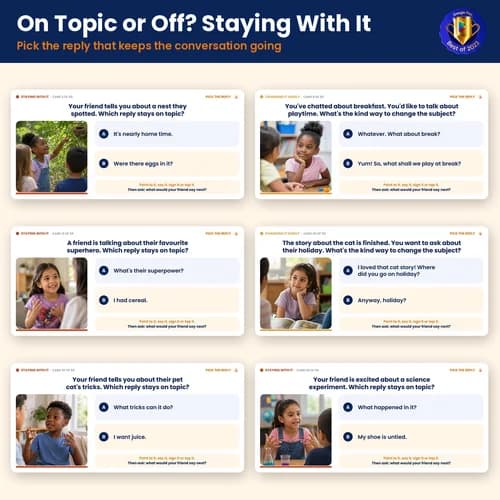
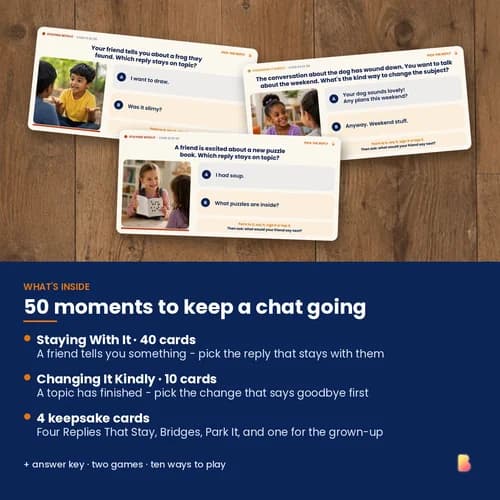
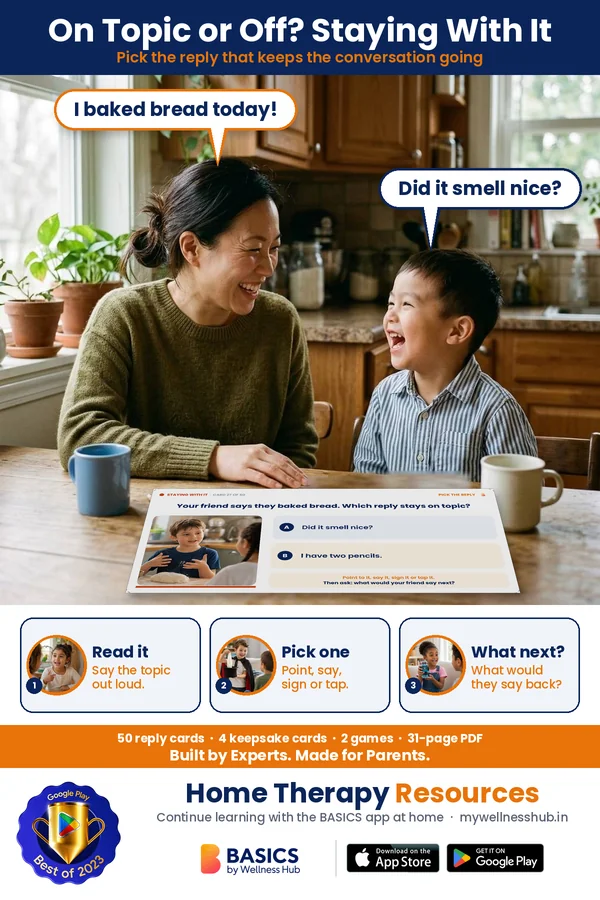
On Topic or Off? Deck 1: Staying With It & Changing It Kindly is a 31-page digital PDF designed for children who find it challenging to stay on topic during conversations. This resource features 50 reply cards, each with a real-life photo and simple dialogue, making it ideal for children using speech, signs, or AAC. The cards help children practice picking replies that connect to what a friend just said, building confidence and understanding in social interactions.
Skills like saying wow, holding a thought for later, and changing the subject with a bridge are woven into every activity. Children learn to name the topic, ask more, say it back, and use gentle transitions like "speaking of" or "that reminds me." The clear answer key supports measurable progress, showing what the friend would have heard and guiding children to recognize topic shifts in a supportive way.
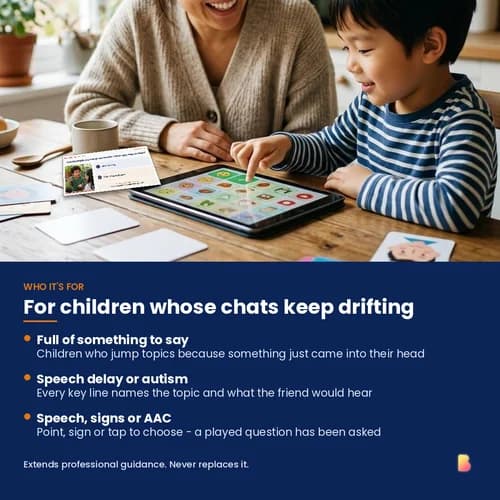
Families, therapists, and teachers can use these cards at home, in classrooms, or during speech sessions to support children who often jump topics, including those with autism or speech delays. The method encourages saying the topic out loud and using visual cues, making it easy to adapt for group games, one-on-one coaching, or everyday practice.
Product Details
- Resource Name: On Topic or Off? Deck 1: Staying With It & Changing It Kindly
- Format: Printable and screen-ready PDF
- Total Pages: 31
- Grade Level: Elementary (ages 5+)
- Designed For: Children with speech delay, autism, or those using AAC/signs
- Printing Notes: Three cards per sheet; color-coded decks; suitable for print or digital use
- Best Used In: Home, classroom, speech therapy
- Sets / Flashcards / Activities: 50 reply cards, 4 keepsake cards, 2 games, practice log, certificate
- Visuals / Illustrations: Real-life photos on every card
Educational Benefits
1. Conversation Topic Awareness
- Teaches children to recognize and name the current topic in conversation.
- Helps them focus on what a friend just said before replying.
- Supports understanding of how conversations flow and connect.
2. Social Communication Skills
- Builds confidence in responding with relevant comments or questions.
- Encourages children to ask more, say it back, or express interest with phrases like "wow."
- Promotes natural turn-taking and active listening in real-life chats.
3. Flexible Thinking and Transitions
- Guides children to use bridges when changing topics, such as "speaking of" or "by the way."
- Supports holding a thought for later, reducing impulsive topic shifts.
- Fosters smoother transitions that keep conversations friendly and connected.
4. AAC and Sign Language Inclusion
- Ensures full participation for children using AAC devices or sign language.
- Validates pointed, signed, or tapped replies as complete answers.
- Makes the primary_keyword accessible for all communication styles.
5. Gentle Self-Monitoring Strategies
- Introduces four supportive tricks for recognizing and managing off-topic bursts.
- Encourages children to notice topic shifts without calling them rude.
- Reinforces positive habits with visual cues, practice logs, and a certificate of progress.
Instructions for Use
Step 1: Print or Open the PDF
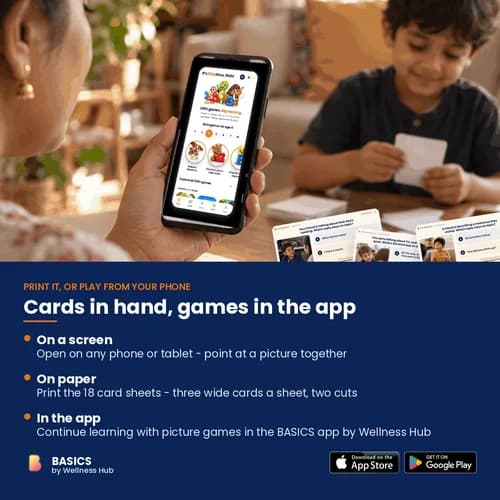
- Print the cards on sturdy paper or open the file on a tablet or computer.
- Cut out the cards if using printed copies for hands-on play.
- Laminating cards increases durability for repeated use.
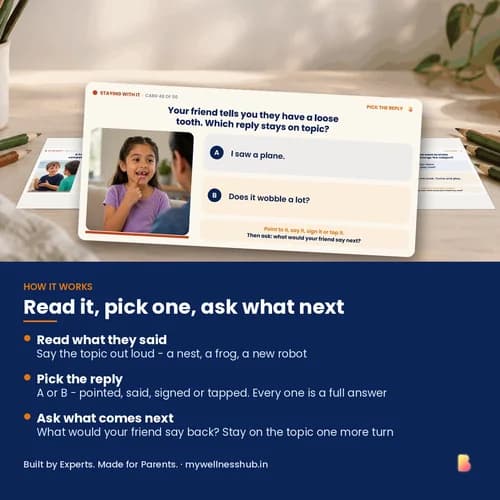
Step 2: Introduce the Deck and Sample Card
- Show the labelled sample card to explain how each card works.
- Read the friend's statement and both reply choices aloud.
- Highlight the staying with it skill as you model a round.
Step 3: Name the Topic Out Loud
- Ask the child to say or sign the topic after reading what the friend said.
- Encourage them to focus on the main idea before choosing a reply.
- This step supports naming the topic skill development.
Step 4: Pick and Discuss a Reply
- Let the child choose reply A or B for each card.
- Discuss why their choice stays on topic or gently bridges to a new one.
- Use the answer key for guidance and to model flexible thinking.
Step 5: Play Games and Track Progress
- Try included games like Three Turns or Park It For Later for extra practice.
- Use the practice log to record sessions and celebrate successes.
- Mix in keepsake cards for reminders and encouragement.
Step 6: Carry Over to Everyday Moments
- Prompt the child to use these skills in real conversations at home or school.
- Reinforce with praise when they stay on topic or use a bridge.
- Encourage regular practice for lasting social communication growth.
Activities Using the Resource
1. Choosing the On-Topic Reply Game
Objective: To help children identify and select the reply that stays with the primary_keyword in a conversation.
How to Play:
- Present a reply card and read the friend's statement aloud.
- Ask the child to say the topic, then pick the reply that matches it.
- Discuss why their choice fits the conversation using the answer key.
Skill Development:
- Builds topic recognition and naming
- Strengthens reply selection accuracy
- Encourages verbal or AAC participation
2. Naming the Topic Out Loud Practice
Objective: To improve the ability to name the conversation topic before responding.
How to Play:
- Show a card and read the friend's line.
- Prompt the child to state or sign the main topic (e.g., "banana," "mug").
- Have them choose the reply that connects to the topic.
Skill Development:
- Increases topic awareness
- Supports expressive language or AAC use
- Reinforces focus on main ideas
3. Using Bridge Phrases for Topic Change
Objective: To teach children how to change the subject kindly with a connecting phrase.
How to Play:
- Select a Changing It Kindly card from the deck.
- Read both replies and highlight the bridge phrase (like "speaking of").
- Practice saying or signing the bridge before shifting topics.
Skill Development:
- Teaches conversational transitions
- Encourages flexible thinking
- Models polite topic changes
4. Saying Wow and Saying It Back
Objective: To encourage children to respond with interest and reflect the topic in their reply.
How to Play:
- Read a card and focus on the friend's statement.
- Ask the child to pick the reply that says "wow" or repeats the main idea.
- Practice echoing the topic in their own words or AAC device.
Skill Development:
- Builds active listening skills
- Supports social engagement
- Reinforces topic-related responses
5. Holding a Thought for Later Activity
Objective: To help children practice saving their own ideas until the conversation's topic changes.
How to Play:
- During a round, prompt the child to "park" their new idea using a keepsake card.
- Finish the current topic before returning to the saved thought.
- Use the "Park It For Later" card as a visual reminder.
Skill Development:
- Develops impulse control
- Encourages patience in conversation
- Supports memory for later sharing
6. Three Turns Conversation Game
Objective: To practice staying with the primary_keyword for multiple exchanges.
How to Play:
- Start with a card and have the child reply on topic.
- Take turns adding two more related replies, keeping to the same topic.
- Use the answer key to check if all turns stayed on topic.
Skill Development:
- Strengthens conversational stamina
- Builds turn-taking and topic maintenance
- Reinforces multi-step social interaction
Frequently Asked Questions
Q1: What age range is On Topic or Off? Deck 1: Staying With It & Changing It Kindly designed for?
A1: This resource is best for children ages 5 and up, typically in elementary grades. The real-life photos and simple dialogue make it accessible for early learners and older children needing extra support. It adapts well for mixed-age groups and developmental levels.
Q2: Can these reply cards be used in classroom group activities?
A2: Yes, the cards are suitable for small group lessons, social skills groups, and classroom games. Each card's visual cues and clear structure support group participation and discussion. Try team games or round-robin practice to encourage peer modeling and feedback.
Q3: Are these cards appropriate for speech therapy sessions with children who use AAC?
A3: Absolutely, the cards fully support AAC users and children who communicate by signs. Pointed, tapped, or signed replies are recognized as valid answers throughout the activities. Therapists can model both spoken and AAC responses to ensure every child participates.
Q4: What is the best way to print and laminate the reply cards for repeated use?
A4: Print the cards on thick paper or cardstock and laminate before cutting them apart. Laminated cards are durable for frequent handling in therapy, classrooms, or at home. Store by color-coded deck for easy sorting and quick setup.
Q5: How does this resource support children with autism or those who struggle to stay on topic?
A5: The cards use real-life scenarios, visual cues, and a predictable format to help children with autism or topic-jumping tendencies. Gentle prompts and the answer key guide children to recognize and practice staying with the conversation. You can scaffold by naming the topic out loud and using keepsake cards as reminders.
Q6: Can I use this PDF on a tablet or computer without printing?
A6: Yes, the PDF is screen-ready and works well on tablets, computers, or interactive whiteboards. Children can point, tap, or verbally select replies directly from the screen. This flexibility makes it ideal for teletherapy and digital classrooms.
Q7: What specific social communication skills will children practice with these cards?
A7: Children will practice naming the topic, asking more, saying it back, responding with "wow," holding a thought for later, and changing the subject with a bridge. The resource targets topic maintenance and flexible thinking in real conversations. Progress is supported by a practice log, answer key, and certificate.
Q8: What are the licensing and usage rights for On Topic or Off? Deck 1: Staying With It & Changing It Kindly?
A8: Your purchase allows you to use the PDF with your own children, students, or therapy clients. Sharing or distributing the file beyond your direct care group is not permitted. For school-wide or clinic-wide use, please contact Wellness Hub for extended licensing options.
Q9: How do I receive and download my digital PDF after purchase?
A9: After purchase, you will receive an instant download link via email from Wellness Hub. The link provides access to the full 31-page PDF for immediate use. Save the file to your device for future access and printing.
Q10: What is Wellness Hub's refund or exchange policy for digital resources?
A10: Due to the digital nature of the resource, refunds and exchanges are generally not available once the PDF has been downloaded. If you experience technical issues or receive the wrong file, Wellness Hub will assist in resolving the problem promptly. Contact customer support for help with any concerns about your order.
Usage Rights and Restrictions
Allowed Usage:
- Personal use by parents, teachers, and therapists.
- Printable for classroom, home, or therapy settings.
- Can be used in group or one-on-one learning sessions.
Not Allowed:
- Reselling, redistributing, or modifying the resource for commercial use.
- Sharing publicly (e.g., on blogs, social media, or websites) without permission.
- Uploading the file to public sharing platforms.
If you need a bulk license for schools or therapy centers, please contact us.
Conclusion
On Topic or Off? Deck 1: Staying With It & Changing It Kindly gives children practical support for building conversation skills and confidence. Designed for those who find it hard to stay with a topic, it empowers users—including AAC communicators and those with autism—to connect replies to what a friend just said in real-life situations.
By practicing flexible thinking and using bridge phrases, children learn how to respond in context at home, in classrooms, or during therapy. The resource encourages staying with the conversation, finishing topics kindly, and developing social awareness in a gentle, supportive way.
Bring meaningful conversation practice into your daily routine—download On Topic or Off? Deck 1: Staying With It & Changing It Kindly and help your child master staying with the topic and making smooth transitions in every chat.