


My First Conversation Cards — 10 Printable Picture Cards and 100 Questions to Get Children Talking
₹80
₹160
You save ₹80
4.8 (35 ratings)
Grade Levels
Pre-K – Kindergarten (Ages 4–7)
Content Overview
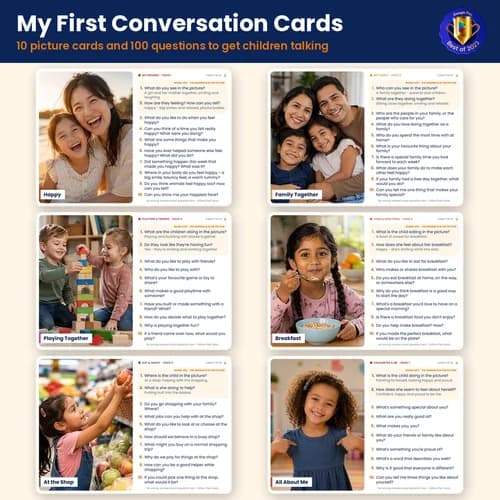
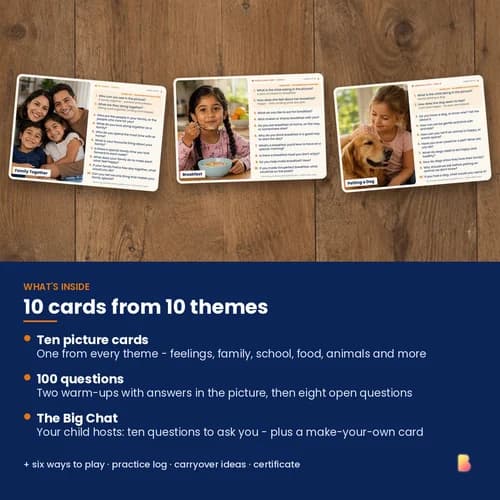
Format: PDF | Pages: 14 | Features: 10 picture cards, 100 questions, builds conversation and turn-taking skills
Categories
Share


About the Product
Introduction
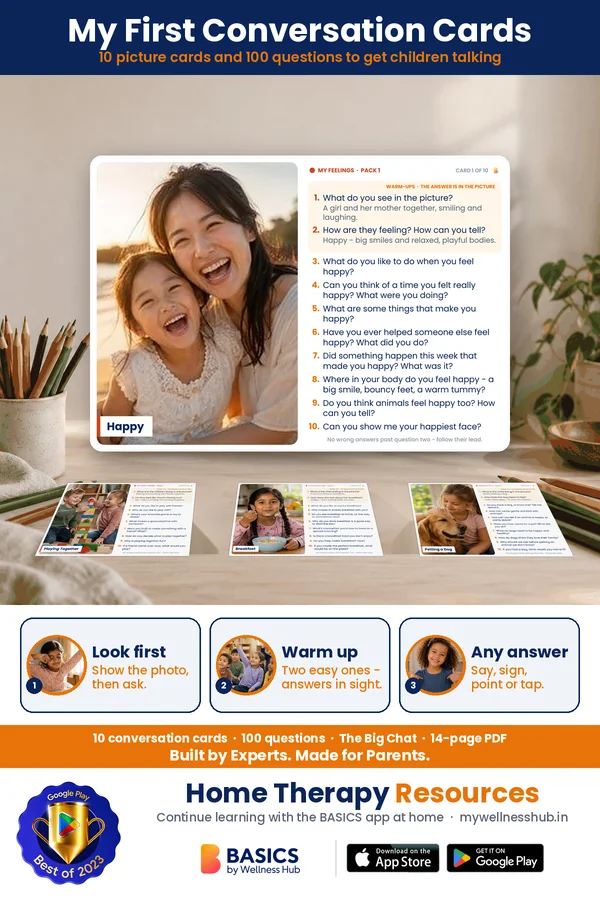
The Conversation Cards Sampler PDF offers a unique way for children to practice real back-and-forth conversation using engaging picture prompts. Designed for kids who are ready to move beyond simple answers, this digital resource features 10 themed cards and 100 questions, perfect for children with speech delay, autism, or those using signs or AAC. Each card uses a large, clear photograph and carefully crafted questions to support confidence and success in early conversations.
Children build skills in answering open questions, talking about feelings, and expanding answers past one word. The cards encourage conversation and turn-taking, helping kids talk about family, routines, friends, school, food, animals, outings, and manners. With every session, children gain practice in sharing their thoughts, listening to others, and asking questions back, all in a supportive and flexible format.
Families, teachers, and therapists can use these cards at home, in classrooms, or during speech sessions to encourage talking about outings and manners. The cards fit easily into everyday routines, making it simple to build communication skills during breakfast, playtime, or shopping trips. The resource includes gentle guidance for adults, ensuring every chat feels like a friendly invitation, not a test.
Product Details
- Resource Name: Conversation Cards Sampler PDF
- Format: Printable and screen-ready PDF
- Total Pages: 14
- Grade Level: Pre-K, Kindergarten, Early Elementary
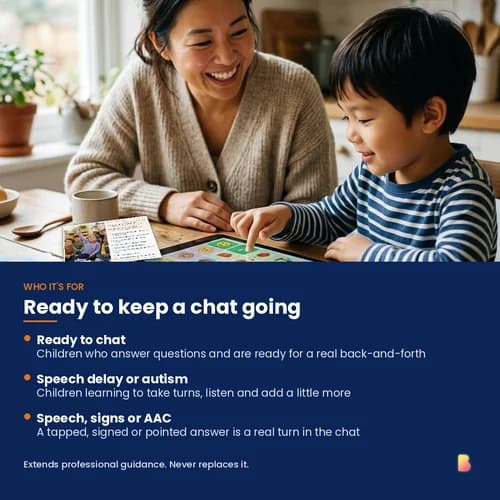
- Designed For: Children ready for conversational turn-taking, including those with speech delay, autism, or AAC users
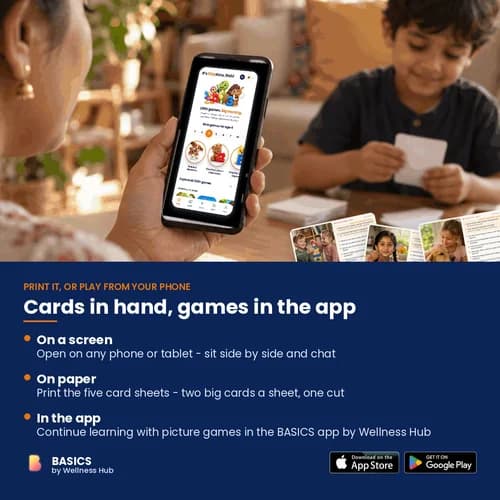
- Printing Notes: Print, cut, and keep; five sheets of two cards each
- Best Used In: Home, classroom, speech therapy, and everyday routines
- Sets / Flashcards / Activities: 10 picture conversation cards, 100 questions, sample card, make-your-own card, practice log, certificate
- Visuals / Illustrations: Large, real-life photographs on each card
Educational Benefits
1. Builds Conversation and Turn-Taking Skills
- Children practice taking turns while speaking and listening to others.
- They learn to wait, respond, and share the conversation space.
- These skills help foster positive peer and adult interactions.
2. Expands Answer Length and Expression
- Kids move beyond one-word replies by describing feelings, experiences, and ideas.
- Open-ended questions encourage full sentences and richer details.
- The primary_keyword supports growth in expressive language skills.
3. Encourages Social Communication About Everyday Life
- Cards prompt discussions about family, routines, school, and outings.
- Children connect personal experiences to real-world topics.
- This builds confidence in sharing stories and opinions.
4. Supports Inclusion for AAC and Sign Users
- Every child's response—spoken, signed, or pointed—is valued as a real turn.
- The cards are accessible for children with speech delay or autism.
- All children can participate fully in conversation activities.
5. Promotes Asking Questions and Active Listening
- Children learn to ask questions back and listen to others' answers.
- Turn-taking routines help develop attentive listening habits.
- This strengthens foundational skills for group discussions.
Instructions for Use
Step 1: Print and Prepare the Cards
- Print the PDF on sturdy paper for repeated use.
- Cut along the lines to separate the ten picture conversation cards.
- Laminate for extra durability if desired.
Step 2: Introduce the Conversation Routine
- Show one card and explain the idea of taking turns in conversation.
- Model conversation and turn-taking for the child to observe.
- Use conversation and turn-taking as a natural skill reference.
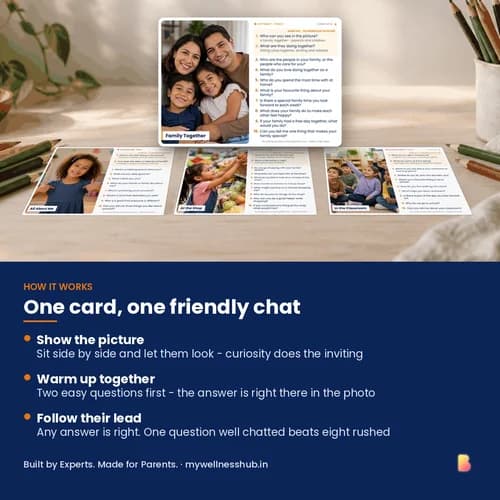
Step 3: Warm Up with Picture-Based Questions
- Begin each session with the two warm-up questions printed on the card.
- Let the child find answers in the picture for early success.
- Encourage them to point, sign, or say their responses.
Step 4: Move to Open Questions and Sharing
- Ask the eight open questions on the card, one at a time.
- Support the child in expanding answers beyond one word.
- Answer one yourself first to model longer responses.
Step 5: Encourage Asking Questions Back
- Invite the child to ask you a question from the card or about the topic.
- Use the Big Chat page to practice asking questions back.
- Celebrate every attempt at back-and-forth conversation.
Step 6: Track Progress and Carry Over to Daily Life
- Use the practice log to note sessions and growth.
- Try "Talk Pile" ideas to fit chats into routines like breakfast or outings.
- Revisit favorite cards often to reinforce skills and confidence.
Activities Using the Resource
1. Picture Conversation Card Turn-Taking
Objective: To build conversation and turn-taking skills using the Conversation Cards Sampler PDF.
How to Play:
- Choose one card and show the large photograph to the child.
- Take turns answering the two warm-up questions using clues from the picture.
- Alternate asking and answering open questions, encouraging sharing and listening.
Skill Development:
- Strengthens conversational turn-taking and patience.
- Improves attention to visual and spoken cues.
- Encourages reciprocal communication.
2. Open Question Answer Expansion
Objective: To help children expand answers beyond one word using real-life topics.
How to Play:
- Select a card with a relatable theme (e.g., breakfast, family together).
- Ask an open-ended question and model a full-sentence answer.
- Prompt the child to add more details to their own response.
Skill Development:
- Develops expressive language and sentence structure.
- Encourages elaboration and descriptive speech.
- Supports confidence in sharing ideas.
3. Feelings and Family Discussion Game
Objective: To practice talking about feelings and family routines in a supportive setting.
How to Play:
- Pick a card featuring a family or emotion-based scene.
- Ask questions about the child's own family or feelings related to the picture.
- Use signs, speech, or AAC to share answers and relate experiences.
Skill Development:
- Builds emotional vocabulary and self-awareness.
- Connects personal experiences to conversation.
- Fosters empathy and understanding.
4. Everyday Routine Role Play
Objective: To reinforce conversation about daily routines and habits.
How to Play:
- Choose a card showing a daily activity (e.g., waking up, playing together).
- Act out the routine together, narrating each step and discussing what happens next.
- Take turns asking and answering questions about the routine.
Skill Development:
- Enhances sequencing and narrative skills.
- Promotes functional communication about routines.
- Supports memory and recall of daily events.
5. Asking Questions Back Practice
Objective: To encourage children to initiate questions and sustain back-and-forth exchanges.
How to Play:
- After answering a question, prompt the child to ask a related question in return.
- Use the Big Chat page for extra practice in asking questions back.
- Celebrate every successful question asked by the child.
Skill Development:
- Increases confidence in initiating conversation.
- Strengthens question formulation skills.
- Reinforces active listening and engagement.
6. Conversation Card Memory and Matching
Objective: To improve attention and recall using conversation and turn-taking.
How to Play:
- Lay out several cards face down.
- Take turns flipping a card, describing the picture, and answering a warm-up question.
- Try to remember which themes have already been discussed and match pairs.
Skill Development:
- Boosts working memory and attention span.
- Encourages theme recognition and categorization.
- Practices sustained conversation and topic recall.
Frequently Asked Questions
Q1: What age range is the Conversation Cards Sampler PDF best for?
A1: The Conversation Cards Sampler PDF is designed for children in Pre-K, Kindergarten, and early elementary grades, typically ages 4–8. The questions and photographs are developmentally appropriate for this range and support early conversational skills. Older children with speech delay or autism may also benefit from the resource's structure and visual support.
Q2: Can these cards be used in a classroom group activity?
A2: Yes, the cards work well for small group or whole-class discussions. Teachers can display a card, ask warm-up questions, and encourage students to take turns answering and asking questions back. This promotes conversation and turn-taking in a supportive, interactive setting.
Q3: Are these conversation cards suitable for speech therapy sessions?
A3: Absolutely, these cards are ideal for speech therapy, especially for children working on conversation and turn-taking. Therapists can use the cards to practice answering open questions, expanding responses, and discussing real-life themes. The cards support a range of communication methods, including signs and AAC.
Q4: What is the best way to print and prepare the cards for repeated use?
A4: Print the cards on sturdy paper or cardstock and laminate them for durability. Cut along the lines to separate each card, and store them in a folder or pouch for easy access. Laminated cards are easy to wipe clean and can be used in various settings, including classrooms and therapy rooms.
Q5: How does this resource support children with special needs or those who use AAC?
A5: The cards are fully accessible for children with speech delay, autism, or those using AAC or signs. Every response—spoken, signed, or pointed—is valued as a real conversational turn, supporting inclusion and confidence. Adults are encouraged to model, wait, and accept all forms of communication equally.
Q6: Can the cards be used on a tablet or computer without printing?
A6: Yes, the PDF is screen-ready and can be displayed on tablets, computers, or interactive whiteboards. Children can point to answers or use AAC devices during digital sessions. This flexibility makes the resource suitable for teletherapy and blended learning environments.
Q7: What conversation and turn-taking skills will children develop using these cards?
A7: Children will practice answering open questions, expanding their responses, and taking conversational turns. The cards help develop listening, sharing, and asking questions back, which are essential for real-world communication. Skills include talking about feelings, routines, family, school, food, animals, outings, and manners.
Q8: What are the usage rights for the Conversation Cards Sampler PDF?
A8: Purchase includes a single-user license for one household, classroom, or therapy caseload. You may print and use the cards as often as needed for your direct work with children. Sharing, reselling, or uploading the PDF to public sites is not permitted.
Q9: How do I receive and download the Conversation Cards Sampler PDF after purchase?
A9: After completing your purchase, you will receive an instant download link via email. The PDF file can be saved to your computer or device for immediate use. If you have trouble accessing your file, Wellness Hub's support team can assist promptly.
Q10: What is Wellness Hub's refund or exchange policy for digital resources?
A10: Wellness Hub does not offer refunds or exchanges on digital PDF resources once downloaded. This policy ensures the integrity of digital content and licensing. If you encounter a technical issue or receive the wrong file, contact support for a prompt resolution.
Usage Rights and Restrictions
Allowed Usage:
- Personal use by parents, teachers, and therapists.
- Printable for classroom, home, or therapy settings.
- Can be used in group or one-on-one learning sessions.
Not Allowed:
- Reselling, redistributing, or modifying the resource for commercial use.
- Sharing publicly (e.g., on blogs, social media, or websites) without permission.
- Uploading the file to public sharing platforms.
If you need a bulk license for schools or therapy centers, please contact us.
Conclusion
The Conversation Cards Sampler PDF gives children a supportive way to practice real conversation and turn-taking with engaging photographs and open questions. Designed for kids ready to share more, it helps families, teachers, and therapists encourage meaningful back-and-forth, whether a child speaks, signs, or uses AAC. Every session builds confidence and real-world communication skills in a friendly, flexible format.
Children develop expressive language and active listening as they answer open questions and talk about feelings in everyday settings. The cards support progress in conversation and turn-taking at home, in classrooms, and during therapy, with special attention to inclusion for children who use AAC.
Start using the Conversation Cards Sampler PDF today and help your child grow in conversation and turn-taking, building skills that last a lifetime.