

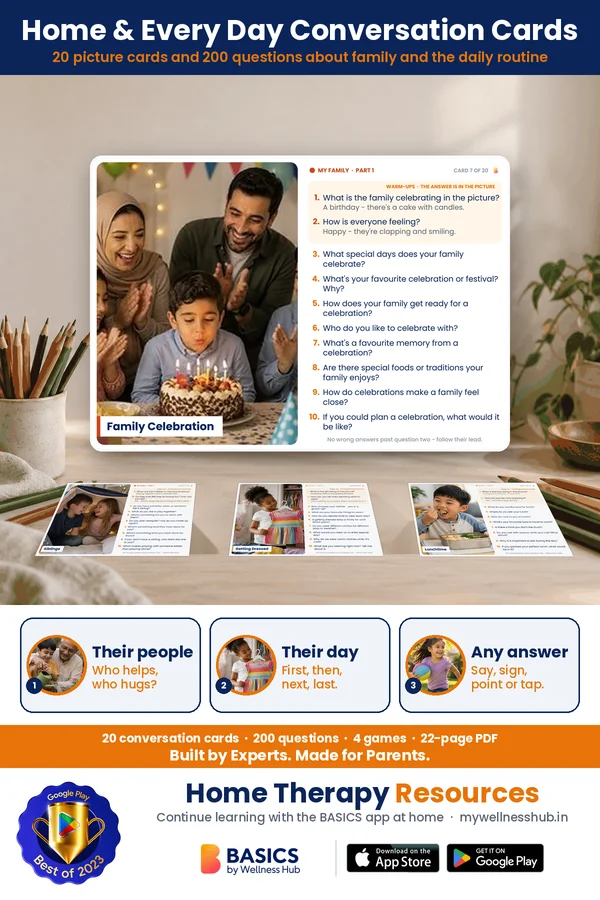
Home & Every Day Conversation Cards — 20 Printable Picture Cards and 200 Questions about Family and Daily Routine
₹80
₹160
You save ₹80
5 (44 ratings)
Grade Levels
Pre-K – Kindergarten (Ages 4–8)
Content Overview
Format: PDF | Pages: 22 | Features: 20 picture cards, 200 questions, conversation and turn-taking practice
Categories
Share


About the Product
Introduction
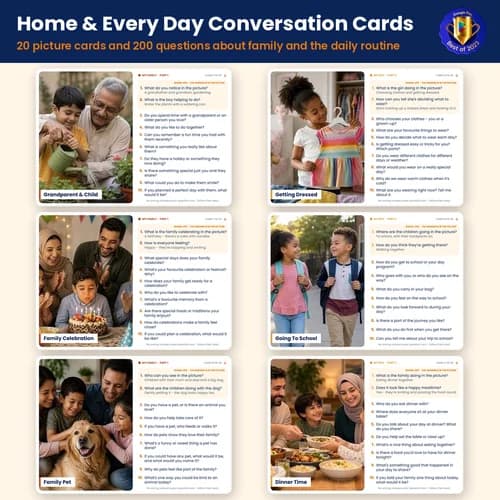
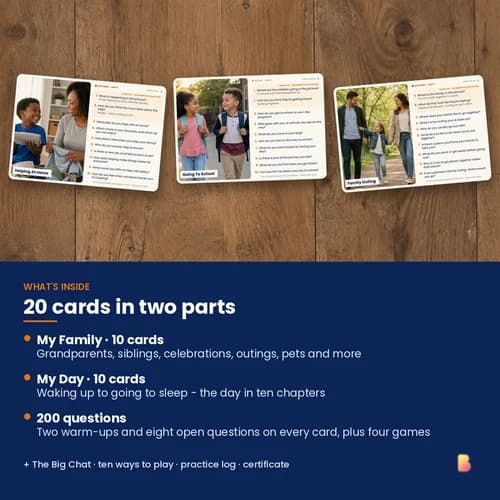
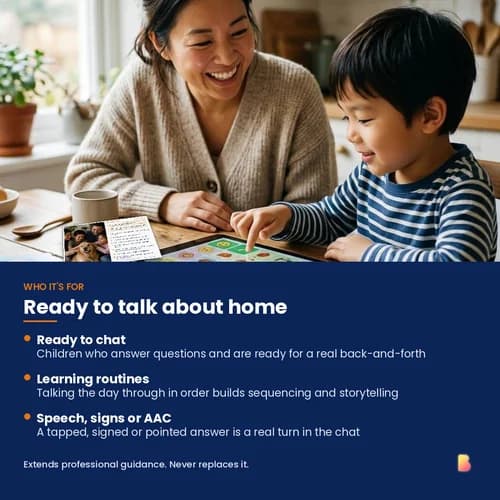
The My Family & My Day Conversation Cards PDF is a 22-page digital resource designed for children ready to engage in real conversations about their home life. This set features 20 large, photo-based cards and 200 thoughtful questions, perfect for kids who answer questions, use signs or AAC, or need extra support for speech and language. Families, teachers, and therapists can use these cards to spark meaningful discussions and build confidence in everyday communication.
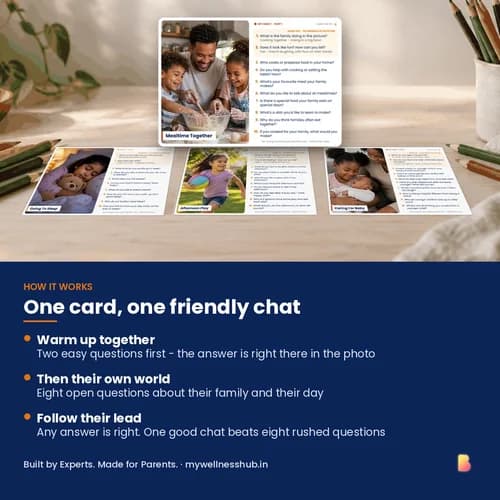
Children practice describing daily routines and sequencing (first, then, next, last) as they explore each card. The warm-up questions help kids find answers in the pictures, while open-ended prompts encourage longer answers, storytelling, and perspective-taking. These cards support skills like turn-taking, talking about family members, and expanding responses beyond one word.
Parents, educators, and therapists will find these cards useful in a variety of settings, including home routines, classroom circle time, and speech therapy sessions. Sequencing activities make it easy to lay out a timeline of the day, while family-focused cards invite children to share about siblings, grandparents, and special moments. The cards adapt to many communication styles, making every child's voice heard.
Product Details
- Resource Name: My Family & My Day Conversation Cards PDF
- Format: Printable and screen-ready PDF
- Total Pages: 22
- Grade Level: Pre-K, Kindergarten, Early Elementary
- Designed For: Children developing conversation skills, including those with speech delay, autism, or AAC users
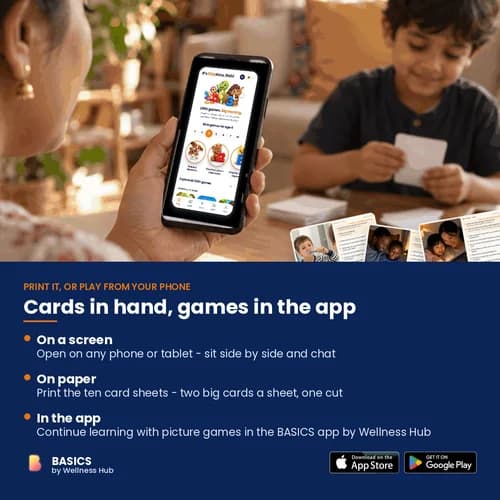
- Printing Notes: Print, cut, and keep; two cards per sheet
- Best Used In: Home, classroom, speech therapy, special education
- Sets / Flashcards / Activities: 20 picture conversation cards, 200 questions, 4 games, timeline activity
- Visuals / Illustrations: Large real-life photographs on every card
Educational Benefits
1. Conversation and Turn-Taking Practice
- Builds confidence in back-and-forth exchanges with peers and adults.
- Encourages children to listen, respond, and wait for their turn.
- Supports the development of real conversational flow in natural settings.
2. Sequencing and Daily Routine Understanding
- Helps children organize events using first, then, next, and last.
- Reinforces understanding of daily routines through visual timelines.
- Promotes logical thinking as children describe and order their day.
3. Describing Family and Familiar People
- Invites children to talk about siblings, grandparents, and other family members.
- Fosters connections by sharing personal stories and experiences.
- Expands vocabulary related to family life and relationships.
4. Open-Ended Question Answering Skills
- Encourages children to answer beyond yes/no or one-word responses.
- Promotes expressive language and early storytelling abilities.
- Supports the use of AAC, signs, or speech for all responses.
5. Perspective-Taking and Social Communication
- The primary_keyword, My Family & My Day Conversation Cards PDF, supports children in understanding others' feelings and viewpoints.
- Promotes empathy and flexible thinking during discussions.
- Aids children in using language for both sharing and listening.
Instructions for Use
Step 1: Print and Prepare the Cards
- Print the PDF on sturdy paper for repeated use.
- Cut along the lines to separate the 20 conversation cards.
- Laminate for durability if desired.
Step 2: Introduce Conversation and Turn-Taking
- Show one card and model a turn by answering a warm-up question yourself.
- Invite the child to take their turn, using conversation and turn-taking as a guide.
- Pause and count to five to give thinking time.
Step 3: Explore Sequencing with My Day Cards
- Lay out the My Day cards in order to create a daily timeline.
- Encourage the child to describe each routine using sequencing terms.
- Ask them to place cards in first, next, then, last order.
Step 4: Encourage Describing Family Members
- Select a My Family card and prompt the child to talk about familiar people.
- Use open-ended questions to invite stories about siblings or grandparents.
- Match cards to real family moments for deeper engagement.
Step 5: Support Open-Ended Question Practice
- Read the open questions on each card and encourage expanded answers.
- Model how to answer with more than one word for practice.
- Use AAC, signs, or speech to accept any form of response.
Step 6: Play Conversation Games and Track Progress
- Choose from included games like Pass & Ask or Story Chain for variety.
- Use the practice log to note progress and celebrate successes.
- End with the Certificate of Real Conversations to motivate continued use.
Activities Using the Resource
1. Picture Card Warm-Up Question Game
Objective: To build confidence in using the My Family & My Day Conversation Cards PDF for answering picture-based questions.
How to Play:
- Show a card and read the two warm-up questions printed on it.
- Encourage the child to point, sign, or say the answers found in the photo.
- Celebrate each correct answer and take turns asking and answering.
Skill Development:
- Strengthens observation and listening skills.
- Encourages turn-taking and participation.
- Builds confidence in responding to visual cues.
2. Sequencing Daily Routine Timeline
Objective: To practice sequencing daily events using visual supports.
How to Play:
- Lay out the My Day cards in order: waking up, brushing teeth, and so on.
- Ask the child to arrange the cards using terms like first, next, then, last.
- Have them describe each step aloud or with AAC as they build the timeline.
Skill Development:
- Develops sequencing and logical thinking.
- Increases understanding of daily routines.
- Supports expressive language with visual aids.
3. Family Member Story Sharing Activity
Objective: To encourage children to describe family members and share personal stories.
How to Play:
- Select a My Family card (e.g., siblings, grandparents, family pet).
- Ask open-ended questions about the child's own family experiences.
- Prompt the child to expand on answers using details or examples.
Skill Development:
- Expands vocabulary about family and relationships.
- Fosters storytelling and descriptive language.
- Builds connections between personal experience and conversation.
4. Open Question Conversation Practice
Objective: To help children answer open-ended questions and expand responses.
How to Play:
- Read the eight open questions on a selected card.
- Model answering with more than one word, then invite the child to try.
- Encourage use of AAC, signs, or speech for all answers.
Skill Development:
- Promotes expressive language development.
- Encourages multi-word and detailed responses.
- Supports flexible communication methods.
5. Turn-Taking and Conversation Game
Objective: To reinforce conversation and turn-taking skills in a playful setting.
How to Play:
- Play a game like Pass & Ask or The Hot Seat using the cards.
- Each player answers a question, then asks one back to another player.
- Use a visual cue or timer to signal whose turn it is.
Skill Development:
- Builds conversational turn-taking.
- Improves question-asking and listening.
- Enhances social interaction in group settings.
6. Real-Life Matching and Carryover Activity
Objective: To connect card scenarios with real-life routines and encourage generalization.
How to Play:
- Match a card to a real moment in the child's day (e.g., mealtime, bedtime story).
- Use the card's questions to spark discussion during the actual activity.
- Reinforce answers with praise and relate them to everyday experiences.
Skill Development:
- Promotes generalization of conversation skills.
- Strengthens real-world communication.
- Encourages self-awareness and reflection on daily life.
Frequently Asked Questions
Q1: What age range is the My Family & My Day Conversation Cards PDF designed for?
A1: The My Family & My Day Conversation Cards PDF is best for children ages 4–8, including Pre-K, kindergarten, and early elementary. The real-life photos and question structure are developmentally appropriate for early conversational skills. Older children with speech or social communication needs may also benefit from the resource.
Q2: Can these cards be used with small groups or in classroom circle time?
A2: Yes, these cards are ideal for small group activities and classroom discussions. The large photographs and variety of questions encourage participation from multiple children. Try passing a card around the circle, letting each child answer a different question for collaborative learning.
Q3: Are the cards suitable for speech therapy sessions with children who use AAC or sign language?
A3: Yes, the cards are fully accessible for children using AAC, signs, or speech. All responses—spoken, signed, pointed, or tapped—are treated as valid turns in conversation. Therapists can model answers and encourage children to use their preferred communication method.
Q4: What is the best way to print and prepare the conversation cards for repeated use?
A4: Print the PDF on thick paper or cardstock for durability and vibrant images. Cut along the lines to separate the cards, and laminate if you want them to last through frequent handling. Store the cards in a zip pouch or binder for easy access during sessions.
Q5: How does this resource support children with autism or language delays?
A5: The cards use clear visuals, predictable routines, and a mix of warm-up and open-ended questions to scaffold conversation for children with autism or language delays. Turn-taking and sequencing are built into every activity, making it easier to practice social communication. You can start with just a few cards and gradually increase complexity as the child gains confidence.
Q6: Can the My Family & My Day Conversation Cards PDF be used on a tablet or computer without printing?
A6: Yes, the PDF is screen-ready for use on tablets, computers, or interactive whiteboards. Display cards digitally to save on printing or for remote/teletherapy sessions. Children can point, tap, or use digital annotation tools to interact with the cards.
Q7: What specific conversation and sequencing skills do children practice with these cards?
A7: Children practice conversation and turn-taking, describing family members, sequencing daily routines, and answering open-ended questions. The cards encourage longer responses, storytelling, and perspective-taking about family and daily life. Skills like expanding answers and asking questions back are also targeted throughout the resource.
Q8: What are the licensing and usage rights for this PDF resource?
A8: Purchase includes a single-user license for one family, classroom, or therapy caseload. You may print or use the PDF digitally for your direct students or clients, but sharing outside your group is not permitted. For multi-site or commercial use, contact Wellness Hub for extended licensing options.
Q9: How do I receive and download the My Family & My Day Conversation Cards PDF after purchase?
A9: After purchase, you will receive an instant download link via email from Wellness Hub. The PDF is ready for immediate use on your device or for printing. If you have trouble accessing your file, Wellness Hub's support team can assist promptly.
Q10: What is Wellness Hub's refund or exchange policy for digital resources?
A10: Wellness Hub offers refunds or exchanges for digital resources if you experience technical issues or receive the wrong product. Contact support within 7 days of purchase for assistance. Please review all product details before purchase, as refunds for change of mind are not typically available.
Usage Rights and Restrictions
Allowed Usage:
- Personal use by parents, teachers, and therapists.
- Printable for classroom, home, or therapy settings.
- Can be used in group or one-on-one learning sessions.
Not Allowed:
- Reselling, redistributing, or modifying the resource for commercial use.
- Sharing publicly (e.g., on blogs, social media, or websites) without permission.
- Uploading the file to public sharing platforms.
If you need a bulk license for schools or therapy centers, please contact us.
Conclusion
My Family & My Day Conversation Cards PDF offers a comprehensive approach to building real conversation skills for children at home, in classrooms, or during therapy. Designed for kids developing expressive language, it supports meaningful back-and-forth exchanges and helps every child share about their family and daily life, regardless of communication style.
Children strengthen turn-taking and perspective-taking as they talk about familiar routines and relationships. These cards encourage open-ended answers and allow kids to practice describing their experiences, while also supporting aac users in participating fully and confidently.
Start using My Family & My Day Conversation Cards PDF today to inspire engaging conversations, nurture social skills, and help children connect their world to language in a way that feels natural and fun.