

Help the Animals Rescue Stories — 12 Printable Picture Stories for Practising First Request Phrases
₹80
₹160
You save ₹80
5 (31 ratings)
Grade Levels
Pre-K – Kindergarten (Ages 2–6)
Content Overview
Format: PDF | Pages: 23 | Features: 12 short stories, two-word phrases, requesting skills, AAC-friendly
Categories
Share


About the Product
Introduction
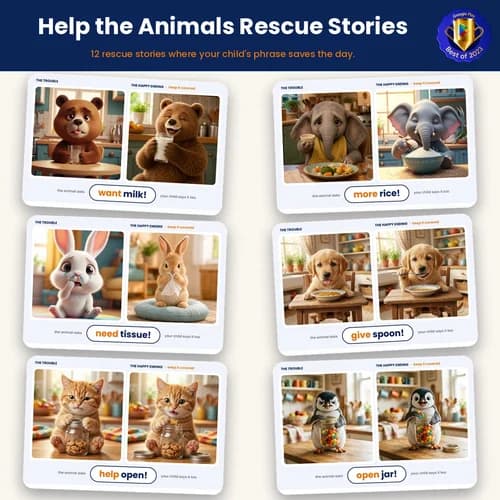
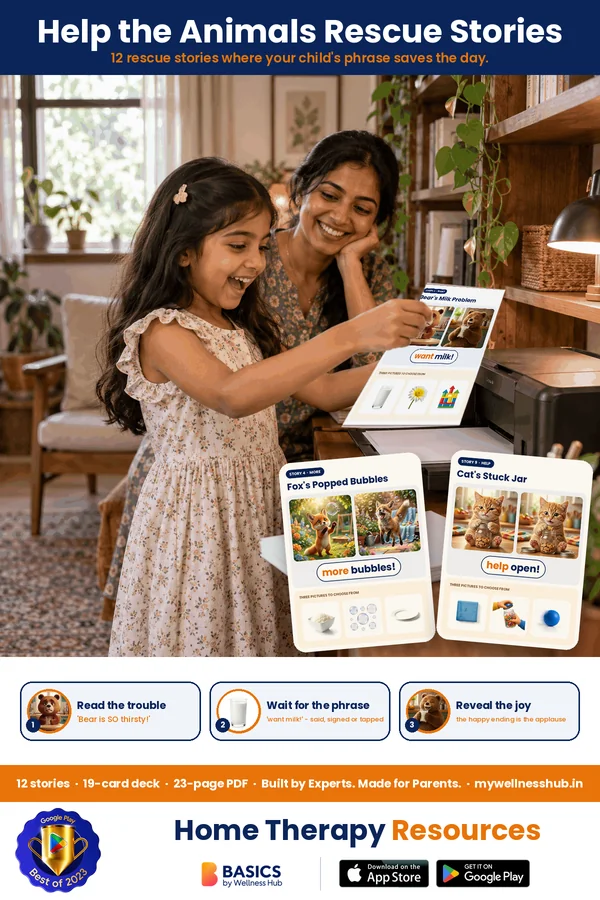
The First Requests Rescue Stories PDF is a 23-page digital resource designed for children at the first-phrase stage, including those with speech delay, autism, or who use signs or AAC. This collection features 12 short, engaging stories where animals need help, giving children the chance to practice essential two-word request phrases in a playful, supportive setting. Each story encourages children to use phrases like want milk or help open, making communication practice fun and meaningful.
Children build confidence as they practice choosing from three pictures and use two-word phrases with a request word first. The stories also support requesting inside pretend play, turn-taking, and following a simple story sequence from trouble to fix to joy. By focusing on these skills, learners experience measurable progress in expressive language and carryover into real-life moments.
Families, teachers, and therapists will find these stories easy to use at home, in classrooms, or during speech therapy sessions. The included object deck and visual supports make it simple to adapt for group or one-on-one settings, while the story log and make-your-own-story page encourage repeated use and creativity.
Product Details
- Resource Name: First Requests Rescue Stories PDF
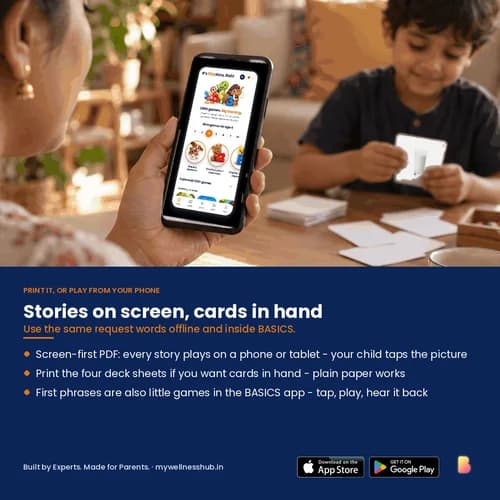
- Format: Printable and screen-ready PDF
- Total Pages: 23
- Grade Level: Early childhood, Pre-K, Kindergarten
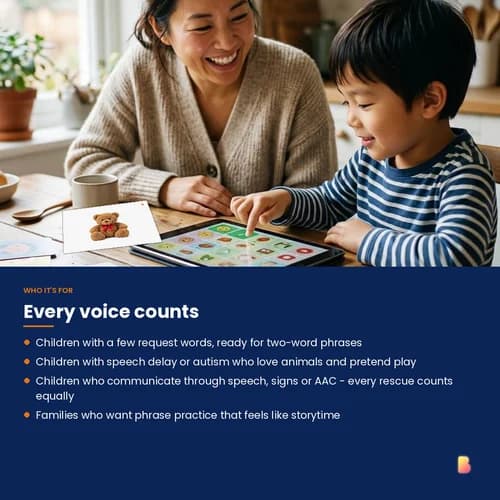
- Designed For: Children at first-phrase stage, speech delay, autism, AAC users
- Printing Notes: Optional—stories can be used on screen or printed
- Best Used In: Home, classroom, speech therapy, special education
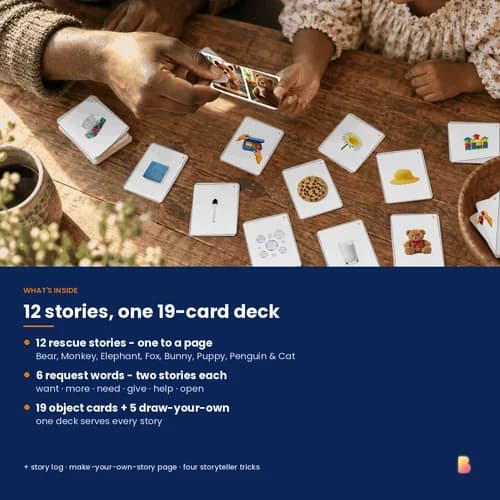
- Sets: 12 one-page stories, 19-card object deck, 5 draw-your-own cards
- Visuals / Illustrations: Two scene pictures per story, three choice pictures per story
Educational Benefits
1. Builds Two-Word Phrase Expression
- Children practice combining request words with objects, boosting expressive language.
- The stories model phrases like "want milk" and "help open" in real context.
- First Requests Rescue Stories PDF supports early phrase-building for all communicators.
2. Strengthens Requesting and Choice-Making
- Learners choose from three pictures to match the animal's need.
- This builds decision-making and reinforces the link between words and actions.
- Children gain confidence in making requests during pretend play.
3. Supports Turn-Taking and Social Communication
- Each story encourages waiting, listening, and responding in a playful way.
- Children learn to take turns as they help solve the animal's gentle trouble.
- Practicing these skills prepares them for real-life social interactions.
4. Enhances Story Sequence Understanding
- Stories follow a clear sequence: trouble, fix, and joy.
- Children learn to anticipate what comes next and retell simple stories.
- This foundation supports later reading comprehension and narrative skills.
5. Promotes AAC Parity and Visual Engagement
- Visual supports and object cards make the resource accessible for AAC users.
- Children who use signs or alternative communication can fully participate.
- The deck and illustrations encourage engagement and repeated practice.
Instructions for Use
Step 1: Prepare the Stories and Object Deck
- Download the PDF and open on your device or print if preferred.
- Cut out the 19-card object deck and draw-your-own cards for hands-on use.
- Laminate cards for durability if using in groups or therapy.
Step 2: Introduce a Story with Visuals
- Select a story and show the two scene pictures to the child.
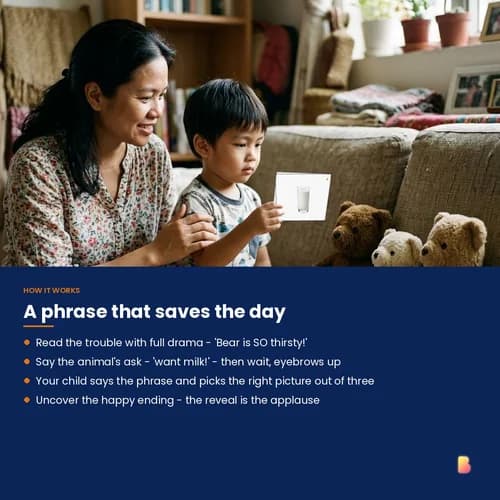
- Read the "trouble" part with drama, keeping the happy ending covered.
- Invite the child to look at the three choice pictures provided.
Step 3: Model the Request Phrase
- Say the animal's two-word ask aloud, such as "want teddy."
- Emphasize the request word first for clear modeling.
- Encourage the child to repeat or sign the phrase.
Step 4: Encourage Choice and Participation
- Ask the child to select the matching picture from the three options.
- Support them in using the correct two-word phrase for their choice.
- Praise all attempts and participation, not just perfect responses.
Step 5: Reveal the Happy Ending
- Uncover the happy ending scene after the child's phrase and choice.
- Celebrate the animal's joy and the child's communication success.
- Reinforce that the animal never withholds the happy ending.
Step 6: Extend and Personalize Practice
- Use the object deck for extra phrase practice with new combinations.
- Try the make-your-own-story page for creative storytelling.
- Incorporate phrases like requesting into daily routines for carryover.
Activities Using the Resource
1. Picture Choice Request Game
Objective: To practice using the primary_keyword by matching two-word phrases to the correct picture.
How to Play:
- Read a story's "trouble" scene and present the three choice pictures.
- Encourage the child to say or sign the phrase (e.g., want teddy) before selecting.
- Reveal the happy ending when the correct picture and phrase are chosen.
Skill Development:
- Builds two-word phrase formation and expressive language.
- Strengthens picture-to-word association.
- Supports decision-making in communication.
2. Object Deck Phrase Building
Objective: To expand use of two-word requests by combining object cards with request words.
How to Play:
- Lay out several object cards from the deck.
- Say a request word (e.g., need) and prompt the child to pair it with an object card.
- Have the child say, sign, or point to the full phrase (e.g., need tissue).
Skill Development:
- Encourages flexible phrase construction.
- Reinforces vocabulary for everyday needs.
- Develops visual scanning and matching.
3. Story Sequence Retell with Visuals
Objective: To improve story sequence understanding using illustrated story steps.
How to Play:
- Show the two scene pictures from a story (trouble and joy).
- Ask the child to retell what happened in order, using simple phrases.
- Use prompts to support: "First the animal was sad, then we said want milk, then happy!"
Skill Development:
- Enhances narrative retelling skills.
- Builds sequencing and temporal language.
- Supports memory for story events.
4. Turn-Taking with Request Phrases
Objective: To foster turn-taking and social communication with the primary_keyword in a group or pair.
How to Play:
- Take turns reading a story and modeling the animal's request phrase.
- Each participant chooses a picture and says the phrase before the ending is revealed.
- Rotate roles so every child gets a chance to lead.
Skill Development:
- Practices conversational turn-taking.
- Builds confidence in group communication.
- Reinforces listening and waiting skills.
5. Pretend Play Rescue Scenarios
Objective: To generalize requesting skills into pretend play routines.
How to Play:
- Use favorite toys or props to create new "trouble" scenes (e.g., a toy needs a blanket).
- Prompt the child to use a two-word phrase (e.g., need blanket) to solve the problem.
- Celebrate by acting out the "joy" ending together.
Skill Development:
- Applies phrase use in imaginative play.
- Encourages problem-solving language.
- Supports transfer of skills to daily routines.
6. Make-Your-Own Story Activity
Objective: To promote creativity and independent phrase generation using the resource's story template.
How to Play:
- Use the make-your-own-story page and draw-your-own cards.
- Guide the child to invent a new animal rescue and choose a request phrase.
- Illustrate and share the story, using the two-word phrase at the key moment.
Skill Development:
- Fosters creative language expression.
- Strengthens story planning and structure.
- Encourages independent communication attempts.
Frequently Asked Questions
Q1: What ages and developmental stages are the First Requests Rescue Stories PDF best for?
A1: This resource is designed for children at the first-phrase stage, typically ages 2–6, including those with speech delay or autism. It works well for early communicators using speech, signs, or AAC. Children should have a few request words emerging for best results.
Q2: Can I use the First Requests Rescue Stories PDF with groups in a classroom or therapy setting?
A2: Yes, the stories and object deck are suitable for small groups or classroom activities. Group use encourages turn-taking, peer modeling, and social communication practice. Try rotating roles so each child gets a chance to lead a story.
Q3: Are these stories effective for speech therapy with AAC users?
A3: Absolutely, this resource provides full AAC parity and visual supports for children who use communication devices or signs. The two-word request phrases and picture choices are accessible for a wide range of communicators. Therapists can model phrases on the child's device or board for maximum participation.
Q4: What is the best way to print and prepare the object deck and story pages?
A4: Print the PDF on standard A4 or letter paper and laminate the object cards for durability. Cut out the 19 object cards and 5 draw-your-own cards for hands-on use. Store cards in a small box or pouch for easy access during sessions.
Q5: How does the resource support children with special needs or those requiring differentiation?
A5: The First Requests Rescue Stories PDF is designed for flexibility, supporting children with varying communication and cognitive needs. Visuals, simple scripts, and choice-making allow for easy adaptation and scaffolding. You can slow the pace, repeat stories, or use additional prompts as needed.
Q6: Can I use the PDF on a tablet or computer without printing?
A6: Yes, every story and activity is screen-ready for use on tablets, computers, or interactive whiteboards. Children can point to pictures, listen to the story, and participate fully without printing. This digital option is ideal for teletherapy or travel.
Q7: What specific skills and learning goals does the resource target?
A7: The First Requests Rescue Stories PDF targets two-word phrase building, requesting, turn-taking, story sequence understanding, and expressive communication. It also builds confidence in choosing from visual options and carrying phrases into real-life moments. These skills are foundational for early language development and social interaction.
Q8: What are the licensing and usage rights for this PDF resource?
A8: Your purchase includes a single-user license for personal, classroom, or therapy use. You may print or use the PDF digitally with your own students or clients. Sharing, redistributing, or uploading the file for public access is not permitted.
Q9: How do I receive and download the First Requests Rescue Stories PDF after purchase?
A9: After completing your purchase, you will receive an instant download link via email. The PDF can be saved to your device for immediate use. If you need assistance, Wellness Hub's support team is available to help.
Q10: What is Wellness Hub's refund or exchange policy for digital resources?
A10: Wellness Hub does not offer refunds or exchanges for digital PDF resources once downloaded. This policy ensures the integrity of digital content and licensing. If you experience technical issues or have concerns, contact support for prompt assistance.
Usage Rights and Restrictions
Allowed Usage:
- Personal use by parents, teachers, and therapists.
- Printable for classroom, home, or therapy settings.
- Can be used in group or one-on-one learning sessions.
Not Allowed:
- Reselling, redistributing, or modifying the resource for commercial use.
- Sharing publicly (e.g., on blogs, social media, or websites) without permission.
- Uploading the file to public sharing platforms.
If you need a bulk license for schools or therapy centers, please contact us.
Conclusion
First Requests Rescue Stories PDF empowers children at the first-phrase stage—especially those with speech delay, autism, or who use AAC—to practice real communication in a playful, supportive way. With 12 gentle animal stories and interactive visuals, it helps early communicators build confidence while learning to express needs and solve problems.
Children develop turn-taking and story sequence skills as they choose, request, and celebrate each happy ending. The resource fits seamlessly into home routines, classroom groups, or therapy sessions, supporting expressive language and story-based learning for every child.
Download First Requests Rescue Stories PDF today and give your child the chance to practice meaningful two-word requests, develop turn-taking, and experience the joy of communication in every story.