

Good Friend, Tricky Friend: Spot the Signs — 50 Printable Friendship Skills Cards for Spotting Unkindness and Who to Tell
₹80
₹160
You save ₹80
4.9 (39 ratings)
Grade Levels
Grade 3 – Grade 4 (Ages 8–10)
Content Overview
Format: PDF | Pages: 32 | Features: 50 friendship cards, real-life photos, social skills, feeling identification
Categories
Share


About the Product
Introduction
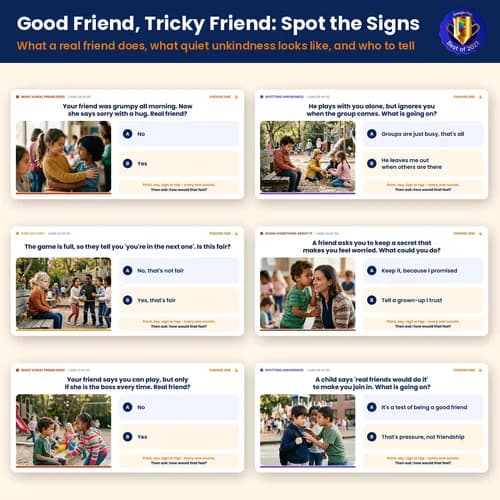
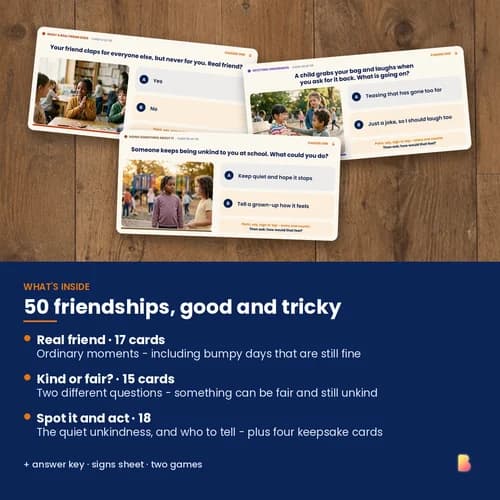
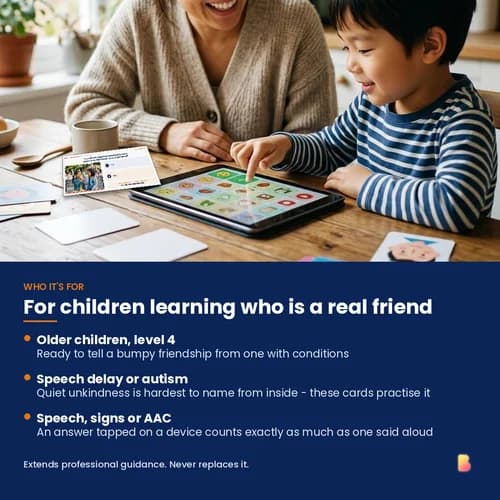
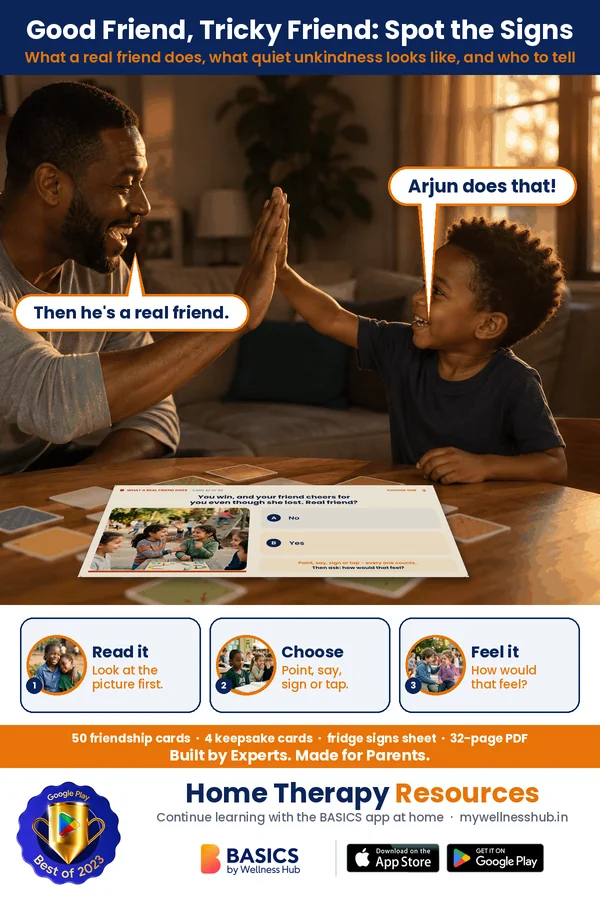
Good Friend, Tricky Friend: Spotting the Signs Card Deck is a 32-page printable and screen-ready PDF designed for older children who are learning to tell the difference between a bumpy friendship and a truly bad one. This resource features 50 realistic friendship cards, each with a photo and a thoughtful question, offering two choices that reflect real-life social situations. Created for kids ready to discuss feelings and choices, it supports those with speech delay, autism, or those who use AAC, making it accessible and inclusive.
Children practice skills like naming a feeling before a rule, and telling a fair choice from a kind one, which helps them navigate tricky social moments. The cards encourage spotting "only sometimes" friendships, recognizing warning signs, and learning to say no in a safe, supportive way. Outcomes include improved social awareness, increased confidence in making decisions, and the ability to identify when to seek help from trusted adults.
Perfect for home, classroom, and therapy settings, these cards foster open conversations about friendship and unkindness. The set includes four color-coded types of cards, a sample card to get started, and a three-page answer key for guided discussion. Use them in small groups, one-on-one sessions, or as part of social-emotional learning programs to build empathy and resilience.
Product Details
- Resource Name: Good Friend, Tricky Friend: Spotting the Signs Card Deck
- Format: Printable and screen-ready PDF
- Total Pages: 32
- Grade Level: Upper elementary and middle school
- Designed For: Social-emotional learning, speech therapy, special education, AAC users
- Printing Notes: Cards print three to a sheet; includes keepsake and reference pages
- Best Used In: Home, classroom, therapy sessions
- Sets / Flashcards / Activities: 50 scenario cards, 4 keepsake cards, answer key, sample card, games, practice log
- Visuals / Illustrations: Real-life photos on every card, color-coded card types, illustrated reference sheets
Educational Benefits
1. Social Decision-Making Skills
- Strengthens the ability to weigh choices in real-life friendship scenarios.
- Promotes thoughtful responses rather than snap judgments.
- Builds confidence in navigating tricky social moments.
2. Emotional Recognition and Expression
- Encourages children to identify and name their feelings before making decisions.
- Supports emotional vocabulary growth and self-awareness.
- Helps children recognize when a situation feels uncomfortable or unsafe.
3. Communication and Self-Advocacy
- Practices saying no, asking for help, and expressing boundaries clearly.
- Supports children who use AAC or alternative communication methods.
- Reinforces that every answer—spoken, signed, or tapped—counts equally.
4. Fairness and Kindness Distinction
- Teaches how to spot the difference between fair and kind actions in friendships.
- Guides children to notice "only sometimes" friends and conditional relationships.
- Promotes understanding that most friendships have ups and downs.
5. Recognizing Signs and Seeking Support
- Uses the primary_keyword to help children spot warning signs in friendships.
- Encourages knowing three trusted adults to tell if something feels wrong.
- Provides strategies for responding to unkindness or exclusion.
Instructions for Use
Step 1: Print or Open the PDF
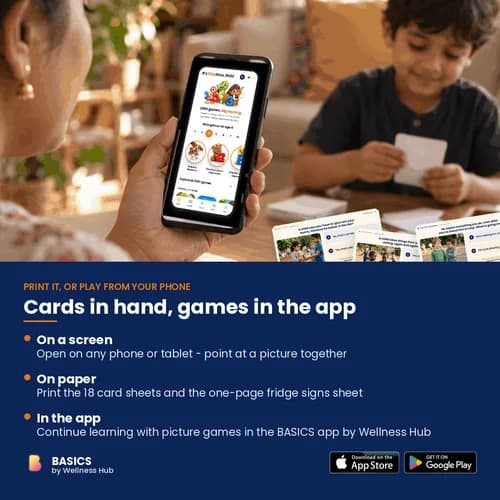
- Download the file and print cards on sturdy paper, or open on a screen.
- Cut out the cards for hands-on use, or swipe through digitally.
- For best results, print in color for card type cues.
Step 2: Introduce the Deck and Card Types
- Show the sample card and explain the four color-coded types.
- Discuss what makes a friendship bumpy versus truly bad.
- Use the "What a Real Friend Does" card to start the conversation.
Step 3: Play a Round with a Scenario Card
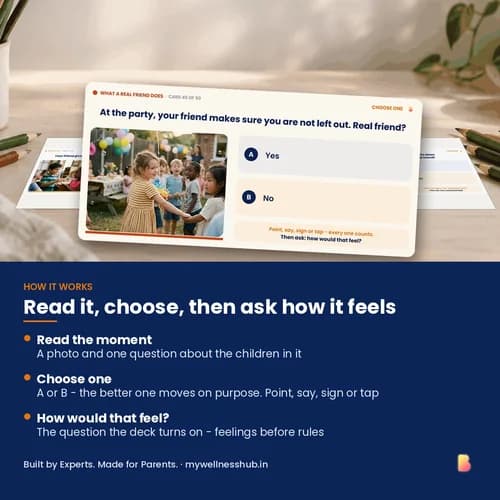
- Select a card and read the photo prompt and question aloud.
- Present both choices (A and B) and invite the child to pick one.
- Encourage the child to explain their choice using social skills.
Step 4: Reflect on Feelings and Choices
- After each card, ask "How would that feel if it happened to you?"
- Discuss why the chosen answer feels right or not.
- Reinforce naming a feeling before deciding on a rule.
Step 5: Use the Answer Key for Guided Discussion
- Check the three-page answer key for insights on what each choice teaches.
- Guide children to notice warning signs and safe responses.
- Use the quick key for fast rounds or deeper conversations.
Step 6: Reinforce Learning with Games and Everyday Carryover
- Try included games like "Three Grown-Ups" or "Good Friend, Every Time."
- Use the practice log and keepsake cards for ongoing reflection.
- Encourage children to spot signs and seek support in real life.
Activities Using the Resource
1. Spotting the Signs Card Sort
Objective: To use Good Friend, Tricky Friend: Spotting the Signs Card Deck for identifying warning signs in friendships.
How to Play:
- Lay out a mix of scenario cards and keepsake cards.
- Ask the child to sort cards into "bumpy but okay" and "warning sign" piles.
- Discuss why each card belongs in its chosen pile.
Skill Development:
- Builds critical thinking about social cues.
- Strengthens ability to spot subtle unkindness.
- Increases confidence in using the primary_keyword.
2. Role-Play with Real-Life Photos
Objective: To practice responding to tricky social moments using realistic friendship scenarios.
How to Play:
- Select a scenario card with a photo and read the question aloud.
- Child chooses a response (A or B) and acts out what they would say or do.
- Switch roles for the next card to reinforce perspective-taking.
Skill Development:
- Enhances expressive communication.
- Develops empathy and perspective-taking.
- Practices real-world problem solving.
3. Kind or Fair? Decision Challenge
Objective: To distinguish between kind actions and fair actions in friendships.
How to Play:
- Present "Kind or Fair?" cards and read each scenario.
- Child decides if the action is kind, fair, or both, and explains their reasoning.
- Use keepsake cards to reinforce the difference.
Skill Development:
- Sharpens reasoning about fairness and kindness.
- Expands social-emotional vocabulary.
- Promotes clear self-advocacy.
4. Feelings First Reflection Game
Objective: To encourage naming a feeling before making a friendship decision.
How to Play:
- Show a scenario card and ask, "How would that feel if it happened to you?"
- Child identifies a feeling and then chooses a response.
- Use the answer key to discuss the impact of each choice.
Skill Development:
- Improves emotional awareness.
- Supports naming and expressing feelings.
- Connects feelings to decision-making.
5. Three Trusted Adults Hunt
Objective: To reinforce knowing who to tell when facing a tricky friendship.
How to Play:
- After reading a scenario with a warning sign, prompt the child to name three grown-ups they could tell.
- Use the signs reference sheet for ideas.
- Repeat with different cards to generalize the skill.
Skill Development:
- Builds self-advocacy and safety planning.
- Encourages proactive help-seeking.
- Reinforces the primary_keyword in real-life contexts.
6. AAC and Sign Language Choice Rounds
Objective: To ensure full participation for AAC users and those who communicate by signs.
How to Play:
- Present a scenario card and both choices.
- Child responds using their AAC device or signs.
- Affirm that all answers—spoken, signed, or tapped—count equally.
Skill Development:
- Supports inclusive communication.
- Increases confidence in expressing choices.
- Validates all forms of participation.
Frequently Asked Questions
Q1: What age group is Good Friend, Tricky Friend: Spotting the Signs Card Deck designed for?
A1: This resource is best for upper elementary and middle school students, typically ages 8–13. The scenarios and questions are realistic and nuanced, matching the social experiences of older children. Younger children may need extra support to understand the difference between bumpy and bad friendships.
Q2: Can these friendship cards be used in small group classroom discussions?
A2: Yes, the cards are ideal for small group activities or classroom circles focused on social-emotional learning. Each card's photo and question prompt open up thoughtful conversations about real friendship experiences. Try mixing card types to encourage a range of perspectives and peer learning.
Q3: Are these cards appropriate for speech therapy sessions?
A3: Absolutely. The resource supports expressive language, social skills, and emotional vocabulary, making it a strong fit for speech therapy. Therapists can use the cards to practice naming feelings, making choices, and discussing tricky social situations.
Q4: What is the best way to print and organize the cards for repeated use?
A4: Print the cards in color on sturdy paper, then cut them out and laminate for durability. Store by card type using colored envelopes or dividers for easy access. Laminated cards withstand frequent handling in classrooms, therapy, or home settings.
Q5: How does this deck support children with special needs or AAC users?
A5: The deck is fully accessible for children with speech delays, autism, or those who use AAC. Every answer—spoken, signed, or tapped—counts equally, and visuals support comprehension. Encourage children to use their preferred communication method and revisit scenarios as needed.
Q6: Can children use this resource on a tablet or computer without printing?
A6: Yes, the PDF is screen-ready and works well on tablets, computers, or interactive whiteboards. Children can view cards, make choices, and discuss answers digitally. This flexibility supports remote learning and blended therapy sessions.
Q7: What specific social-emotional skills and learning goals does the card deck target?
A7: The primary_keyword helps children recognize warning signs, distinguish between kind and fair actions, and build self-advocacy. It also strengthens emotional awareness, decision-making, and knowing when to seek adult support. Practicing with these cards prepares children to handle real-life friendship challenges confidently.
Q8: What are the licensing and usage rights for this PDF resource?
A8: Your purchase includes a single-user license for personal, classroom, or therapy use. Sharing, posting, or distributing the file beyond your immediate setting is not permitted. For wider use, contact Wellness Hub for group or school licensing options.
Q9: How do I receive and download Good Friend, Tricky Friend: Spotting the Signs Card Deck?
A9: After purchase, you will receive an email with a secure download link for the PDF. The resource is delivered instantly and can be saved to your device for immediate use. Check your spam folder if you do not see the email within a few minutes.
Q10: What is Wellness Hub's refund or exchange policy for digital resources?
A10: Due to the nature of digital downloads, all sales are final and non-refundable. If you experience technical issues or receive the wrong file, contact Wellness Hub support for prompt assistance. They are committed to resolving any problems to ensure you can use your resource successfully.
Usage Rights and Restrictions
Allowed Usage:
- Personal use by parents, teachers, and therapists.
- Printable for classroom, home, or therapy settings.
- Can be used in group or one-on-one learning sessions.
Not Allowed:
- Reselling, redistributing, or modifying the resource for commercial use.
- Sharing publicly (e.g., on blogs, social media, or websites) without permission.
- Uploading the file to public sharing platforms.
If you need a bulk license for schools or therapy centers, please contact us.
Conclusion
Good Friend, Tricky Friend: Spotting the Signs Card Deck empowers older children to navigate the complex world of friendships with confidence and clarity. Designed for students who are ready to talk about feelings and choices, it supports kids with diverse communication needs, including those who use AAC or sign language, in building strong social-emotional foundations.
By practicing self-advocacy and learning how to spot warning signs, children develop the ability to recognize when a friendship is healthy or when it may be time to seek support. The resource fits seamlessly into home, classroom, or therapy settings, making it easy to reinforce these vital skills in everyday life.
Start meaningful conversations and build resilience—download Good Friend, Tricky Friend: Spotting the Signs Card Deck today and help your child or students grow into thoughtful, empowered friends.