

Food & Animals Conversation Cards — 20 Printable Picture Cards and 200 Questions for Reluctant Talkers
₹80
₹160
You save ₹80
4.9 (54 ratings)
Grade Levels
Pre-K – Kindergarten (Ages 4–7)
Content Overview
Format: PDF | Pages: 22 | Features: 20 picture cards, 200 questions, conversation and turn-taking practice
Categories
Share


About the Product
Introduction
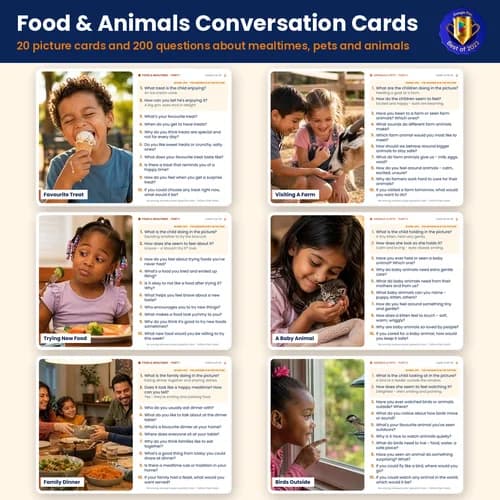
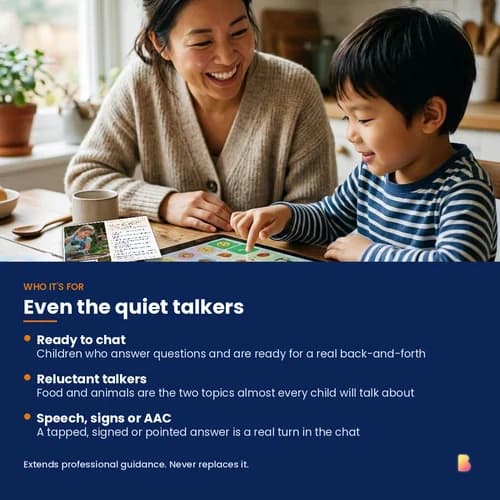
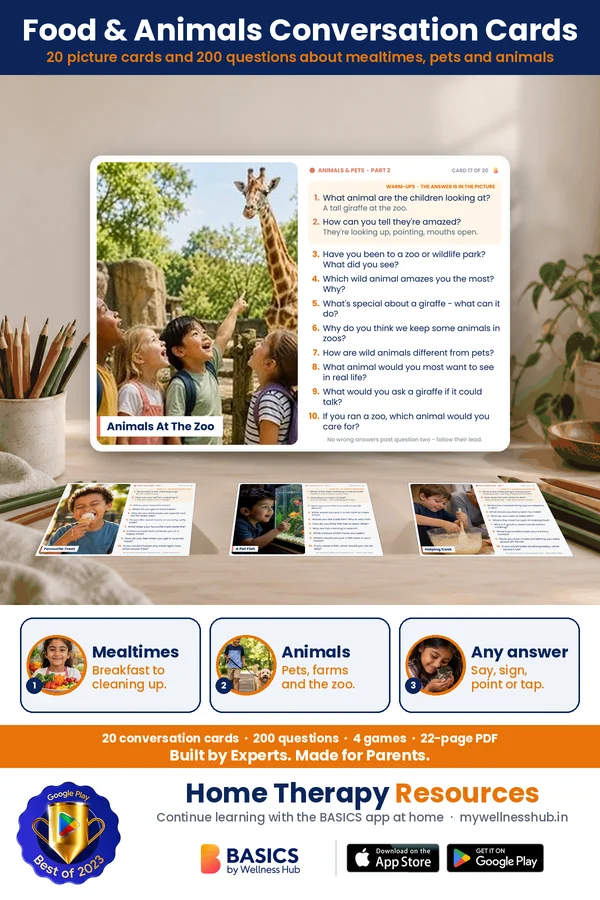
The Conversation Cards for Food & Animals PDF is a 22-page digital resource designed for children who are ready to answer questions and engage in real back-and-forth conversation. This set features 20 large, photo-based cards and 200 conversation prompts, perfect for reluctant talkers, children with speech delay, autism, or those using signs or AAC. Each card focuses on relatable topics like mealtimes and pets, making it easy for every child to join in and share their thoughts.
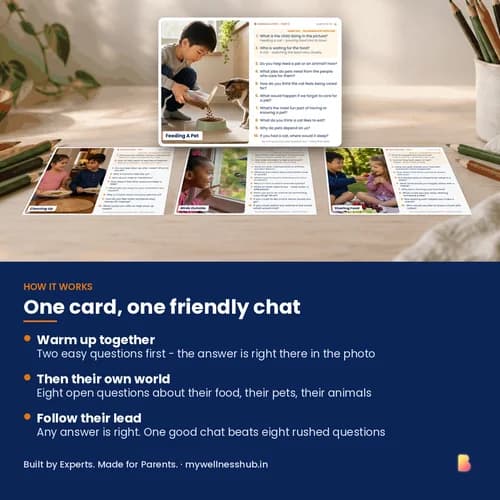
Children practice giving and defending opinions, describing tastes and textures, and expanding answers past one word. The cards encourage skills like empathy and gentleness with animals, as well as talking about routines and mealtimes. With two warm-up questions per card and eight open-ended prompts, kids build confidence in answering open questions, asking questions back, and early storytelling.
Families, teachers, and therapists can use these cards in home, classroom, and therapy settings to spark meaningful conversations and support perspective-taking. The cards also help with talking about routines and mealtime manners, making them a flexible tool for group work, one-on-one sessions, or daily chats at home.
Product Details
- Resource Name: Conversation Cards for Food & Animals PDF
- Format: Printable and screen-ready PDF
- Total Pages: 22
- Grade Level: Pre-K, Kindergarten, Early Elementary
- Designed For: Children developing conversation and social skills, including those with speech delay, autism, or using AAC
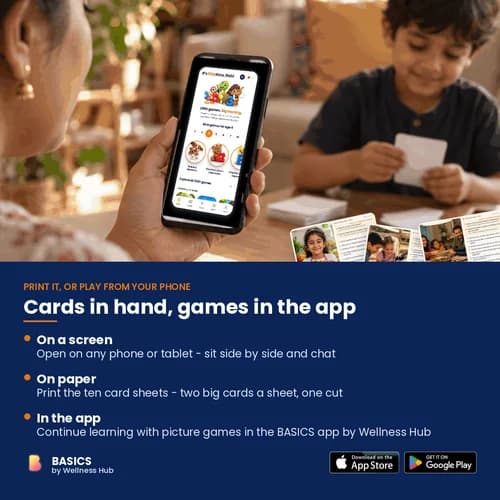
- Printing Notes: Print single- or double-sided; cut each sheet into two cards
- Best Used In: Home, classroom, speech therapy, special education
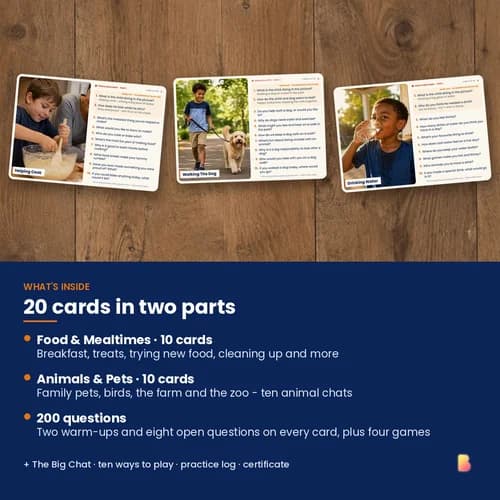
- Sets / Flashcards / Activities: 20 picture conversation cards, 200 questions, four games, practice log, certificate
- Visuals / Illustrations: Large real-life photographs on every card
Educational Benefits
1. Builds Conversation and Turn-Taking Skills
- Children practice taking turns and responding in a real dialogue.
- Guided prompts help them wait, listen, and reply thoughtfully.
- Turn-taking becomes natural through repeated, supported practice.
2. Strengthens Describing and Storytelling Abilities
- Kids learn to describe tastes, textures, and actions in detail.
- Open questions encourage them to expand answers beyond one word.
- Early storytelling skills develop as they share routines and experiences.
3. Fosters Empathy and Perspective-Taking
- Cards prompt children to consider how animals or people feel.
- Discussing "how does the kitten feel?" nurtures emotional awareness.
- Empathy grows as kids reflect on others' experiences and reactions.
4. Encourages Expressive Communication for All Modalities
- Every response counts—spoken, signed, tapped, or pointed.
- The resource supports AAC users and children with speech delay equally.
- Conversation Cards for Food & Animals PDF ensures all voices are valued.
5. Reinforces Mealtime Manners and Social Routines
- Children talk about sharing, helping, and polite behavior at meals.
- Mealtime manners become part of daily conversation and practice.
- Routines are reinforced through relatable, real-life scenarios.
Instructions for Use
Step 1: Print and Prepare the Cards
- Print single- or double-sided on sturdy paper for durability.
- Cut each sheet in half to create 20 large conversation cards.
- Laminate for repeated use or use digitally on a tablet.
Step 2: Introduce a Card and Warm Up
- Show the child a card and read the two warm-up questions together.
- Encourage them to find answers in the picture for early success.
- conversation and turn-taking skills begin with these simple steps.
Step 3: Explore Open-Ended Questions
- Ask the eight open questions on the card, following the child's lead.
- Let them share opinions, routines, or stories about food or animals.
- describing tastes and textures can be modeled if needed.
Step 4: Model and Support Conversation
- Answer a question yourself first to show how to expand responses.
- Wait up to five seconds for the child's reply—patience builds confidence.
- Repeat or rephrase answers to support understanding and engagement.
Step 5: Play Conversation Games
- Try Pass & Ask, The Hot Seat, or Story Chain for group fun.
- Mix cards or use The Big Chat for variety and challenge.
- Games encourage asking questions back and deeper discussion.
Step 6: Encourage Everyday Carryover
- Use cards at meals, with pets, or during daily routines for real-life practice.
- Celebrate progress with the included certificate and practice log.
- Keep sessions positive—cards are invitations, never tests.
Activities Using the Resource
1. Picture Card Warm-Up and Answer Game
Objective: To build confidence in conversation by finding answers in the picture and practicing turn-taking with the Conversation Cards for Food & Animals PDF.
How to Play:
- Show a card and read the two warm-up questions aloud.
- Ask the child to point, tap, or say the answers found in the photo.
- Take turns answering to model conversation and encourage participation.
Skill Development:
- Builds visual scanning and attention to detail.
- Supports turn-taking and active listening.
- Encourages expressive communication in any modality.
2. Open-Ended Mealtime Chat
Objective: To help children expand answers and describe tastes and textures during food-related conversations.
How to Play:
- Select a food or mealtime card (e.g., Breakfast, Sharing Food).
- Ask open questions about the child's own meals or routines.
- Encourage the child to describe flavors, textures, or favorite foods.
Skill Development:
- Expands vocabulary for describing food and experiences.
- Promotes longer, more detailed responses.
- Strengthens describing and storytelling abilities.
3. Animal Feelings and Empathy Discussion
Objective: To foster empathy by discussing animal emotions and gentle behavior.
How to Play:
- Choose an animal card (e.g., Petting a Dog, A Baby Animal).
- Ask, "How does the animal feel?" and "How can you tell?"
- Discuss gentle actions and ways to care for pets or animals.
Skill Development:
- Develops emotional awareness and perspective-taking.
- Reinforces empathy and gentle behavior.
- Builds reasoning skills through discussion.
4. Pass & Ask Conversation Game
Objective: To practice conversation and turn-taking in a group using the Conversation Cards for Food & Animals PDF.
How to Play:
- Sit in a circle and pass a card around.
- Each person answers one question, then asks the next person a new one.
- Continue until all questions on the card are answered.
Skill Development:
- Encourages group participation and social interaction.
- Practices asking and answering questions.
- Supports flexible thinking and adapting to others' responses.
5. Story Chain with Picture Prompts
Objective: To develop early storytelling and sequencing skills using food or animal routines.
How to Play:
- Pick a card showing a routine (e.g., Helping Cook, Walking the Dog).
- Start a story with the first step; each person adds to the story using the picture.
- Continue until the routine is complete or everyone has contributed.
Skill Development:
- Builds sequencing and narrative skills.
- Encourages creativity and logical thinking.
- Supports teamwork and collaborative storytelling.
6. The Hot Seat – Defend Your Opinion
Objective: To help children practice giving and defending opinions about food or animals.
How to Play:
- Choose a card (e.g., Favourite Treat, Being Kind to Animals).
- Ask the child to share their opinion and explain why they feel that way.
- Others can ask follow-up questions or share their own opinions.
Skill Development:
- Strengthens opinion-giving and justification skills.
- Encourages respectful listening and discussion.
- Promotes confidence in self-expression.
Frequently Asked Questions
Q1: What ages and developmental levels are the Conversation Cards for Food & Animals PDF best for?
A1: The Conversation Cards for Food & Animals PDF is designed for children ages 4–8, including those in Pre-K, Kindergarten, and early elementary grades. It supports children ready to answer questions and engage in real back-and-forth conversation. The resource is also suitable for children with speech delay, autism, or those using AAC.
Q2: Can these conversation cards be used with small groups or classroom activities?
A2: Yes, these cards are ideal for small groups, classroom circles, or therapy sessions. Each card's open-ended questions encourage turn-taking, discussion, and peer interaction. Try games like Pass & Ask or Story Chain to make group use engaging and collaborative.
Q3: Are the cards suitable for speech therapy or social skills sessions?
A3: Absolutely, these cards are frequently used in speech therapy and social skills groups. The prompts target conversation and turn-taking skills, as well as empathy and perspective-taking. Therapists can adapt question difficulty and model responses for each child's needs.
Q4: What is the best way to print and prepare the cards for repeated use?
A4: Print the cards on sturdy paper or cardstock for durability, and cut each sheet in half to create 20 large cards. Laminating the cards is recommended for frequent handling and easy cleaning. Store them in a pouch or box for convenient access during sessions.
Q5: How do these cards support children with special needs or communication differences?
A5: The resource is fully inclusive, supporting children who communicate verbally, with signs, or using AAC. Warm-up questions with picture-based answers build confidence, while open-ended prompts allow for flexible, expressive responses. All answers—spoken, signed, tapped, or pointed—are valued equally.
Q6: Can the cards be used digitally without printing?
A6: Yes, the PDF is screen-ready and can be displayed on tablets, laptops, or interactive whiteboards. Children can point, tap, or use digital annotation tools to answer questions. This makes the cards accessible for teletherapy and remote learning.
Q7: What specific conversation and social skills do children develop with this resource?
A7: Children practice conversation and turn-taking, giving and defending opinions, describing tastes and textures, and early storytelling. The cards also foster empathy and gentleness with animals, and reinforce mealtime manners and routines. These skills support confident, flexible communication in daily life.
Q8: What are the licensing and usage rights for the Conversation Cards for Food & Animals PDF?
A8: Your purchase includes a single-user license for personal, classroom, or therapy use. You may print and use the resource as needed for your direct students or clients. Redistribution or commercial sharing beyond your own use is not permitted.
Q9: How do I receive and download my PDF after purchase from Wellness Hub?
A9: After purchase, you will receive an instant download link via email from Wellness Hub. The PDF can be saved to your device and printed or used digitally right away. If you have any trouble accessing your file, Wellness Hub's support team is available to help.
Q10: What is Wellness Hub's refund or exchange policy for digital resources?
A10: Wellness Hub does not offer refunds or exchanges on digital PDF resources once downloaded. This policy ensures the integrity of digital content. If you encounter technical issues or have questions, contact Wellness Hub support for prompt assistance.
Usage Rights and Restrictions
Allowed Usage:
- Personal use by parents, teachers, and therapists.
- Printable for classroom, home, or therapy settings.
- Can be used in group or one-on-one learning sessions.
Not Allowed:
- Reselling, redistributing, or modifying the resource for commercial use.
- Sharing publicly (e.g., on blogs, social media, or websites) without permission.
- Uploading the file to public sharing platforms.
If you need a bulk license for schools or therapy centers, please contact us.
Conclusion
Conversation Cards for Food & Animals PDF offers a practical, inclusive way for children to build real conversation skills and confidence. Designed for young learners—including those with speech delay, autism, or using AAC—it helps every child find their voice while exploring favorite topics like food and animals. Families, teachers, and therapists will find it easy to spark meaningful, everyday chats.
Children develop essential turn-taking and opinion-giving skills, while mealtime manners become part of daily life. The resource also encourages empathy and perspective-taking, making it ideal for home, classroom, or therapy settings. With its focus on real conversations and gentle invitations, every child can participate and succeed.
Bring the Conversation Cards for Food & Animals PDF into your routine today and watch your child's communication, empathy, and confidence grow with every chat. Invite more laughter, sharing, and connection—one picture card at a time.