





Fix the Chat: First Repairs — 50 Printable Conversation Repair Cards for Misunderstandings and Awkward Silences
₹80
₹160
You save ₹80
4.9 (51 ratings)
Grade Levels
Grade 1 – Grade 4 (Ages 6–11)
Content Overview
Format: PDF | Pages: 32 | Features: 50 photo cards for practicing conversation repair and social communication
Categories
Share


About the Product
Introduction
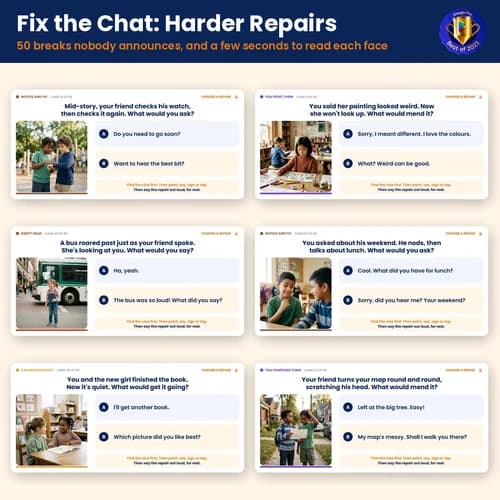
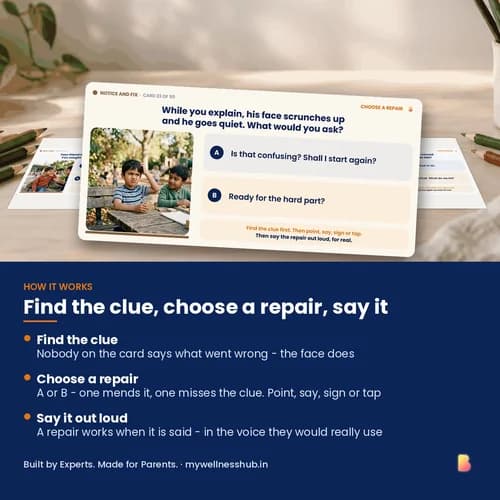
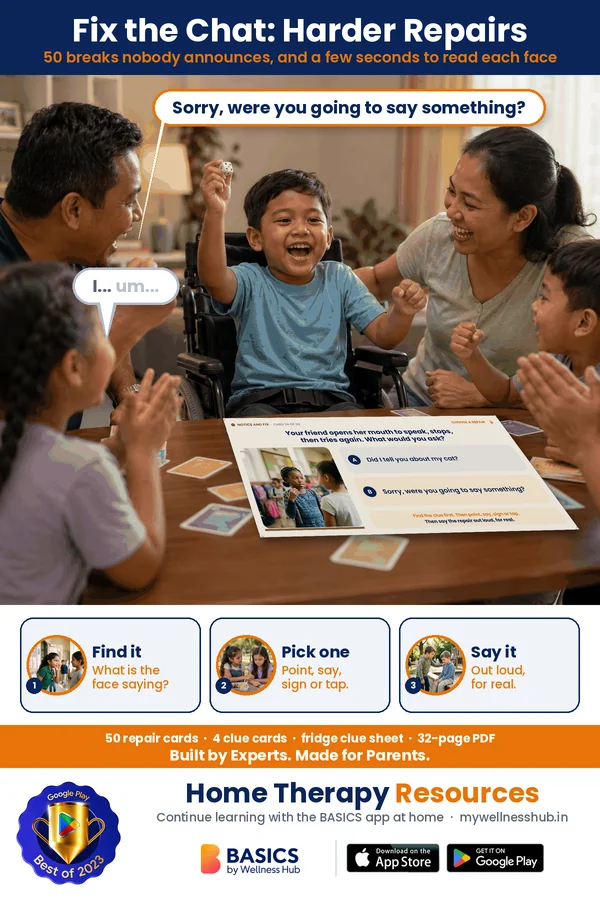
Fix the Chat: Everyday Repair Cards PDF is a 32-page digital resource designed for children who need support when conversations break down. This printable and screen-friendly deck features 50 real-life repair cards, each with a photo, a description of what went wrong, and two authentic responses to choose from. Perfect for children who communicate by speaking, signs, or AAC, these cards help kids practice what to say after a misunderstanding, interruption, or awkward silence.
Skills like asking for a repeat instead of guessing and rephrasing when a listener is lost are at the heart of this resource. Children learn to check what was meant, finish a turn after being interrupted, and restart a stalled chat. Each scenario gives measurable practice in using real-world conversation repair strategies, building confidence and social communication skills.
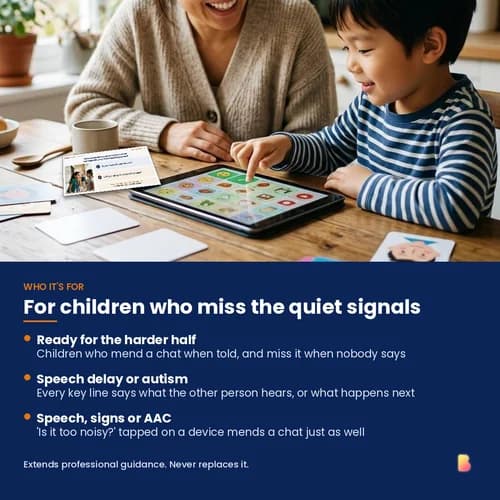
Families, classrooms, and therapy settings will find these cards especially useful for children with speech delay or autism, or anyone who gets stuck when something misfires in conversation. The resource includes a simple answer key, a repair toolkit, and flexible ways to play, making it easy to adapt for group work, one-on-one sessions, or home practice.
Product Details
- Resource Name: Fix the Chat: Everyday Repair Cards PDF
- Format: Printable and screen-ready PDF
- Total Pages: 32
- Grade Level: Elementary and up
- Designed For: Children who need support with social communication, including those using AAC or with speech delay or autism
- Printing Notes: Print single- or double-sided; cards can be cut out for hands-on use
- Best Used In: Home, classroom, speech therapy, social skills groups
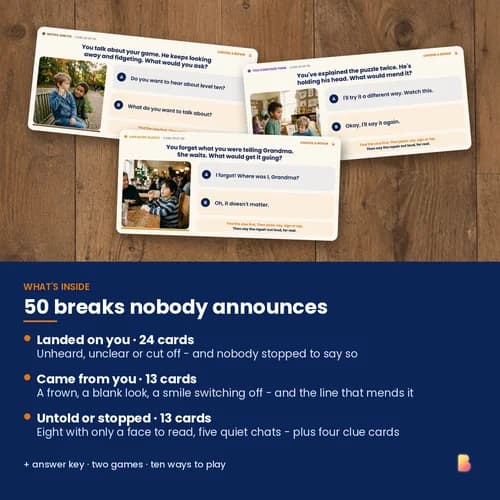
- Sets / Flashcards / Activities: 50 repair cards, 4 cut-out repair cards, answer key, toolkit, practice log, games, certificate
- Visuals / Illustrations: Full-color photos on every card, color-coded by repair type
Educational Benefits
1. Builds Social Communication Strategies
- Children practice real conversation repair moves in safe, everyday scenarios.
- They learn to respond after misunderstandings, interruptions, or awkward silences.
- primary_keyword supports growth in real-world social interactions.
2. Strengthens Self-Advocacy and Assertiveness
- Kids gain confidence to ask for repeats or clarification instead of guessing.
- They learn to express when they didn't hear or understand, using natural language.
- This skill helps children advocate for their needs in group or one-on-one chats.
3. Enhances Listening and Turn-Taking Skills
- Children practice pausing, listening, and responding thoughtfully after a conversational break.
- They learn to finish turns and restart stalled conversations with gentle prompts.
- Every card encourages active listening and smoother exchanges.
4. Supports AAC and Inclusive Communication
- All responses are accessible for children using speech, signs, or AAC devices.
- Visual supports and clear choices help children with diverse communication styles.
- Every child can participate equally, fostering inclusive social learning.
5. Encourages Real-World Carryover and Reflection
- Practice logs and everyday carryover ideas help children use skills beyond the cards.
- Families and educators can track progress and celebrate growth with the certificate.
- lsi_terms[4] is reinforced through repeated, practical use in daily life.
Instructions for Use
Step 1: Print and Prepare the Cards
- Download and print the PDF single- or double-sided as preferred.
- Cut out the 50 repair cards and optional cut-out repair cards for hands-on play.
- Laminate cards for durability if using in groups or therapy.
Step 2: Introduce the Deck and Sample Card
- Show the labelled sample card to explain how each card works.
- Describe the three color-coded types and what each break means.
- Use the coach corner for tips on modeling lsi_terms[0] naturally.
Step 3: Select and Present a Repair Scenario
- Shuffle the deck or pick a card matching a recent real-life situation.
- Read the scenario aloud or show the photo for visual support.
- Ask the child to choose between the two response options.
Step 4: Practice Saying or Signing the Repair
- Encourage the child to say, sign, or tap their chosen repair aloud.
- Model lsi_terms[2] if needed, showing both spoken and AAC options.
- Remind them both choices are real things people say.
Step 5: Check the Answer Key and Discuss Outcomes
- Use the answer key to see what the other person might hear or do next.
- Discuss how each response could change the conversation.
- No verdicts—focus on learning and reflection.
Step 6: Extend with Games and Everyday Carryover
- Try included games like Break It On Purpose or The Repair Relay for extra practice.
- Use the toolkit and practice log to track real-life use and progress.
- Display the certificate and toolkit to celebrate success and encourage daily use.
Activities Using the Resource
1. Real-Life Repair Card Practice
Objective: To practice the primary_keyword in real conversation scenarios and build confidence responding to communication breakdowns.
How to Play:
- Select a repair card showing a common break, such as "Didn't Hear" or "Interrupted."
- Read the scenario and both response options aloud or with AAC.
- Child chooses and says or signs their repair, then discusses what happens next.
Skill Development:
- Builds self-advocacy in social exchanges
- Strengthens flexible communication choices
- Increases comfort with lsi_terms[0] situations
2. Sorting Breaks by Type
Objective: To identify and categorize different kinds of conversation breakdowns using visual cues and reasoning.
How to Play:
- Spread out several cards and review the color-coded break types.
- Ask the child to sort cards into groups: "It Landed on You," "It Came From You," or "The Chat Just Stopped."
- Discuss what makes each type different, using examples from lsi_terms[2].
Skill Development:
- Improves visual sorting and organization
- Reinforces understanding of lsi_terms[0] categories
- Boosts reasoning about social situations
3. AAC Device Repair Response Game
Objective: To practice using AAC or signs for primary_keyword in real-time, increasing accessibility and fluency.
How to Play:
- Present a card and model both response choices using an AAC device or sign language.
- Child selects and taps/signs their chosen repair phrase.
- Practice switching roles, with the adult using AAC and the child responding.
Skill Development:
- Increases AAC fluency for repairs
- Supports inclusive communication
- Enhances expressive skills for lsi_terms[4] users
4. Finish the Conversation Turn
Objective: To develop turn-taking and help children complete interrupted or stalled exchanges.
How to Play:
- Use a card where a conversation was interrupted or stopped.
- Child chooses a repair and says it, then continues the conversation for one more turn.
- Practice with different scenarios, focusing on lsi_terms[0] and lsi_terms[2].
Skill Development:
- Strengthens turn-completion strategies
- Encourages active participation
- Develops lsi_terms[2] in dialogue
5. Role-Play Awkward Silences
Objective: To help children recognize and repair moments when the chat stops unexpectedly.
How to Play:
- Select a "The Chat Just Stopped" card and act out the silence.
- Child picks a repair option and uses it to restart the conversation.
- Reflect on how it feels and what might happen next, referencing lsi_terms[4].
Skill Development:
- Builds confidence handling lsi_terms[4] situations
- Promotes social problem-solving
- Encourages risk-taking in communication
6. Repair Relay Group Game
Objective: To reinforce quick, natural use of repair strategies in a fun, group setting.
How to Play:
- Players sit in a circle; one draws a card and reads the scenario.
- The next player chooses and says a repair, then draws a new card for the next person.
- Continue around the circle, tracking creative lsi_terms[2] repairs.
Skill Development:
- Increases speed and comfort with repairs
- Fosters group cooperation and listening
- Expands lsi_terms[2] repertoire through peer modeling
Frequently Asked Questions
Q1: What ages and grade levels are Fix the Chat: Everyday Repair Cards PDF designed for?
A1: Fix the Chat: Everyday Repair Cards PDF is best for elementary-aged children and up, typically ages 6–12. The scenarios and language are age-appropriate for both younger and older students who need support with conversation repair. Teens and adults with similar needs can also benefit from the resource.
Q2: Can these repair cards be used in classroom group activities?
A2: Yes, these cards work well for classroom group activities such as role-play, sorting games, and group discussions. The color-coded breaks and real-life scenarios encourage participation and peer modeling. Try using them in social skills groups or morning meetings for collaborative practice.
Q3: Are these cards suitable for speech therapy or occupational therapy sessions?
A3: Yes, they are highly effective in both speech and occupational therapy sessions. Therapists can target conversation repair, self-advocacy, and turn-taking using the structured scenarios. The resource supports both individual and small-group therapy formats.
Q4: How should I print and prepare the cards for repeated use?
A4: Print the cards single- or double-sided on thick paper for durability, and laminate if possible. Cut out the cards along the provided lines for hands-on activities. Store them in a box or pouch for easy access during sessions.
Q5: Are these cards appropriate for children with special needs or who use AAC?
A5: Yes, the cards are designed for full AAC parity and are accessible for children with autism, speech delay, or those using signs or devices. Both response options are real, natural phrases that can be spoken, signed, or tapped on a device. The resource supports differentiated instruction and inclusive communication.
Q6: Can I use this PDF on a tablet or computer without printing?
A6: Yes, the PDF is screen-ready and can be displayed on tablets, computers, or interactive whiteboards. Children can point, tap, or verbally choose their repair responses directly from the screen. This makes it easy to use in teletherapy or blended learning environments.
Q7: What specific social communication skills and learning goals do these cards address?
A7: The cards build skills in conversation repair, self-advocacy, and flexible communication choices. Children learn to ask for repeats, clarify misunderstandings, and restart stalled conversations, supporting growth in real-world social interactions. Practicing these moves increases confidence and independence in everyday chats.
Q8: What are the licensing and usage rights for this resource?
A8: Purchase grants a single-user license for personal, classroom, or therapy use. You may print and use the resource with your students or clients, but sharing or distributing the PDF to others is not permitted. For multi-user or school-wide licensing, contact Wellness Hub.
Q9: How do I download and access the Fix the Chat: Everyday Repair Cards PDF after purchase?
A9: After purchase, you will receive an instant download link via email. The PDF can be saved to your device for immediate use. If you have trouble accessing your file, Wellness Hub customer support can assist promptly.
Q10: What is Wellness Hub's refund or exchange policy for digital resources?
A10: Due to the nature of digital products, all sales are final and non-refundable. If you experience technical issues or receive a defective file, Wellness Hub will provide a replacement or help resolve the problem. Contact support within 7 days of purchase for assistance.
Usage Rights and Restrictions
Allowed Usage:
- Personal use by parents, teachers, and therapists.
- Printable for classroom, home, or therapy settings.
- Can be used in group or one-on-one learning sessions.
Not Allowed:
- Reselling, redistributing, or modifying the resource for commercial use.
- Sharing publicly (e.g., on blogs, social media, or websites) without permission.
- Uploading the file to public sharing platforms.
If you need a bulk license for schools or therapy centers, please contact us.
Conclusion
Fix the Chat: Everyday Repair Cards PDF gives children real-world tools to handle conversation breakdowns with confidence and clarity. Designed for kids who need extra support in social communication, it offers practical help for those who speak, sign, or use AAC. The cards foster independence and self-advocacy in a safe, supportive format.
Children develop flexible communication skills and learn how to handle awkward silence and everyday misunderstandings. By practicing with these cards at home, in class, or during therapy, kids strengthen their ability to respond to social challenges and build better connections. The resource is especially helpful for those who rely on aac strategies in daily life.
Start building stronger conversations—download Fix the Chat: Everyday Repair Cards PDF today and empower your child to repair, restart, and thrive in every chat.