

First Sentences: I See & I Like — 31 Printable Three-Word Commenting Sentence Flashcards (I See, I Like, Let Me)
₹80
₹160
You save ₹80
4.9 (51 ratings)
Grade Levels
Pre-K – Kindergarten (Ages 3–6)
Content Overview
Format: PDF | Pages: 20 | Features: 31 three-word sentence cards for commenting and sharing attention
Categories
Share


About the Product
Introduction
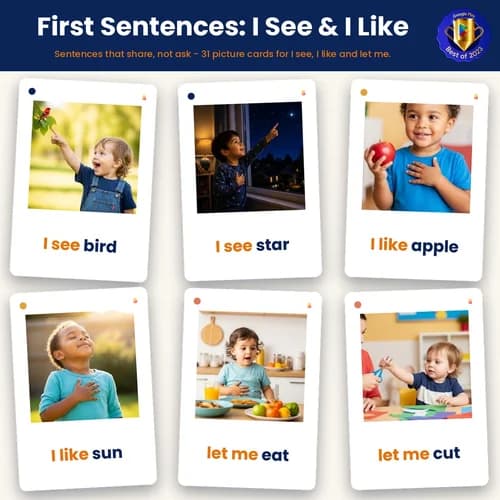
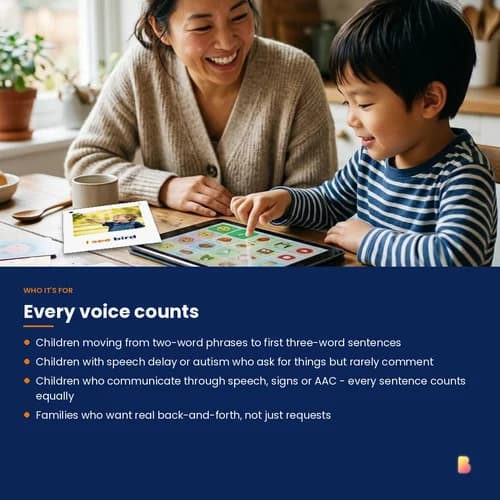
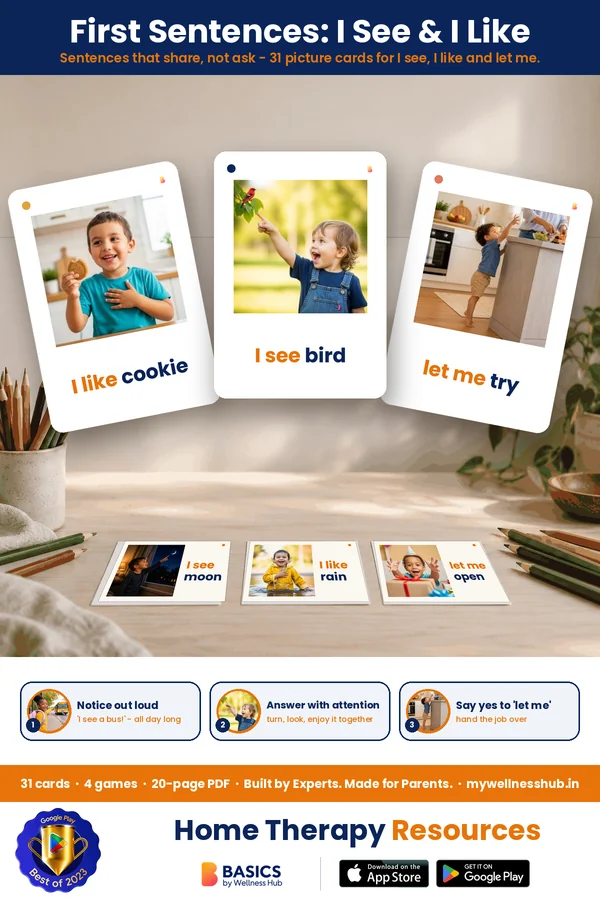
First Sentences: I See, I Like, Let Me – 3-Word Commenting Cards is a 20-page digital PDF designed for children moving from two-word phrases to their first full sentences. This resource supports young learners, including those with speech delay, autism, or who use signs or AAC, as they practice three-word sentence building in a structured, visual format. Each card features a fixed sentence starter, making it easy for children to comment, share, and participate in early conversations.
Children develop skills in stating preferences and opinions as they use phrases like I like cookie or I see bus. Practicing these sentence frames helps children move beyond simple requests, encouraging them to express what they notice, what they enjoy, and when they want to try something independently. Measurable outcomes include increased commenting and sharing attention, as well as greater confidence in joining conversations.
Families, teachers, and therapists can use these cards during daily routines, small group lessons, or speech therapy sessions. Claiming independence becomes a natural part of learning when children use phrases like let me try in play, at mealtime, or during classroom activities. The cards fit seamlessly into home practice, therapy carryover, and inclusive classroom settings.
Product Details
- Resource Name: First Sentences: I See, I Like, Let Me – 3-Word Commenting Cards
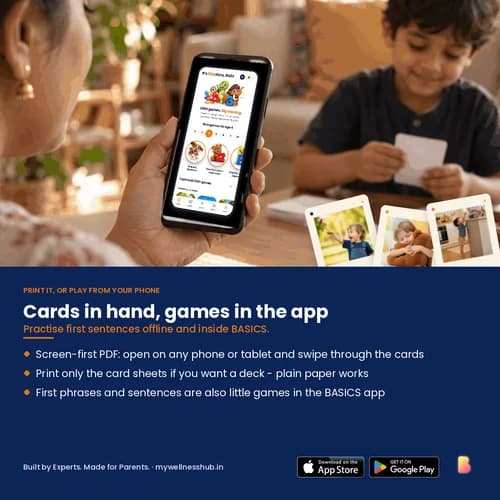
- Format: Printable and screen-ready PDF
- Total Pages: 20
- Grade Level: Pre-K, Kindergarten, Early Elementary
- Designed For: Children moving from two-word phrases to first sentences; speech delay; autism; AAC users
- Printing Notes: Suitable for color or black-and-white printing; screen use supported
- Best Used In: Home, classroom, speech therapy, special education
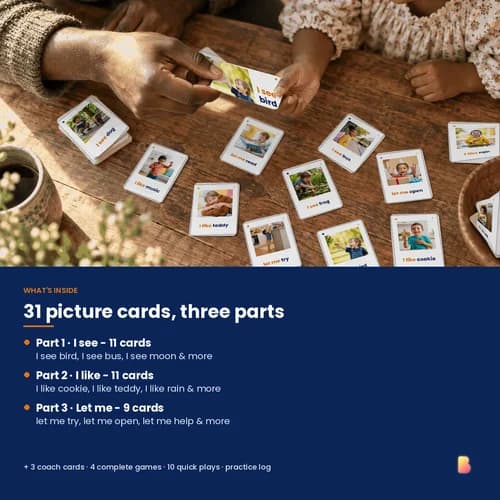
- Sets / Flashcards / Activities: 31 three-word sentence cards, 3 coach cards, 2 make-your-own cards, 4 games, 10 two-minute plays
- Visuals / Illustrations: Child-friendly images for each sentence card
Educational Benefits
1. Three-Word Sentence Building Mastery
- Children learn to expand from two-word phrases to full three-word sentences.
- Repetition of fixed starters supports consistent sentence structure.
- primary_keyword provides a scaffolded path for early language growth.
2. Commenting and Sharing Attention Skills
- Promotes joint attention as children comment on what they see or like.
- Encourages turn-taking and shared focus in group or one-on-one settings.
- Builds foundational conversation skills for social interaction.
3. Stating Preferences and Expressing Opinions
- Children practice expressing likes and interests using clear, simple language.
- Helps learners communicate choices and opinions confidently.
- Supports self-advocacy and personal expression in daily routines.
4. Claiming Independence and Self-Advocacy
- Let me starter cards empower children to request participation and try new things.
- Fosters independence by encouraging children to ask for opportunities.
- Helps children with speech delay or autism assert themselves in safe situations.
5. AAC Parity and Inclusive Communication
- Resource supports children using speech, signs, or AAC devices equally.
- Visuals and structure ensure accessibility for diverse communication needs.
- lsi_terms[4] is naturally addressed, making the resource suitable for all learners.
Instructions for Use
Step 1: Print or Display the Cards
- Print the PDF in color or black-and-white, or display on a tablet or computer.
- Cut out the sentence cards for hands-on activities if using printed versions.
- Laminate cards for durability and repeated classroom or therapy use.
Step 2: Introduce Commenting Starters
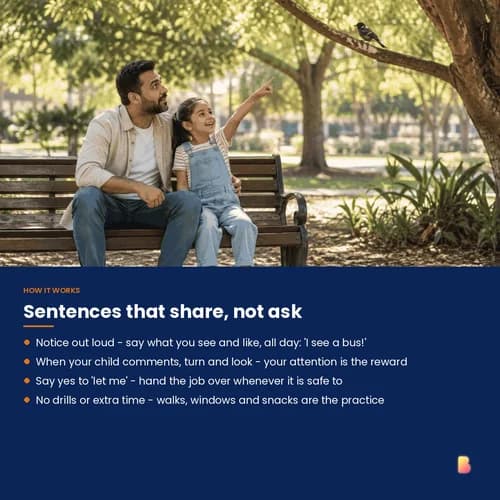
- Begin with I see cards to model commenting and sharing attention.
- Show a card, say the sentence, and encourage the child to repeat or sign it.
- lsi_terms[0] is introduced naturally in this step.
Step 3: Practice Stating Preferences
- Use I like cards to help children express their opinions and interests.
- Model the sentence, then invite the child to point, say, or select their answer.
- Offer choices to make the activity engaging and relevant.
Step 4: Encourage Independence with Let Me
- Present let me cards to support children in claiming independence.
- Model asking for a turn or to try something new using the sentence frame.
- lsi_terms[2] is highlighted as children practice self-advocacy.
Step 5: Play Games and Two-Minute Plays
- Use included games and short plays to reinforce sentence building in context.
- Encourage children to use the sentence starters during each activity.
- Rotate games to keep practice fresh and motivating.
Step 6: Track Progress and Carry Over Skills
- Use the practice log and carryover pages to monitor growth and set goals.
- Encourage families and educators to notice and respond to comments daily.
- Celebrate every new three-word sentence to build confidence and joy in communication.
Activities Using the Resource
1. Three-Word Sentence Card Sorting
Objective: To build three-word sentence structure using the primary_keyword and visual cues.
How to Play:
- Lay out a mix of I see, I like, and let me cards.
- Ask the child to group cards by their sentence starter.
- Read each sorted card aloud together.
Skill Development:
- Sentence starter recognition
- Early categorization skills
- Oral reading fluency
2. Commenting Walk with Visual Cards
Objective: To increase commenting and sharing attention using real-world objects.
How to Play:
- Take the cards on a walk around the room or outdoors.
- Prompt the child to use an I see card for each new object found.
- Model commenting and encourage turn-taking with peers or adults.
Skill Development:
- Joint attention in context
- Spontaneous commenting
- Turn-taking in conversation
3. Expressing Preferences with Choice Boards
Objective: To practice stating preferences and opinions using the primary_keyword.
How to Play:
- Present two or more I like cards with matching visuals.
- Ask the child to choose and say which one they prefer.
- Encourage them to use the full sentence each time.
Skill Development:
- Expressing likes and dislikes
- Making independent choices
- Expanding expressive vocabulary
4. Let Me Try Role-Play
Objective: To foster independence and self-advocacy through structured sentence practice.
How to Play:
- Use let me cards during daily routines (e.g., snack, art, cleanup).
- Prompt the child to request a turn or action using the card.
- Respond positively and allow the child to participate.
Skill Development:
- Self-advocacy skills
- Requesting participation
- Confidence in communication
5. Finish My Sentence Game
Objective: To strengthen three-word sentence building and flexible language use.
How to Play:
- Start a sentence with a card (e.g., I see...) and pause.
- Invite the child to complete it using a matching picture or their own idea.
- Celebrate each completed sentence together.
Skill Development:
- Sentence completion
- Listening and recall
- Flexible language generation
6. AAC Device Sentence Practice
Objective: To support AAC users in building and sharing three-word comments.
How to Play:
- Show a card and help the child find each word or symbol on their AAC device.
- Model the sentence, then prompt the child to share it using their device.
- Repeat with different cards for varied practice.
Skill Development:
- AAC navigation
- Multi-word message construction
- Inclusive communication skills
Frequently Asked Questions
Q1: What ages or developmental stages are these three-word commenting cards best for?
A1: These cards are designed for children aged 3–7 who are moving from two-word phrases to first sentences. They are especially helpful for early communicators, including those with speech delay or autism. Children using signs or AAC also benefit from the visual, structured format.
Q2: Can I use these cards for small group activities in the classroom?
A2: Yes, these cards are ideal for small group work and inclusive classroom settings. The fixed sentence starters support turn-taking and group commenting activities. Try pairing students for games or sorting tasks to encourage peer interaction.
Q3: Are these cards suitable for speech therapy sessions targeting commenting and sharing attention?
A3: Absolutely, these cards directly target commenting and sharing attention skills. Therapists can use them to prompt spontaneous comments and joint attention in structured or play-based sessions. The included games and two-minute plays make therapy engaging and varied.
Q4: What is the best way to print and prepare these cards for repeated use?
A4: Print the cards in color or black-and-white on sturdy paper, then laminate for durability. Laminated cards withstand frequent handling in therapy or classroom settings. Store them in a labeled pouch or binder for easy access.
Q5: How does this resource support children with special needs or those using AAC devices?
A5: The cards provide full AAC parity and are accessible for children using speech, signs, or AAC devices. Visual supports and fixed sentence frames help all learners participate equally. Model using the cards with AAC to encourage multi-modal communication.
Q6: Can I use these cards on a tablet or computer without printing?
A6: Yes, the PDF is screen-ready for use on tablets, computers, or interactive whiteboards. Display cards digitally for group modeling or individual practice. Digital use is especially helpful for teletherapy or remote learning.
Q7: What specific language skills and learning goals do these cards target?
A7: These cards target three-word sentence building, commenting, stating preferences, and claiming independence. Children learn to move beyond requests to share opinions and participate in early conversations. The resource also builds confidence in using complete sentences.
Q8: What are the licensing and usage rights for this PDF resource?
A8: Purchase grants a single-user license for personal, classroom, or therapy use. Redistribution, sharing, or commercial use beyond your own students or clients is not permitted. For multi-user or school-wide licensing, contact Wellness Hub for options.
Q9: How do I receive and download the PDF after purchase?
A9: After purchase, you receive an instant download link via email and on your Wellness Hub account dashboard. The PDF is ready for immediate use on any device. Save a backup copy for easy access in the future.
Q10: What is the refund or exchange policy for digital resources at Wellness Hub?
A10: Wellness Hub does not offer refunds or exchanges on digital PDF resources. This policy ensures the integrity of downloadable content. If you encounter any technical issues, contact customer support for prompt assistance.
Usage Rights and Restrictions
Allowed Usage:
- Personal use by parents, teachers, and therapists.
- Printable for classroom, home, or therapy settings.
- Can be used in group or one-on-one learning sessions.
Not Allowed:
- Reselling, redistributing, or modifying the resource for commercial use.
- Sharing publicly (e.g., on blogs, social media, or websites) without permission.
- Uploading the file to public sharing platforms.
If you need a bulk license for schools or therapy centers, please contact us.
Conclusion
First Sentences: I See, I Like, Let Me – 3-Word Commenting Cards helps children move confidently from two-word phrases to full three-word sentences. Designed for early communicators, this resource supports speech, sign, and AAC users as they learn to comment, share attention, and express independence in daily routines.
Children build essential skills in stating preferences and opinions while practicing flexible, natural conversation. The cards fit seamlessly into home activities, classroom lessons, and speech therapy sessions, making them ideal for diverse learning environments and supporting inclusive communication.
Start your journey with First Sentences: I See, I Like, Let Me – 3-Word Commenting Cards today to give your child or students the tools for confident, connected communication and lifelong language growth.