

Conversation Starters: First Openers — 50 Printable Picture Cards with 200 Ways for Kids to Open a Chat
₹80
₹160
You save ₹80
4.9 (58 ratings)
Grade Levels
Grade 1 – Grade 2 (Ages 6–8)
Content Overview
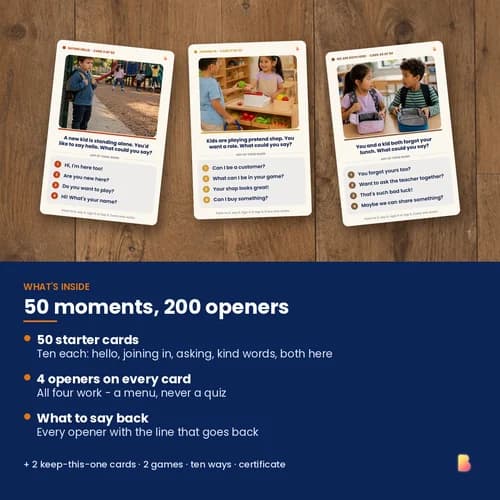
Format: PDF | Pages: 27 | Features: 50 picture starter cards, 200 openers, builds initiating conversation and joining in
Categories
Share


About the Product
Introduction
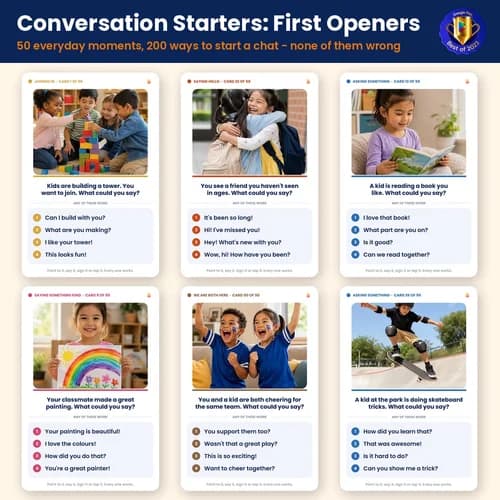
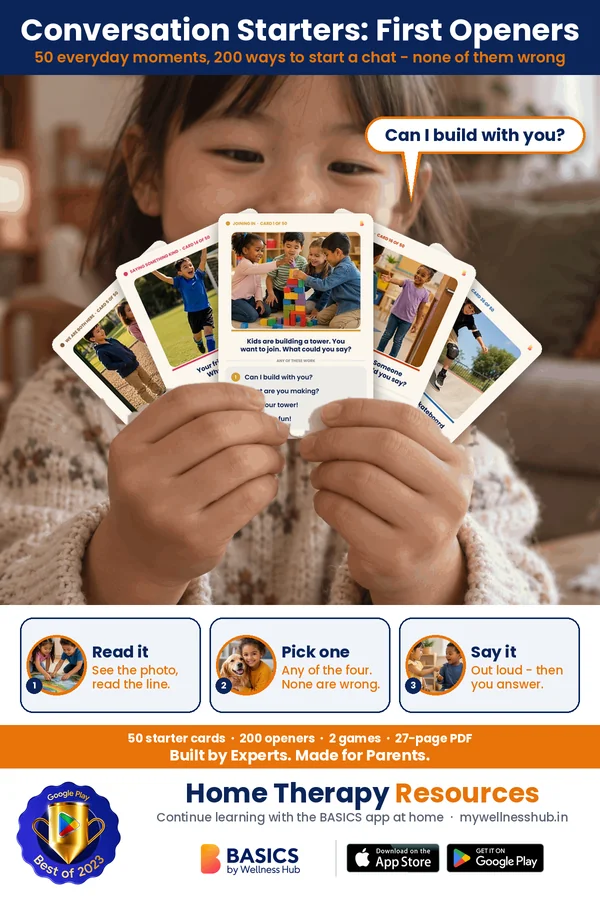
The Conversation Openers for Everyday Moments: 50 Picture Starter Cards PDF is a versatile digital resource designed for children who need support starting conversations in real-life situations. This 27-page printable and screen-ready set features fifty illustrated cards, each showing a familiar moment and offering four different things a child could say to join in. It's perfect for children who understand what's happening but struggle to find the right words, including those with speech delay, autism, or who use AAC or signs.
Children practice initiating conversation in a safe, supportive way, building skills like giving a compliment and responding with a second line after an opener. Each card encourages natural search phrases such as joining a group, greetings, asking a peer a question, and commenting on a shared moment. With multiple options for every scenario, kids gain confidence and flexibility in real interactions.
Families, teachers, and therapists can use these cards at home, in classrooms, or during therapy sessions to support generalising to real children. The cards work well for one-on-one practice, small group activities, or as part of a communication curriculum, making it easy to fit into any daily routine.
Product Details
- Resource Name: Conversation Openers for Everyday Moments: 50 Picture Starter Cards PDF
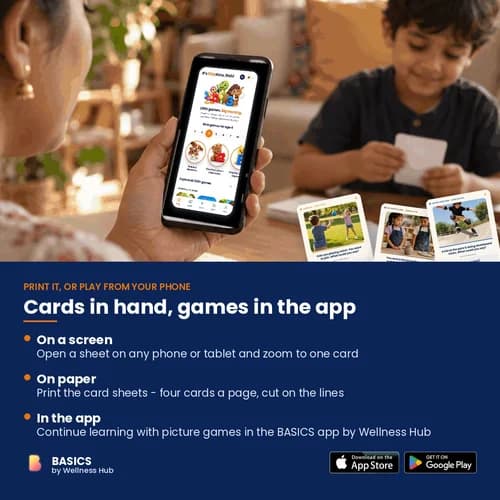
- Format: Printable and screen-ready PDF
- Total Pages: 27
- Grade Level: Elementary/Primary (ages 5–12)
- Designed For: Children with speech delay, autism, or AAC users; social skills groups; inclusive classrooms; therapy
- Printing Notes: Print single- or double-sided; laminate for durability
- Best Used In: Home, classroom, speech therapy, social skills groups
- Sets: 50 picture starter cards, 200 openers, five color-coded ways in
- Visuals / Illustrations: Everyday moments with child-friendly illustrations
Educational Benefits
1. Conversation Initiation Skills
- Builds confidence in starting conversations with peers in real-life situations.
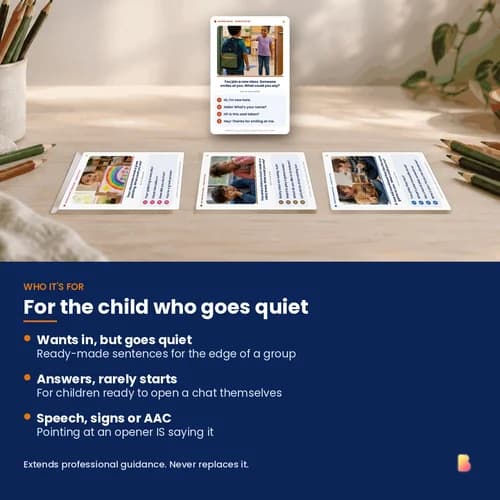
- Supports children who find it hard to say the first word in a group.
- Helps generalise conversation openers from cards to real children.
2. Social Communication Growth
- Teaches greetings, asking questions, and giving compliments in context.
- Provides practice for both verbal and AAC communicators.
- Encourages natural, flexible responses to everyday moments.
3. Group Participation and Inclusion
- Promotes joining a group by offering multiple ways to enter social play.
- Reduces anxiety at the edge of group activities or during transitions.
- Fosters a sense of belonging and participation in shared experiences.
4. Second Line and Follow-Up Skills
- Guides children to respond after an opener, not just start a chat.
- Models the "second line" to keep conversations going naturally.
- Supports back-and-forth exchanges, building true dialogue.
5. AAC and Neurodiversity Support
- Ensures full AAC parity—pointing at an opener counts as saying it.
- Designed for children with speech delay, autism, or who use signs.
- primary_keyword provides accessible, visual support for diverse communicators.
Instructions for Use
Step 1: Print and Prepare the Cards
- Print the PDF single- or double-sided on sturdy paper for best results.
- Cut out each picture starter card along the lines.
- Laminate cards for durability and repeated use. ✔ Use color coding for easy sorting.
Step 2: Introduce the Five Ways In
- Show the child the five color-coded conversation types.
- Explain each way in: Saying Hello, Joining In, Asking Something, Saying Something Kind, We Are Both Here.
- Use the joining a group set to demonstrate starting conversations.
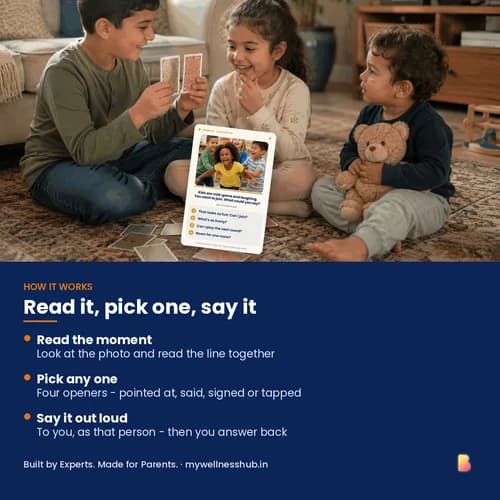
Step 3: Read and Select a Moment
- Present a card and describe the everyday moment pictured.
- Let the child choose any one of the four openers on the card.
- Encourage them to say or point to their chosen opener.
Step 4: Model and Practice Responses
- Play the role of the other child and answer as a peer would.
- Practice responding with the second line after an opener for natural flow.
- Use giving a compliment as an example to extend the exchange.
Step 5: Play Conversation Games
- Try included games like Four in the Pocket or And Then They Answer.
- Mix and match cards for different scenarios and group sizes.
- Repeat openers as needed—repetition is encouraged for skill building.
Step 6: Track Progress and Encourage Carryover
- Use the practice log to track which cards and skills have been used.
- Celebrate successes with the Certificate of First Openers.
- Prompt children to use openers during real-life moments for generalisation.
Activities Using the Resource
1. Joining a Group Card Sort
Objective: To practice using conversation openers for joining a group in real-life moments.
How to Play:
- Select joining a group cards and lay them out with their four openers.
- Child chooses an opener and says or points to it.
- Adult models a peer's response and encourages a second line.
Skill Development:
- Initiates peer interaction in group settings.
- Builds confidence in conversation openers.
- Supports flexible communication choices.
2. Greeting Practice with Picture Cards
Objective: To develop greeting skills using the primary_keyword in structured scenarios.
How to Play:
- Use saying hello cards and present everyday moments.
- Child selects a greeting opener and practices saying or signing it.
- Adult responds as a peer and prompts a follow-up line.
Skill Development:
- Increases greeting vocabulary and social awareness.
- Encourages turn-taking in conversation.
- Reinforces generalisation to real children.
3. Asking a Peer a Question Game
Objective: To strengthen question-asking skills for peer interactions.
How to Play:
- Choose asking something cards and review the four openers.
- Child picks an opener and asks the question to the adult or peer.
- Adult answers and models a natural second line.
Skill Development:
- Enhances question formation and listening skills.
- Fosters reciprocal exchanges.
- Improves understanding of conversation flow.
4. Compliment Sharing Activity
Objective: To practice giving a compliment using the primary_keyword in everyday situations.
How to Play:
- Select saying something kind cards and discuss the pictured moment.
- Child chooses a compliment opener and delivers it to a peer or adult.
- Adult models an appropriate response and encourages further exchange.
Skill Development:
- Builds self-esteem and empathy.
- Expands expressive language for compliments.
- Promotes positive peer relationships.
5. Commenting on Shared Experiences
Objective: To encourage commenting on a shared moment for social connection.
How to Play:
- Use we are both here cards and describe the illustrated scene.
- Child selects a comment opener and shares it with the group.
- Adult or peer responds and invites a second comment.
Skill Development:
- Develops joint attention and shared enjoyment.
- Increases descriptive language use.
- Supports group participation skills.
6. Four in the Pocket Conversation Game
Objective: To reinforce the use of multiple conversation openers in a playful setting.
How to Play:
- Give each child four different cards from various ways in.
- Child practices using one opener from each card during a group activity.
- Adult provides positive feedback and models responses for each attempt.
Skill Development:
- Encourages variety in conversation initiation.
- Strengthens memory and choice-making.
- Supports conversation stamina and resilience.
Frequently Asked Questions
Q1: What age range is Conversation Openers for Everyday Moments: 50 Picture Starter Cards PDF designed for?
A1: This resource is ideal for children ages 5–12 in elementary or primary school. The everyday scenarios and openers are developmentally appropriate for early learners through preteens. Older students with social communication needs may also benefit from the flexible, visual format.
Q2: Can these cards be used in classroom group activities?
A2: Yes, the cards are perfect for small group or whole-class social skills practice. Each card offers multiple openers, making it easy for several children to participate at once. Try circle time games or group role-play to encourage peer interaction.
Q3: Are these picture starter cards suitable for speech therapy sessions?
A3: Absolutely, these cards support key goals in speech therapy, especially for children with speech delay or autism. Therapists can use them to practice initiating conversation, responding with a second line, and generalising skills to real-life situations. The visual supports and open-ended prompts make them adaptable for individual or group therapy.
Q4: What is the best way to print and prepare the cards for repeated use?
A4: Print the PDF single- or double-sided on sturdy paper for durability. Laminating the cards protects them from wear and allows for easy cleaning between uses. Store by color-coded category to quickly find cards for specific skills like joining a group or giving a compliment.
Q5: Is this resource accessible for AAC users and children who communicate with signs?
A5: Yes, the cards provide full AAC parity—pointing at an opener is considered a valid response. Visuals and clear text support children who use communication devices or signs. Encourage all forms of communication, including gestures, to ensure everyone can participate fully.
Q6: Can children use these cards on a tablet or computer instead of printing?
A6: Yes, the PDF is screen-ready and can be displayed on tablets, computers, or interactive whiteboards. Children can point, tap, or use a stylus to select openers digitally. This is especially helpful for teletherapy or classrooms with limited printing resources.
Q7: What specific social communication skills will children develop using this resource?
A7: Children will practice initiating conversations, joining groups, greeting peers, asking questions, giving compliments, and commenting on shared moments. The cards also support learning the second line after an opener and generalising skills to real children. These outcomes build confidence and flexibility in everyday social situations.
Q8: What are the licensing and usage rights for this PDF resource?
A8: Your purchase grants you a single-user license for personal, classroom, or therapy use. You may print and use the cards with your students or clients, but sharing or distributing the file beyond your direct use is not permitted. For multi-user or school-wide licensing, please contact Wellness Hub directly.
Q9: How do I receive and download the Conversation Openers for Everyday Moments PDF after purchase?
A9: After completing your purchase, you will receive an instant download link via email from Wellness Hub. The PDF can be saved to your device and printed or used on-screen as needed. If you experience any issues, customer support is available to assist with access.
Q10: What is Wellness Hub's refund or exchange policy for digital resources?
A10: Wellness Hub does not offer refunds or exchanges on digital PDF resources once downloaded. This policy ensures the integrity of digital content and protects intellectual property. If you have concerns or technical difficulties, contact Wellness Hub support for troubleshooting or possible solutions.
Usage Rights and Restrictions
Allowed Usage:
- Personal use by parents, teachers, and therapists.
- Printable for classroom, home, or therapy settings.
- Can be used in group or one-on-one learning sessions.
Not Allowed:
- Reselling, redistributing, or modifying the resource for commercial use.
- Sharing publicly (e.g., on blogs, social media, or websites) without permission.
- Uploading the file to public sharing platforms.
If you need a bulk license for schools or therapy centers, please contact us.
Conclusion
Conversation Openers for Everyday Moments: 50 Picture Starter Cards PDF empowers children who need support with social communication, especially those who answer well but hesitate to speak up in group settings. Designed for ages 5–12, it gives families, educators, and therapists a flexible tool to help children break the ice and join in with confidence.
By focusing on initiating conversation and encouraging saying something kind, this resource builds core skills like greetings, asking questions, and commenting on shared experiences. It fits seamlessly into home routines, classroom activities, and therapy sessions, supporting children who communicate with speech, signs, or AAC.
Make a difference in your child's social journey—download Conversation Openers for Everyday Moments: 50 Picture Starter Cards PDF today and help them find their voice in every group. With regular practice, you'll see progress in confidence, peer connection, and real-world communication.