

Conversation Starters: Braver Openers — 50 Printable Cards for Joining Groups and Comforting Friends
₹80
₹160
You save ₹80
4.8 (51 ratings)
Grade Levels
Grade 1 – Grade 4 (Ages 6–10)
Content Overview
Format: PDF | Pages: 28 | Features: 50 picture starter cards, 200 openers, joining group conversations, AAC-friendly
Categories
Share


About the Product
Introduction
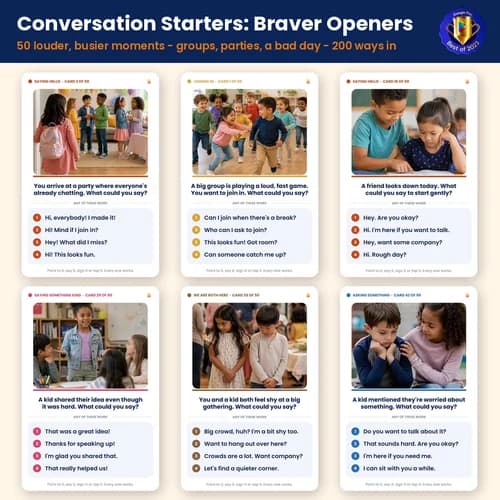
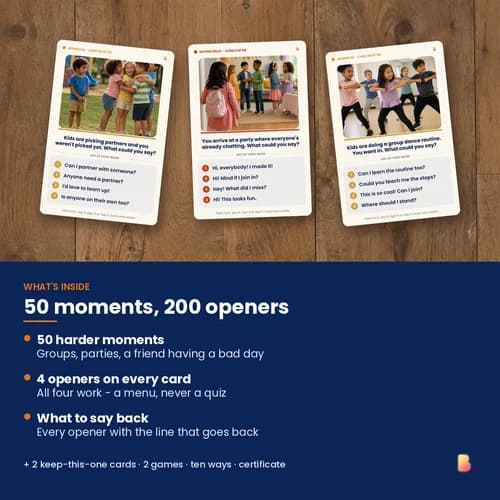
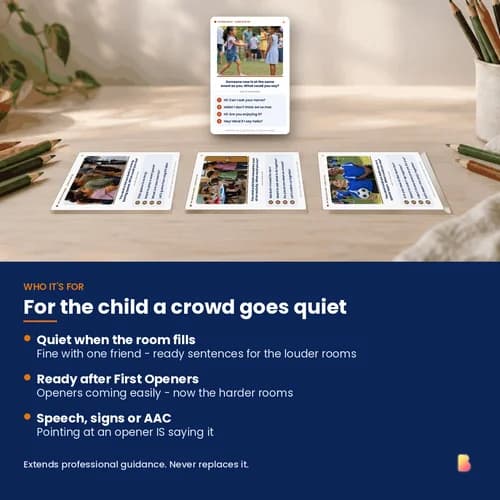
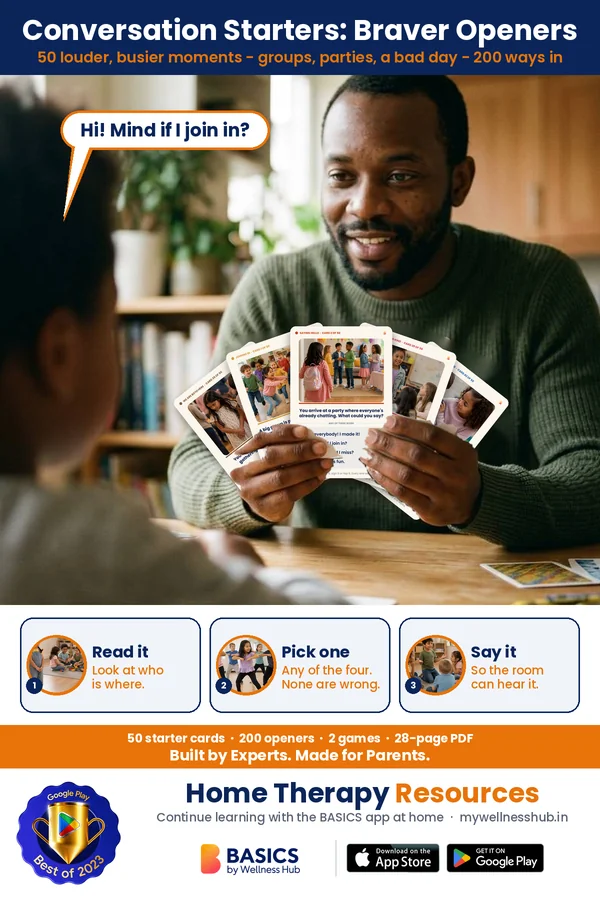
Conversation Starters: Braver Openers PDF equips children with practical ways to join group conversations and handle challenging social moments. This 28-page digital resource features 50 picture starter cards and 200 openers, each tailored for situations like entering a busy room, joining a loud game, or noticing a friend who looks down. Designed for children who can chat with one friend but struggle in bigger groups, it supports learners with speech delay, autism, or those using signs or AAC.
Children practice joining a group already in conversation and greeting a whole room, building confidence through real-life scenarios. Each card presents four things a child could say, helping them shorten a sentence until it is easy to say and speak at the right volume. Outcomes include inviting a child who is left out and generalising these skills to everyday group settings.
Parents, teachers, and therapists can use these cards at home, in classrooms, or during therapy sessions to support speaking at the volume a room needs. The resource encourages practice through gentle, game-like methods, making social communication accessible and stress-free for all children.
Product Details
- Resource Name: Conversation Starters: Braver Openers PDF
- Format: Printable and screen-ready PDF
- Total Pages: 28
- Grade Level: Elementary (Ages 6–12)
- Designed For: Children with speech delay, autism, or using AAC/signs; general social skills support
- Printing Notes: Suitable for color or black-and-white printing; screen use optimized
- Best Used In: Home, classroom, speech/language therapy
- Sets / Flashcards / Activities: 50 picture starter cards, 200 openers, 10 ways to play, 2 games
- Visuals / Illustrations: Full-color illustrations on each card
Educational Benefits
1. Social Communication Confidence
- Builds courage to join group conversations in real-life settings.
- Supports children in greeting a whole room or entering a busy group.
- Helps generalize conversation skills beyond one-on-one chats.
2. Conversation Initiation Skills
- Teaches five distinct ways to start or join a conversation.
- Offers practical scripts for saying hello, joining in, or asking questions.
- Reduces anxiety when approaching new or challenging social moments.
3. Adaptable Communication for AAC and Signs
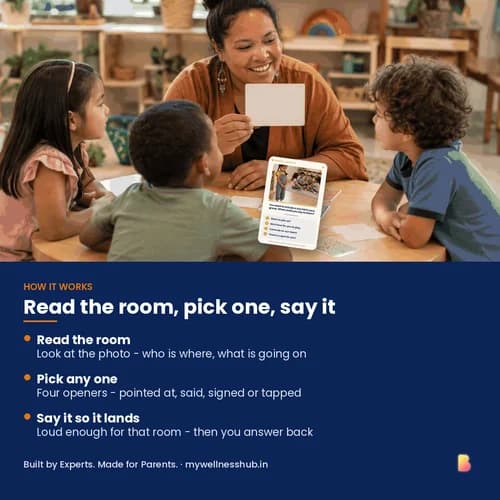
- Ensures full AAC parity—pointing, signing, or tapping counts as participation.
- Enables children to communicate in the way that suits them best.
- Promotes inclusion for nonverbal or minimally verbal learners.
4. Volume and Sentence Simplification Practice
- Guides children in speaking at the volume a room needs.
- Encourages shortening sentences until they are easy to say.
- Improves clarity and confidence when speaking in groups.
5. Emotional Awareness and Peer Support
- Helps children notice and respond to peers who may feel left out.
- Promotes kindness, empathy, and supportive social behaviors.
- Conversation Starters: Braver Openers PDF provides real strategies for checking in with friends.
Instructions for Use
Step 1: Print or Display the Cards
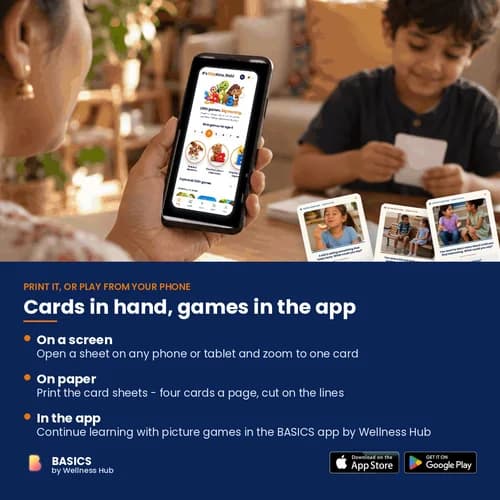
- Choose to print the PDF in color or black-and-white, or use on a tablet or computer.
- Cut out the 50 picture starter cards if using printed versions.
- Laminate cards for durability and repeated practice.
Step 2: Introduce the Five Ways In
- Explain the five conversation openers: Saying Hello, Joining In, Asking Something, Saying Something Kind, We Are Both Here.
- Show one card from each color-coded set to familiarize children with the structure.
- Encourage children to notice which opener feels comfortable.
Step 3: Model and Practice Joining a Group
- Demonstrate joining a group already in conversation using a card from the deck.
- Role-play scenarios with the child, using openers from the cards.
- Provide feedback and celebrate successful attempts.
Step 4: Encourage Volume and Sentence Practice
- Guide children to practice speaking at the volume a room needs.
- Use the cards to help them shorten a sentence until it is easy to say.
- Remind them that short beats clever—clarity is the goal.
Step 5: Play Conversation Games
- Select from the included games like The Loud Kitchen or Say Less to make practice fun.
- Rotate through different cards and scenarios to build flexibility.
- Incorporate joining in as a skill during game play.
Step 6: Track Progress and Celebrate Success
- Use the practice log and Certificate of Braver Openers to mark achievements.
- Notice signs of growing confidence, such as greeting a whole room or checking in with a friend.
- Encourage continued use in everyday group settings.
Activities Using the Resource
1. Joining a Group Conversation Practice
Objective: To help children use conversation starters to join a group already in conversation.
How to Play:
- Lay out picture starter cards showing group scenes.
- Child selects a card and chooses one of the four openers to say or point to.
- Adult responds with a friendly reply, modeling turn-taking.
Skill Development:
- Builds confidence in group entry.
- Practices using visual conversation cues.
- Encourages flexible communication choices.
2. Greeting the Whole Room Activity
Objective: To practice using the Conversation Starters: Braver Openers PDF for greeting a whole room with appropriate volume.
How to Play:
- Display cards from the "Saying Hello" set.
- Child picks a card and practices saying or signing the greeting at a room-appropriate volume.
- Adult and peers respond with a group hello.
Skill Development:
- Develops volume control for social settings.
- Reinforces group greeting skills.
- Supports AAC and sign communication.
3. Asking to Join a Game Scenario
Objective: To use openers for joining in when a game is already in progress.
How to Play:
- Show a picture card of a game in full flow.
- Child selects an "Asking Something" opener and uses it to request joining.
- Group responds, modeling positive inclusion.
Skill Development:
- Teaches polite entry into ongoing activities.
- Encourages peer interaction.
- Strengthens question-asking skills.
4. Checking in with a Friend Role-Play
Objective: To support children in noticing and responding to a peer who looks down or left out.
How to Play:
- Present a card showing a friend who looks sad or alone.
- Child chooses a "We Are Both Here" or "Saying Something Kind" opener.
- Practice responding with empathy and supportive words.
Skill Development:
- Builds emotional awareness.
- Promotes supportive peer communication.
- Encourages kindness in social situations.
5. Say Less Challenge Game
Objective: To help children practice shortening sentences until they are easy to say.
How to Play:
- Pick any scenario card and read all four openers.
- Child chooses the shortest opener and practices saying or signing it.
- Repeat with different cards, celebrating each successful attempt.
Skill Development:
- Improves sentence simplification.
- Reduces anxiety around speaking.
- Enhances clarity in communication.
6. Volume Practice in Noisy Rooms
Objective: To practice speaking at the volume a room needs using real-life scenarios.
How to Play:
- Use cards depicting busy or noisy environments.
- Child selects an opener and practices saying it at an appropriate volume.
- Adult gives feedback: too soft, too loud, or just right.
Skill Development:
- Builds self-monitoring of speech volume.
- Prepares for real-world group settings.
- Supports generalization to everyday situations.
Frequently Asked Questions
Q1: What age range is Conversation Starters: Braver Openers PDF designed for?
A1: This resource is designed for children ages 6–12, typically in elementary school. The scenarios and openers are developmentally appropriate for this age group, including those with speech delay or autism. Younger or older children may also benefit with adult support.
Q2: Can I use these conversation starter cards with a small group in my classroom?
A2: Yes, the cards work well for small group activities and social skills groups. Each card offers multiple openers, allowing several children to practice together in turn. Rotate roles so every child gets a chance to lead and respond.
Q3: Are these cards suitable for speech therapy sessions focusing on joining group conversations?
A3: Absolutely. The resource targets joining a group already in conversation, greeting a whole room, and practicing volume and sentence length. Therapists can use the cards for role-play, modeling, and real-life scenario practice.
Q4: What is the best way to print and prepare the cards for repeated classroom or therapy use?
A4: Print the cards in color or black-and-white on sturdy paper for best results. Laminate the cards to increase durability and allow for frequent handling. Store them by color-coded set for easy access during sessions.
Q5: How does this resource support children with special needs or those using AAC or signs?
A5: The PDF ensures full AAC parity—pointing, signing, or tapping any opener counts as participation. Visuals and sentence options are designed for children with speech delay, autism, or those who communicate nonverbally. Encourage children to use whichever communication method feels most comfortable.
Q6: Can the cards be used on a tablet or computer without printing?
A6: Yes, the PDF is screen-ready and optimized for digital use. Display cards on a tablet, computer, or interactive whiteboard for group or individual practice. Children can tap or point to their chosen opener directly on the screen.
Q7: What specific social communication skills will children develop using this resource?
A7: Children will practice joining a group already in conversation, greeting a whole room, and responding to peers who may feel left out. The cards also build skills in speaking at the volume a room needs and shortening sentences for clarity. These skills generalize to real-life group settings and everyday social moments.
Q8: What are the usage rights for Conversation Starters: Braver Openers PDF?
A8: You may use the PDF for personal, classroom, or therapy purposes. Sharing, posting, or selling the file outside your immediate setting is not permitted. For wider licensing, contact Wellness Hub directly.
Q9: How do I receive and download my PDF after purchase?
A9: After purchase, you will receive an instant download link via email from Wellness Hub. The PDF is ready for immediate use on any device or for printing. Check your spam or promotions folder if you do not see the email promptly.
Q10: What is the refund or exchange policy for digital resources from Wellness Hub?
A10: Wellness Hub does not offer refunds or exchanges on digital downloads due to their nature. If you have trouble accessing your file or find an error, contact Wellness Hub support for assistance. They are committed to resolving issues quickly and ensuring customer satisfaction.
Usage Rights and Restrictions
Allowed Usage:
- Personal use by parents, teachers, and therapists.
- Printable for classroom, home, or therapy settings.
- Can be used in group or one-on-one learning sessions.
Not Allowed:
- Reselling, redistributing, or modifying the resource for commercial use.
- Sharing publicly (e.g., on blogs, social media, or websites) without permission.
- Uploading the file to public sharing platforms.
If you need a bulk license for schools or therapy centers, please contact us.
Conclusion
Conversation Starters: Braver Openers PDF empowers children to confidently join group conversations and handle tricky social moments, especially those who find busy rooms or new situations overwhelming. Designed for ages 6–12, it supports learners who use speech, signs, or AAC, making social communication more accessible and less stressful for everyone involved.
By focusing on joining in and using supportive peer communication, children build essential skills for home, classroom, and therapy settings. The resource encourages practicing volume control and kindness, helping every child feel included and ready to participate in group activities.
Give your child the tools to thrive—download Conversation Starters: Braver Openers PDF today and watch them grow braver, kinder, and more confident in every social setting.