

Colour Words: Red, Blue, Green & Yellow — 60 Printable Colour Phrase Flashcards for Early Talkers
₹80
₹160
You save ₹80
4.8 (56 ratings)
Grade Levels
Pre-K – Kindergarten (Ages 3–6)
Content Overview
Format: PDF | Pages: 26 | Features: 60 colour + object cards, builds describing skills, supports speech delay
Categories
Share


About the Product
Introduction
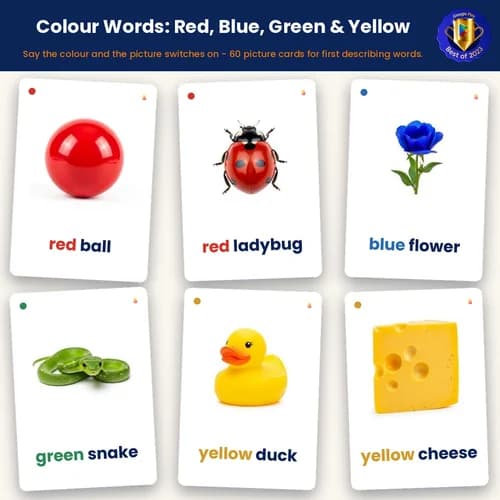
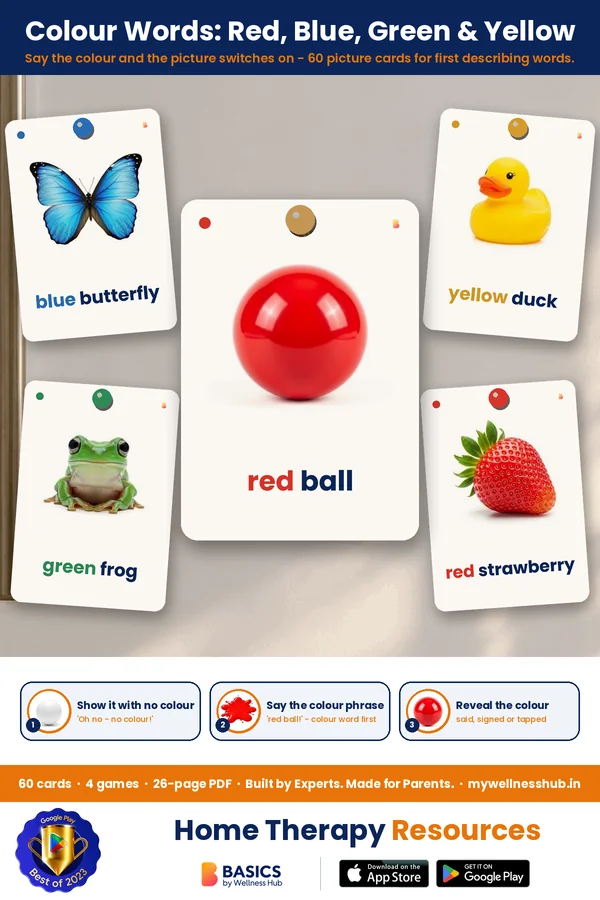
Colour Words: Red, Blue, Green, Yellow Picture Cards is a 26-page digital PDF designed for children beginning to use describing words, including those with speech delay, autism, or who communicate with signs or AAC. This resource features 60 vibrant picture cards, each pairing a colour word with a familiar object in a clear, colour-first phrase like red ball or blue whale. Every colour word appears in its own hue, making learning both visual and interactive for early language learners.
Children practice matching colour words to objects with engaging activities that focus on the fixed colour-first frame. The method encourages noticing and using colour words naturally, never testing or quizzing, and supports full AAC parity. Outcomes include increased confidence with first describing words and the ability to use colour-object phrases in everyday communication.
Perfect for home, classroom, and therapy settings, the games and coach cards help children learn through play and repetition. The resource supports structured practice in speech sessions, group activities in preschool, and daily routines at home, ensuring children build skills with colour-object phrases in many real-life contexts.
Product Details
- Resource Name: Colour Words: Red, Blue, Green, Yellow Picture Cards
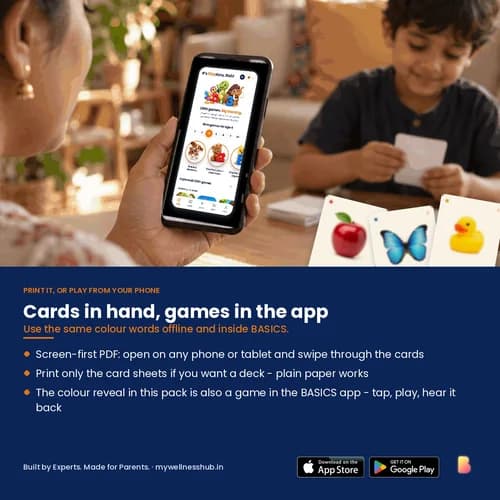
- Format: Printable and screen-ready PDF
- Total Pages: 26
- Grade Level: Preschool, Kindergarten, Early Primary
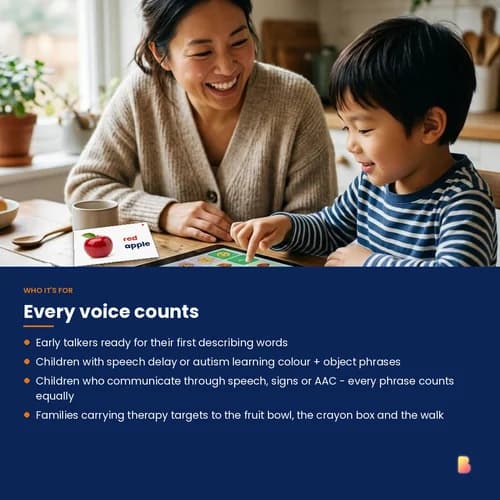
- Designed For: Children developing first describing words, speech delay, autism, AAC users
- Printing Notes: Colour printing recommended for best results
- Best Used In: Home, classroom, speech therapy, special education
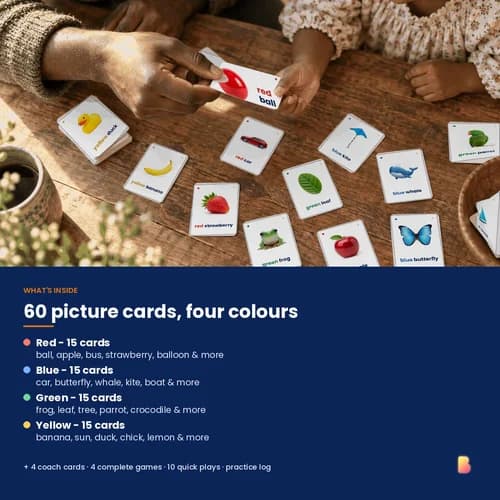
- Sets / Flashcards / Activities: 60 picture cards, 4 coach cards, 4 games, 10 plays, practice log, carryover pages
- Visuals / Illustrations: Full-colour object illustrations, colour-coded words
Educational Benefits
1. Early Describing Word Acquisition
- Supports children in using colour words as first describing words in daily speech.
- Encourages spontaneous use of phrases like red ball and blue whale.
- primary_keyword helps bridge from naming to describing objects.
2. Visual Discrimination and Attention
- Strengthens ability to notice differences between colours and objects.
- Colour words printed in matching hues reinforce visual connections.
- Children learn to focus on details in each vivid image.
3. AAC and Communication Access
- Ensures full AAC parity for children using speech devices or signs.
- Promotes equal participation in games and activities for all communicators.
- Facilitates expressive language for non-speaking or minimally verbal learners.
4. Structured Practice and Generalization
- Games and coach cards offer repeated, playful practice in varied settings.
- Children apply skills across home, classroom, and therapy environments.
- Carryover pages support using new phrases in real-life routines.
5. Engagement and Motivation for Speech Delay
- Games like The Colour Reveal make learning interactive and fun.
- Children with speech delay stay motivated through quick, success-based activities.
- lsi_terms[4] is naturally reinforced with every colour-object phrase.
Instructions for Use
Step 1: Print and Prepare the Cards
- Print the PDF in colour for best visual clarity.
- Cut out the 60 picture cards and four coach cards.
- Laminate for durability if using in groups or therapy.
Step 2: Introduce Colour Words with Objects
- Present one colour at a time using the red, blue, green, or yellow sets.
- Emphasize the colour word in each phrase, such as red ball.
- Encourage children to repeat or sign the colour-object phrase.
Step 3: Play The Colour Reveal Game
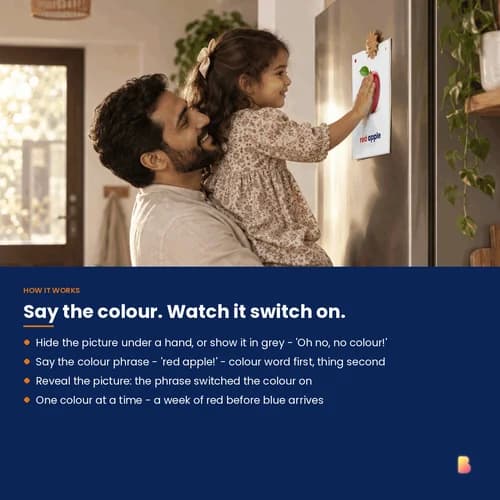
- Hide the coloured picture with your hand or use the grey version.
- Say the colour-object phrase aloud before revealing the vivid image.
- lsi_terms[0] is naturally targeted as children see the colour "switch on."
Step 4: Engage with AAC and Signs
- Model colour-object phrases using AAC devices or sign language.
- Prompt children to select or sign the correct colour word.
- Ensure all learners participate equally in each activity.
Step 5: Explore Additional Games and Plays
- Use Which Picture?, Finish My Phrase, and The Mixed-Up Painter for variety.
- Incorporate the four-splash board and ten two-minute plays for extra practice.
- lsi_terms[2] is reinforced as children respond to prompts and finish phrases.
Step 6: Track Progress and Carry Over
- Record practice on the included log and readiness pages.
- Encourage families to use colour-object phrases during daily routines.
- Review progress regularly and celebrate new describing word use.
Activities Using the Resource
1. Colour-Object Picture Card Sorting
Objective: To build the ability to match and name objects using the primary_keyword in structured phrases.
How to Play:
- Lay out several cards from one colour set (e.g., red ball, red apple).
- Ask the child to group cards by object or by colour word.
- Say each phrase together, pointing to the printed colour word.
Skill Development:
- Increases colour-object association accuracy.
- Strengthens phrase repetition and articulation.
- Boosts visual discrimination between objects.
2. The Colour Reveal Game
Objective: To help children notice and use the primary_keyword in daily communication.
How to Play:
- Hide the coloured picture (cover or use grey version).
- Say the colour-object phrase (e.g., blue whale), then reveal the vivid card.
- Let the child repeat or sign the phrase as the colour "switches on."
Skill Development:
- Reinforces colour word recognition.
- Supports expressive language with visual cues.
- Encourages joint attention and anticipation.
3. AAC Device Colour Matching
Objective: To practice selecting and expressing colour-object phrases using AAC or signs.
How to Play:
- Show a set of cards (e.g., green frog, green leaf).
- Prompt the child to select the matching colour word on their AAC device.
- Model the phrase and encourage the child to repeat or sign it.
Skill Development:
- Builds AAC navigation and selection skills.
- Promotes two-word phrase construction.
- Supports receptive and expressive communication.
4. Finish My Phrase with Four-Splash Board
Objective: To develop turn-taking and phrase completion using visual prompts.
How to Play:
- Place the four-splash board and several cards in front of the child.
- Start a phrase: "Yellow…" and pause for the child to finish (e.g., "duck").
- Place completed phrases on the matching splash colour.
Skill Development:
- Enhances phrase completion and recall.
- Improves turn-taking and listening skills.
- Fosters confidence in early describing word use.
5. Which Picture? Visual Discrimination Game
Objective: To strengthen the ability to identify and select objects based on colour word cues.
How to Play:
- Say a colour-object phrase aloud (e.g., "red ball").
- Present several cards and ask the child to find the matching picture.
- Take turns giving and following colour-object instructions.
Skill Development:
- Sharpens listening and following directions.
- Develops quick visual scanning.
- Reinforces understanding of colour-object pairs.
6. Carryover Colour Hunt at Home
Objective: To generalize use of colour-object phrases from the primary_keyword to real-life settings.
How to Play:
- Ask the child to find objects at home matching a colour word (e.g., "Find something green!").
- Help them say or sign the phrase (e.g., "green frog" or "green cup").
- Record new phrases on the practice log for review.
Skill Development:
- Transfers describing word use to daily routines.
- Expands vocabulary with real-world examples.
- Encourages independent phrase generation.
Frequently Asked Questions
Q1: What age range or developmental stage is Colour Words: Red, Blue, Green, Yellow Picture Cards designed for?
A1: This resource is best for children in preschool, kindergarten, and early primary grades who are ready for their first describing words. It is also appropriate for children with speech delay, autism, or those using AAC. Children should already know basic object words before starting.
Q2: Can I use these colour-object picture cards in group classroom activities?
A2: Yes, these cards are ideal for small group work, circle time, or classroom centers. The fixed colour-first frame and visual cues help all students participate, regardless of communication level. Try sorting, matching, or group games to encourage peer interaction.
Q3: Are these cards suitable for speech therapy sessions with children who use AAC?
A3: Absolutely. The cards are designed for full AAC parity, supporting children who communicate with speech devices, signs, or gestures. Therapists can model, prompt, and encourage expressive use of colour-object phrases during sessions.
Q4: What is the best way to print and prepare the cards for repeated use?
A4: Print in colour on thick paper or cardstock for best results. Laminate the cards to increase durability, especially for frequent handling in therapy or classroom settings. Cut out the cards and coach cards before first use.
Q5: How does this resource support children with special needs or those requiring differentiation?
A5: The resource uses clear visuals, consistent phrase structure, and colour-coded words to support diverse learners, including those with autism or speech delay. Activities can be easily adapted for different communication methods and learning speeds. You can introduce one colour at a time or simplify games as needed.
Q6: Can I use the PDF on a tablet or computer without printing?
A6: Yes, the PDF is screen-ready and works well on tablets, computers, or interactive whiteboards. Children can point, sign, or use AAC to respond directly on-screen. This is especially helpful for teletherapy or digital classrooms.
Q7: What specific language and communication skills will children develop using this resource?
A7: Children will learn to use colour-object phrases in a natural, descriptive way. The primary_keyword builds early describing word skills and helps children generalize these phrases to real-life situations. Skills include expressive language, colour word recognition, and phrase construction.
Q8: What are the licensing and usage rights for Colour Words: Red, Blue, Green, Yellow Picture Cards?
A8: Purchase includes a single-user or classroom license for personal, educational, or therapy use. You may print and use the resource with your own students or clients, but sharing or distributing the PDF beyond your setting is not permitted. For multi-site or commercial licensing, contact Wellness Hub support.
Q9: How do I receive and download my PDF after purchase?
A9: After purchase, you will receive an instant download link via email from Wellness Hub. The PDF is accessible immediately and can be saved to your device for repeated use. If you have trouble accessing your file, customer support is available to assist.
Q10: What is Wellness Hub's refund or exchange policy for digital resources?
A10: Wellness Hub does not offer refunds or exchanges on digital PDF resources once downloaded. This policy ensures the integrity of digital content and licensing. If your file is faulty or incomplete, contact support for a replacement or technical help.
Usage Rights and Restrictions
Allowed Usage:
- Personal use by parents, teachers, and therapists.
- Printable for classroom, home, or therapy settings.
- Can be used in group or one-on-one learning sessions.
Not Allowed:
- Reselling, redistributing, or modifying the resource for commercial use.
- Sharing publicly (e.g., on blogs, social media, or websites) without permission.
- Uploading the file to public sharing platforms.
If you need a bulk license for schools or therapy centers, please contact us.
Conclusion
Colour Words: Red, Blue, Green, Yellow Picture Cards gives children a strong foundation in early describing words, supporting those with speech delay, autism, or who use AAC. The resource is designed for preschoolers and early primary learners ready to move from naming objects to using colour-object phrases in real communication.
Children build expressive language and phrase construction skills while engaging in meaningful practice with colour word recognition. The included games and activities encourage participation in home, classroom, and therapy settings, making learning accessible and fun for every child.
Download Colour Words: Red, Blue, Green, Yellow Picture Cards today to help your child or students master their first describing words and gain confidence with colour-object phrases in daily life. Start building language skills that last a lifetime.