

Can I Join? Harder Ways In — 50 Printable Joining-In Cards for Busy Games and Close Friendships
₹80
₹160
You save ₹80
4.9 (36 ratings)
Grade Levels
Grade 1 – Grade 4 (Ages 6–10)
Content Overview
Format: PDF | Pages: 31 | Features: 50 cards for social skills and joining busy games
Categories
Share


About the Product
Introduction
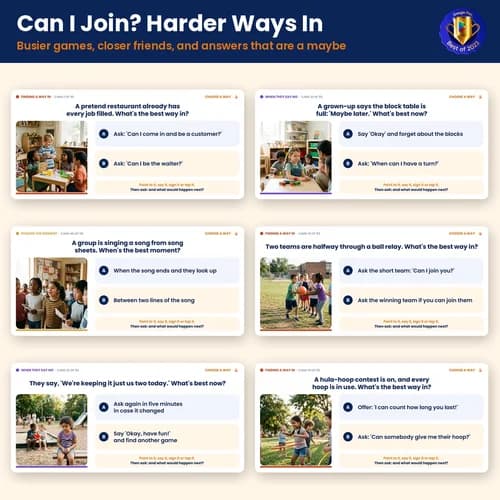
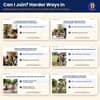
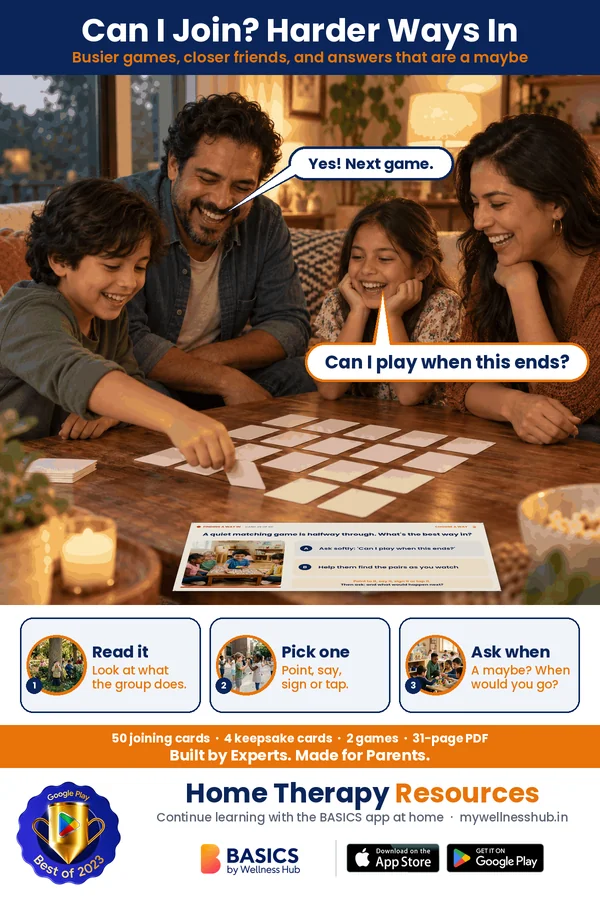
The Can I Join? Harder Ways In: 50 Social Joining Cards PDF is a 31-page digital resource designed for children who already know how to ask to join but find busier games and close friendships challenging. Perfect for ages 6–11, this printable and screen-friendly deck uses real-life scenarios and photos to help kids practice joining in when the answer is not a simple yes or no. Each card presents a realistic social moment, offering two possible actions—one that works better, and one that often misses the mark.
Children will strengthen skills such as finding a door that does not stop the game and joining a pair as a third. Practicing these social moves helps kids learn to read the moment, pick the right time, and go back when invited later. The cards encourage problem-solving, flexible thinking, and resilience in social settings, with outcomes like increased confidence and more successful peer interactions.
Families, teachers, and therapists can use these cards in home, classroom, and therapy contexts to support children with speech delays, autism, or social communication needs. The set includes visual supports and clear choices, making it accessible for children who use signs or AAC. Each activity helps children navigate tricky group dynamics and build lasting social skills.
Product Details
- Resource Name: Can I Join? Harder Ways In: 50 Social Joining Cards PDF
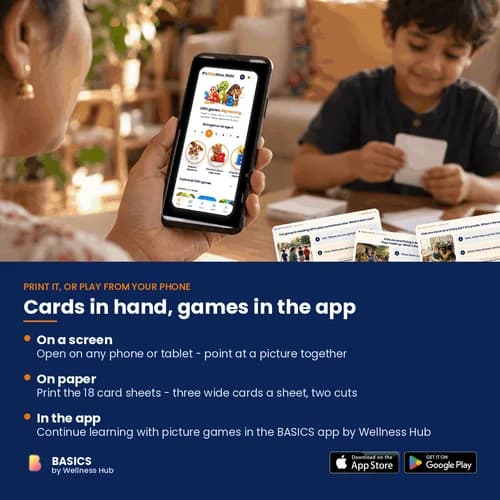
- Format: Printable and screen-ready PDF
- Total Pages: 31
- Grade Level: Elementary (ages 6–11)
- Designed For: Children with social communication challenges, including speech delay, autism, or AAC users
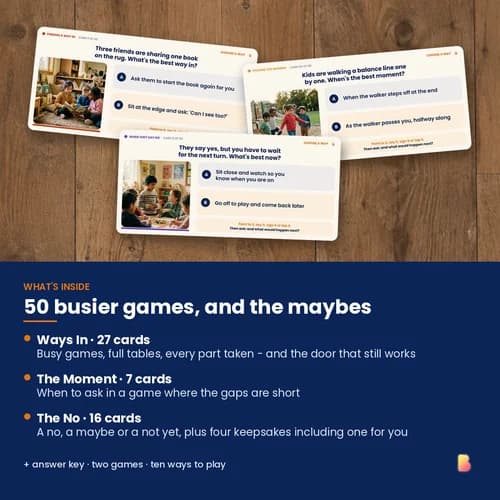
- Printing Notes: Three cards per sheet; print single- or double-sided
- Best Used In: Home, classroom, therapy settings
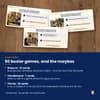
- Sets / Flashcards / Activities: 50 scenario cards, 4 keepsake cards, answer key, games, and practice log
- Visuals / Illustrations: Real-life photos on every card
Educational Benefits
1. Social Problem-Solving Skills
- Children practice analyzing busy group situations and choosing effective ways to join.
- They learn to spot realistic options, like waiting or inventing a new role.
- This builds confidence navigating complex social moments.
2. Flexible Thinking and Adaptability
- Kids encounter scenarios where answers are not simply yes or no.
- They practice adjusting their approach and trying again if needed.
- This resource encourages resilience and creative solutions.
3. Peer Relationship Building
- By exploring moments in close friendships and group games, children strengthen their ability to connect.
- They learn when to join, when to wait, and how to respect boundaries.
- The primary_keyword supports positive, lasting peer interactions.
4. AAC and Communication Access
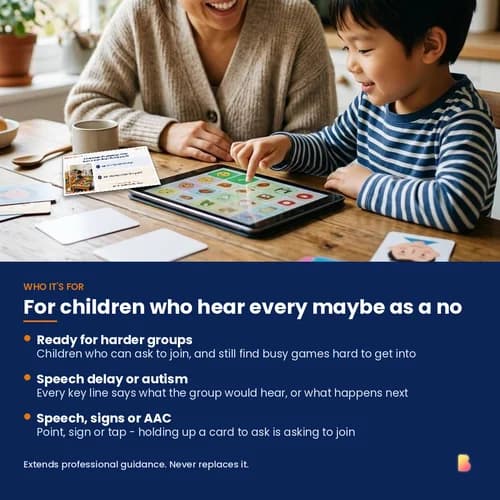
- Every card is designed for full AAC parity, supporting children who use signs or alternative communication.
- Children can participate by pointing, signing, or tapping their answers.
- This ensures everyone can access and practice social joining skills.
5. Self-Advocacy and Independence
- Children learn to read social cues and advocate for themselves in group settings.
- They practice going back at the right time, not giving up after a "maybe."
- This resource empowers kids to persist and find their own way in.
Instructions for Use
Step 1: Print and Prepare the Cards
- Download and print the PDF, single- or double-sided, on sturdy paper.
- Cut out the cards; laminate for durability if desired.
- Organize by color: Finding a Way In, Picking the Moment, When They Say No.
Step 2: Introduce the Deck with a Sample Card
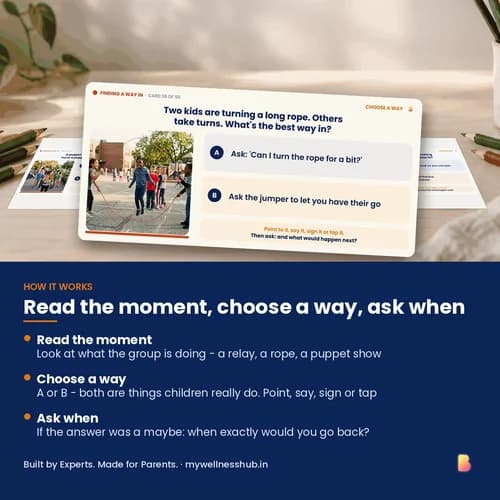
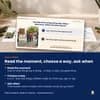
- Show the labelled sample card and explain how each scenario works.
- Discuss the two choices (A and B) and what each one means.
- Use the finding a door that does not stop the game skill as an example.
Step 3: Model a Practice Round
- Pick one card and read the scenario aloud with the child or group.
- Have them choose A or B, then check the answer key for what happens next.
- Encourage discussion about why one way might work better.
Step 4: Play in Small Groups or Pairs
- Shuffle the cards and let children take turns drawing and answering.
- Support children in using joining a pair as a third when appropriate.
- Remind everyone that there are no wrong questions—just real choices.
Step 5: Use Visual Supports and AAC
- Encourage children to point, sign, or tap their answers if they use AAC.
- Allow asking to join by holding up a card as a valid response.
- Adapt the pace and support to each child's communication style.
Step 6: Reflect and Track Progress
- Use the practice log and certificate included to celebrate growth.
- Discuss real-life moments when children tried a new way in.
- Revisit the cards regularly to reinforce skills and build independence.
Activities Using the Resource
1. Busy Game Scenario Sorting
Objective: To help children identify the best way to join a busy group using the Can I Join? Harder Ways In: 50 Social Joining Cards PDF.
How to Play:
- Lay out several cards from the Finding a Way In set.
- Ask the child to sort cards into "best way to join" and "try a different way" piles.
- Discuss how finding a door that does not stop the game appears in each scenario.
Skill Development:
- Improves social decision-making in dynamic group settings.
- Builds awareness of multiple entry points in play.
- Strengthens ability to analyze and compare options.
2. Role-Playing Realistic Choices
Objective: To practice responding to tricky social moments with flexible, realistic actions.
How to Play:
- Select a card showing a close friendship or busy game.
- Take turns acting out both options (A and B) with a partner.
- Highlight joining a pair as a third and discuss what feels different.
Skill Development:
- Enhances perspective-taking and empathy.
- Encourages flexible thinking in social play.
- Develops expressive communication skills.
3. When They Say No Reflection Game
Objective: To build resilience and self-advocacy after hearing "no," "maybe," or "not yet."
How to Play:
- Use cards from the When They Say No set.
- Read the scenario and both choices; ask the child to pick one.
- Talk about going back when you said you would and what that looks like.
Skill Development:
- Fosters perseverance after social setbacks.
- Teaches self-advocacy and respectful persistence.
- Supports emotional regulation in peer interactions.
4. Invent a New Role Challenge
Objective: To encourage creative problem-solving in joining games with every job filled.
How to Play:
- Present a Finding a Way In card where all roles are taken.
- Brainstorm with the child how to invent a new job or helpful role.
- Use props or drawings to act out the invented part.
Skill Development:
- Promotes creative thinking and adaptability.
- Reinforces finding a door that does not stop the game.
- Increases confidence in initiating group play.
5. AAC and Visual Choice Practice
Objective: To ensure all children, including AAC users, can participate in social joining activities.
How to Play:
- Show a card and both response options.
- Invite the child to point, sign, or tap their chosen answer.
- Celebrate all forms of communication as valid ways to join.
Skill Development:
- Builds accessible communication strategies.
- Supports inclusion of AAC and nonverbal children.
- Encourages self-expression and participation.
6. Social Scenario Memory Match
Objective: To reinforce recognition and recall of effective joining strategies.
How to Play:
- Mix up cards and lay them face down.
- Take turns flipping two cards, looking for pairs with similar finding a door that does not stop the game strategies.
- Discuss why those approaches work in each situation.
Skill Development:
- Improves memory for social strategies.
- Strengthens pattern recognition in peer interactions.
- Encourages discussion and reasoning about social choices.
Frequently Asked Questions
Q1: What ages and developmental levels are best for the Can I Join? Harder Ways In: 50 Social Joining Cards PDF?
A1: This resource is designed for children ages 6–11 who already know how to ask to join but struggle with busier games and close friendships. It works well for elementary students with social communication challenges, including those with speech delay or autism. Children who need support with nuanced peer interactions will benefit most.
Q2: Can I use these cards for small group social skills lessons in a classroom?
A2: Yes, these cards are ideal for small group work in classrooms. The scenarios encourage discussion, role-play, and peer modeling of joining strategies. Try rotating cards among students to practice reading the moment and finding a door that does not stop the game.
Q3: Are these joining cards suitable for speech therapy or autism intervention sessions?
A3: Absolutely, therapists frequently use these cards to target flexible thinking and peer interaction skills. The realistic choices help children practice responding to "maybe" or "not yet" answers in a supportive setting. Incorporate them into role-play or as prompts for social stories.
Q4: How should I print and prepare the cards for repeated use?
A4: Print the PDF single- or double-sided on sturdy paper, then cut out the cards. Laminating the cards increases durability for frequent handling in groups or therapy sessions. Organize by color-coded sets (Finding a Way In, Picking the Moment, When They Say No) for easy access.
Q5: Are these cards differentiated for children with special needs or AAC users?
A5: Yes, every card offers full AAC parity and is accessible for children who use signs or alternative communication. Children can answer by pointing, signing, or tapping, and holding up a card counts as asking to join. The resource supports a wide range of communication and cognitive levels.
Q6: Can I display these cards on a tablet or interactive whiteboard instead of printing?
A6: Yes, the PDF is screen-ready and works well on tablets, computers, or interactive boards. Display cards digitally for group modeling, remote sessions, or teletherapy. Children can indicate their choice by tapping or pointing to the screen.
Q7: What specific social skills and learning goals do these joining cards target?
A7: The primary_keyword builds skills in reading social cues, flexible problem-solving, and joining a pair as a third. Children learn to handle "maybe" and "not now" responses, invent new roles, and persist respectfully. These skills foster resilience and stronger peer relationships.
Q8: What are the usage rights for the Can I Join? Harder Ways In: 50 Social Joining Cards PDF?
A8: Your purchase grants you a single-user license for personal, classroom, or therapy use. You may print and use the resource with your own students or clients but not share or distribute it digitally. For school-wide or clinic-wide use, please contact Wellness Hub for extended licensing.
Q9: How do I receive and download my digital resource after purchase?
A9: After completing your purchase, you will receive an instant download link via email from Wellness Hub. The PDF is ready for immediate use on any compatible device or printer. If you encounter issues, customer support can assist with access.
Q10: What is Wellness Hub's refund or exchange policy for digital resources?
A10: Wellness Hub does not offer refunds or exchanges on digital downloads due to the nature of the product. If you experience a technical problem or receive the wrong file, contact support for a prompt resolution. Review all product details before purchase to ensure it meets your needs.
Usage Rights and Restrictions
Allowed Usage:
- Personal use by parents, teachers, and therapists.
- Printable for classroom, home, or therapy settings.
- Can be used in group or one-on-one learning sessions.
Not Allowed:
- Reselling, redistributing, or modifying the resource for commercial use.
- Sharing publicly (e.g., on blogs, social media, or websites) without permission.
- Uploading the file to public sharing platforms.
If you need a bulk license for schools or therapy centers, please contact us.
Conclusion
The Can I Join? Harder Ways In: 50 Social Joining Cards PDF empowers children who already know how to ask but need support with busier games and closer friendships. Designed for ages 6–11, it offers real-life scenarios and practical choices, helping kids build confidence and resilience as they navigate complex social moments.
Children develop key skills like picking the moment and understanding when later never comes, making this resource invaluable in home, classroom, and therapy settings. By practicing realistic responses, kids learn to handle "maybe," "not yet," and subtle social cues, fostering independence and stronger peer relationships.
Start building lasting social confidence—download the Can I Join? Harder Ways In: 50 Social Joining Cards PDF today and help your child or students thrive in every group setting.