

Asking Questions Interview Kit — 16 Printable Get-to-Know-You Interview Boards and 112 Model Questions for Kids
₹80
₹160
You save ₹80
5 (37 ratings)
Grade Levels
Grade 1 – Grade 4 (Ages 6–10)
Content Overview
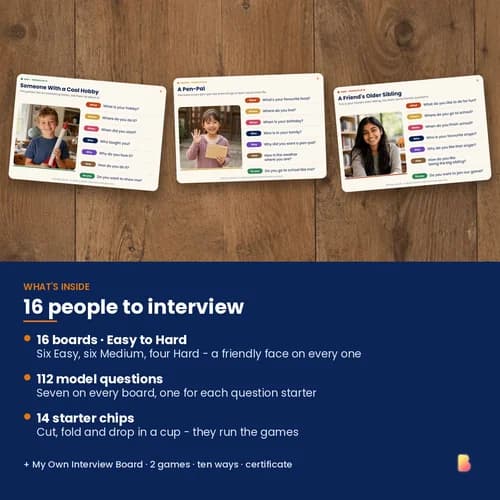
Format: PDF | Pages: 20 | Features: 16 interview boards, 112 model questions, 14 starter chips, wh-questions practice
Categories
Share


About the Product
Introduction
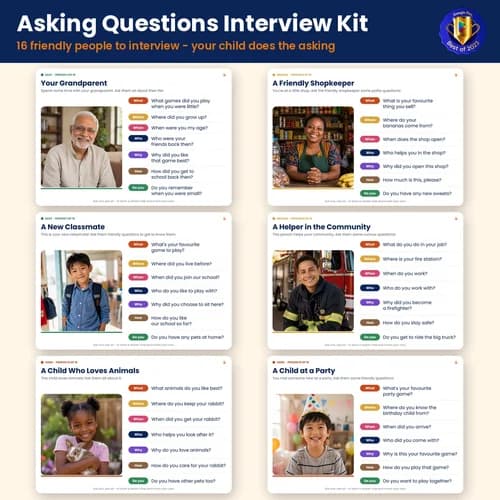
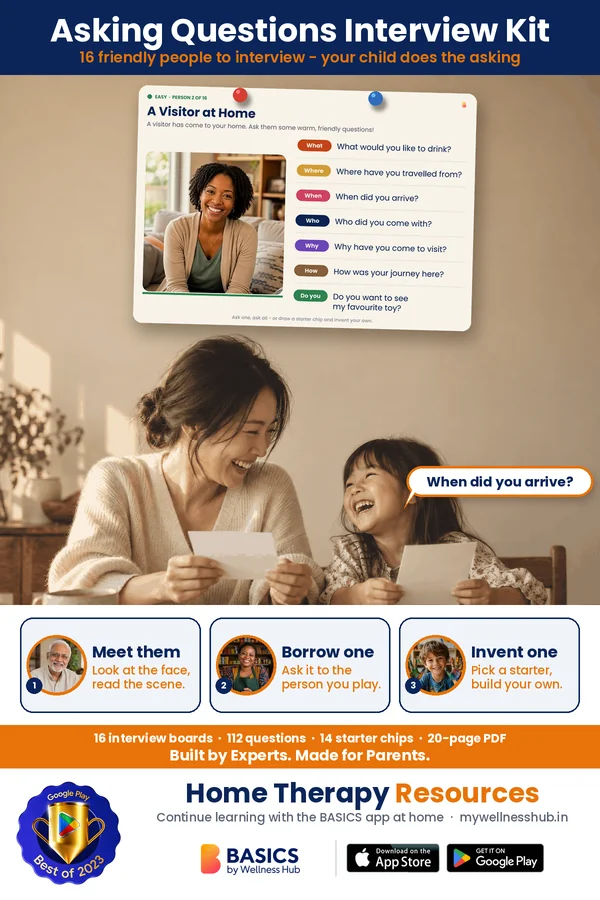
Interview Boards for Kids: Printable PDF with Model Questions and Starters is a 20-page digital resource crafted for children ready to practice asking questions and initiating conversations. This set features 16 interview boards, each with a friendly photo, a relatable scene, and seven color-coded question starters. Designed for children who are shy, have speech delays, use AAC, or simply want to build confidence with new people, it provides a structured yet playful way to develop social skills.
Children will practice initiating conversation using follow-up questions and topic maintenance, building curiosity about other people along the way. Each board encourages kids to borrow a model question, then invent their own, supporting growth in asking questions and using the seven question starters. The resource also includes gentle strategies to help children feel successful and motivated as they interact with peers, adults, and community helpers.
Perfect for home practice, speech therapy, or classroom social skills groups, these boards offer flexible ways to play and learn. The approach works well for one-on-one sessions, small group activities, or even family game nights, making social interaction with peers and adults both accessible and fun.
Product Details
- Resource Name: Interview Boards for Kids: Printable PDF with Model Questions and Starters
- Format: Printable PDF
- Total Pages: 20
- Grade Level: Elementary (ages 6–12)
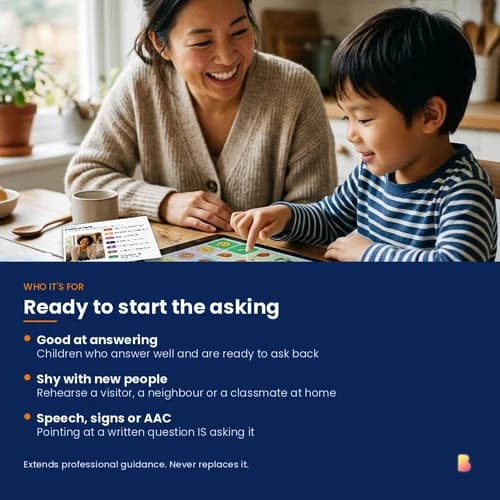
- Designed For: Children developing conversation skills, including those who are shy, use AAC, or have speech/language delays
- Printing Notes: Print single- or double-sided; cut boards and chips as directed
- Best Used In: Home, classroom, speech therapy, social skills groups
- Sets / Flashcards / Activities: 16 interview boards, 14 fold-over starter chips, 112 model questions, 2 games, practice log, certificate
- Visuals / Illustrations: Friendly photos of people, color-coded question starters, and engaging scene illustrations
Educational Benefits
1. Builds Question-Asking Skills
- Children practice forming questions using seven clear starters on every board.
- Model questions help kids learn to ask what, where, when, who, why, how, and do you.
- Interview Boards for Kids: Printable PDF with Model Questions and Starters makes question-asking accessible and fun.
2. Develops Social Interaction Abilities
- Kids engage with peers, adults, and community helpers in safe, structured scenarios.
- Boards encourage turn-taking and respectful listening during pretend interviews.
- Children gain confidence to approach real-life conversations outside practice.
3. Strengthens Topic Maintenance
- Boards prompt children to stay on topic and build on answers with follow-up questions.
- Practicing topic maintenance helps kids hold longer, more meaningful conversations.
- This skill supports smoother interactions in both group and one-on-one settings.
4. Encourages Curiosity and Perspective-Taking
- Children meet a variety of characters, each with unique backgrounds and interests.
- Kids learn to ask about others' experiences, fostering empathy and curiosity.
- This approach supports understanding and appreciation of diverse perspectives.
5. Supports AAC and Inclusive Communication
- Full AAC parity ensures pointing to a written question is as valid as speaking it.
- Children who use signs or devices participate equally in all activities.
- This resource helps bridge communication gaps for nonverbal or speech-delayed learners.
Instructions for Use
Step 1: Print and Prepare the Boards
- Print the PDF single- or double-sided as preferred for your setting.
- Cut out the 16 interview boards and 14 fold-over starter chips along the guide lines.
- Laminate pieces for durability if frequent use is expected.
Step 2: Introduce the Seven Question Starters
- Show the seven color-coded starters page and discuss each type of question.
- Highlight how using different starters (what, where, when, etc.) makes conversations richer.
- Encourage children to notice which starter is used on each board.
Step 3: Meet a Board Character
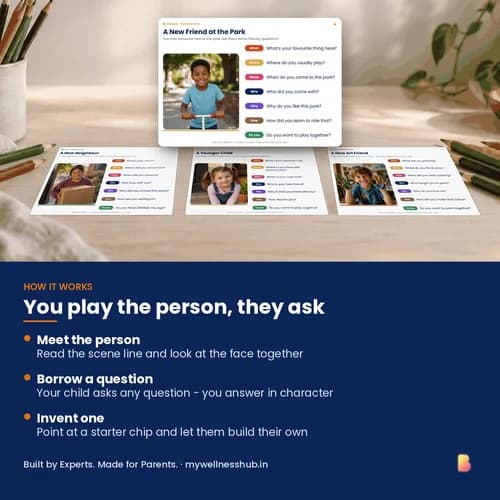
- Select one interview board and read the scene together with the child.
- Let the child observe the friendly photo and imagine meeting the person.
- This step supports curiosity about other people and their experiences.
Step 4: Borrow a Model Question
- Have the child choose a starter chip and borrow a matching model question from the board.
- Practice asking the question aloud or by pointing, supporting AAC users.
- Remind children that any starter is a good way to begin.
Step 5: Invent and Ask a New Question
- Encourage the child to create their own question using a different starter.
- Guide them to think of something new to ask the character, building conversation skills.
- This step helps develop topic maintenance in a natural, playful way.
Step 6: Play a Game or Track Progress
- Try one of the included games, such as The Chip Cup or The Grand Interview.
- Use the practice log to celebrate progress and add to the Best Questions Pile.
- Award the Certificate of Curious Questions for motivation and achievement.
Activities Using the Resource
1. Interview Board Role-Play for Kids
Objective: To help children use Interview Boards for Kids: Printable PDF with Model Questions and Starters to initiate conversation with a peer or adult.
How to Play:
- Choose a board and let the child "interview" a grown-up, sibling, or teddy.
- Use a starter chip to select a model question from the board.
- Encourage inventing a new question after the first.
Skill Development:
- Builds confidence in social initiation
- Practices using question starters
- Encourages flexible thinking in conversation
2. Seven Starter Sorting Game
Objective: To reinforce recognition and use of different question starters in conversation.
How to Play:
- Lay out the seven color-coded starter chips.
- Read questions from a board and sort them under the correct starter.
- Ask the child to invent a new question for each starter.
Skill Development:
- Improves question categorization
- Strengthens understanding of question types
- Boosts expressive language
3. Follow-Up Question Challenge
Objective: To develop topic maintenance and follow-up questioning skills.
How to Play:
- After asking a model question, listen to the answer.
- Prompt the child to ask a related follow-up question using another starter.
- Give a "high five" for each successful follow-up.
Skill Development:
- Enhances topic maintenance
- Develops active listening
- Fosters curiosity about others
4. AAC Point-and-Ask Practice
Objective: To support inclusive communication for children using AAC or signs.
How to Play:
- Present a board and the seven starter chips.
- Child points to a question or uses their device to select one.
- Adult answers in character, modeling conversation.
Skill Development:
- Increases AAC fluency
- Encourages participation for nonverbal children
- Builds turn-taking skills
5. The Grand Interview with a Real Person
Objective: To generalize interview skills from boards to real-life situations.
How to Play:
- Choose a family member, friend, or helper as the interviewee.
- Child uses a board and chips to guide the interview.
- Celebrate with the Certificate of Curious Questions after completion.
Skill Development:
- Transfers conversation skills to real people
- Builds confidence in social settings
- Reinforces respectful interaction
6. Best Questions Pile Reflection
Objective: To encourage self-evaluation and celebrate progress in question-asking.
How to Play:
- After several interviews, review questions asked.
- Let the child pick their favorite "best questions" and add them to a pile.
- Discuss what made those questions interesting or effective.
Skill Development:
- Promotes self-reflection
- Highlights creative questioning
- Supports memory and recall of conversation skills
Frequently Asked Questions
Q1: What ages and skill levels are Interview Boards for Kids: Printable PDF with Model Questions and Starters designed for?
A1: This resource is best for children ages 6–12 who are ready to practice asking questions and initiating conversations. It is suitable for kids who answer questions well and are ready to take the next step in social interaction. Children who are shy, have speech delays, or use AAC will benefit from the structured supports.
Q2: Can I use these interview boards in a classroom group activity?
A2: Yes, the boards are ideal for small group work or social skills circles. Each child can take turns being the interviewer or the character, promoting peer interaction and confidence. Try rotating roles and using the included games for added engagement.
Q3: Are these boards appropriate for speech therapy sessions with children who use AAC?
A3: Absolutely. The resource offers full AAC parity, allowing children to point to questions or use their device to participate equally. Therapists can model both spoken and nonverbal question-asking for inclusive practice.
Q4: What is the best way to print and prepare the boards and chips?
A4: Print single- or double-sided on sturdy paper and cut along the guide lines for each board and chip. Laminating pieces increases durability, especially for frequent use in therapy or classrooms. Store boards and chips in labeled envelopes or pouches for easy access.
Q5: How does this resource support children with special needs or those who are shy?
A5: The boards provide visual cues, model questions, and gentle rules to reduce anxiety and support success. Children can participate by speaking, signing, or pointing, making the resource flexible for diverse learners. Start with easier boards and gradually introduce more challenging scenarios as confidence grows.
Q6: Can children use the boards on a tablet or computer instead of printing?
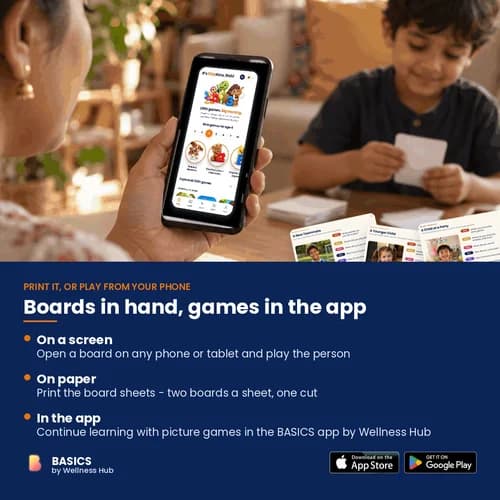
A6: Yes, the PDF is screen-ready and can be used on tablets or computers for digital practice. Children can point to or highlight questions on-screen, supporting both in-person and remote learning. This is especially helpful for teletherapy or blended classrooms.
Q7: What conversation skills and learning goals do these interview boards target?
A7: The resource develops asking questions, initiating conversations, using seven question starters, and maintaining topics through follow-up questions. It also builds curiosity about others and social interaction with peers, adults, and community helpers. Progress can be tracked using the included practice log and certificate.
Q8: What are the licensing and usage rights for Interview Boards for Kids: Printable PDF with Model Questions and Starters?
A8: Purchase grants a single-user license for personal, classroom, or therapy use. Sharing, posting online, or distributing copies outside your direct setting is not permitted. For multi-user or school-wide licensing, contact Wellness Hub directly.
Q9: How do I receive my digital download after purchase?
A9: After completing your purchase, you will receive an instant download link via email. The PDF can be saved and accessed on any device or printed as needed. If you have trouble accessing your file, Wellness Hub support is available to assist.
Q10: What is Wellness Hub's refund or exchange policy for digital therapy resources?
A10: Wellness Hub does not offer refunds or exchanges on digital downloads due to their instant-access nature. If your file is damaged or you experience technical issues, contact support for a replacement. Wellness Hub is committed to ensuring you receive a fully functional resource.
Usage Rights and Restrictions
Allowed Usage:
- Personal use by parents, teachers, and therapists.
- Printable for classroom, home, or therapy settings.
- Can be used in group or one-on-one learning sessions.
Not Allowed:
- Reselling, redistributing, or modifying the resource for commercial use.
- Sharing publicly (e.g., on blogs, social media, or websites) without permission.
- Uploading the file to public sharing platforms.
If you need a bulk license for schools or therapy centers, please contact us.
Conclusion
Interview Boards for Kids: Printable PDF with Model Questions and Starters empowers children to take the lead in conversations, building confidence and independence as they practice with peers, adults, or even a favorite toy. Designed for a wide range of learners, it supports both verbal and nonverbal children, including those who use AAC or are shy in new situations.
By focusing on initiating conversation and follow-up questions, this resource helps children master the art of social interaction in home, classroom, and therapy settings. The included question starters and topic maintenance strategies make it easy to adapt for individual or group use, ensuring every child can participate and succeed.
Start using Interview Boards for Kids: Printable PDF with Model Questions and Starters today and watch your child grow into a curious, confident communicator ready to connect with the world around them.