

Asking for Help: Need, Open & Close — 50 Printable Request Phrase Flashcards for Early Talkers
₹80
₹160
You save ₹80
5 (48 ratings)
Grade Levels
Pre-K – Kindergarten (Ages 3–6)
Content Overview
Format: PDF | Pages: 24 | Features: 50 two-word phrase cards for requesting help and expressing needs
Categories
Share


About the Product
Introduction
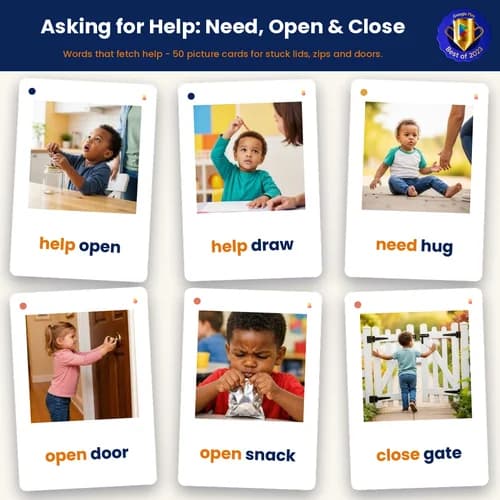
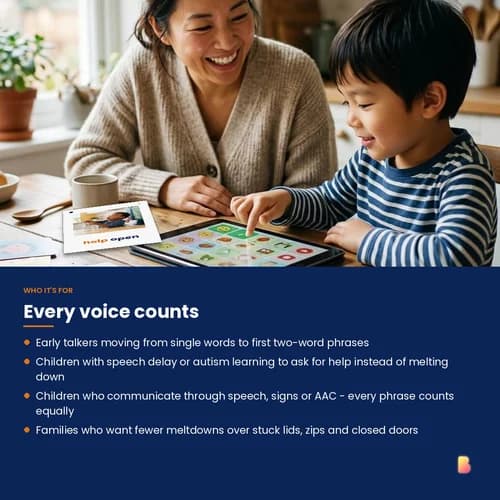
The primary_keyword Two-Word Request Cards: Help, Need, Open, Close PDF is a versatile digital resource designed for children at the first-phrase stage, including those with speech delay, autism, or who use signs or AAC. This 24-page printable and screen-ready set features 50 two-word phrase cards, each crafted to support early communication and reduce frustration. Parents, teachers, and therapists will find this tool invaluable for building essential language skills in a supportive, real-world context.
Children practice requesting assistance and expressing body needs through engaging, picture-supported cards. The resource emphasizes container and barrier words, helping kids expand from single words to two-word phrase expansion. Measurable outcomes include increased spontaneous requests, more confident communication, and the ability to replace frustration with asking for help or needs.
Ideal for home, classroom, and therapy settings, the cards encourage interactive learning and consistent practice of open and close concepts. The included games, coach cards, and practice log make it easy to integrate into daily routines, group activities, or one-on-one sessions. These cards support carryover and readiness for more advanced communication skills.
Product Details
- Resource Name: Two-Word Request Cards: Help, Need, Open, Close PDF
- Format: Printable and screen-ready PDF
- Total Pages: 24
- Grade Level: Early childhood, Pre-K, Kindergarten
- Designed For: Children at first-phrase stage, speech delay, autism, AAC users
- Printing Notes: Print single- or double-sided; laminate for durability
- Best Used In: Home, classroom, speech therapy, special education
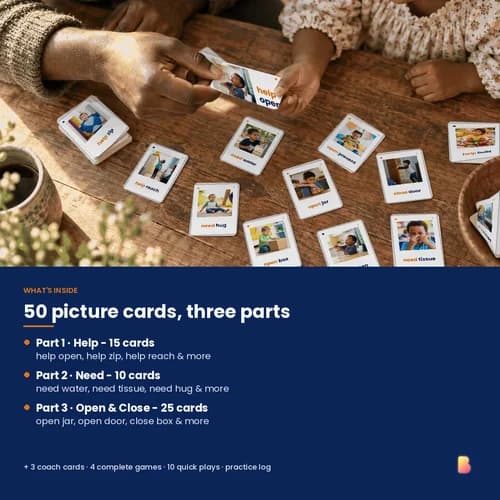
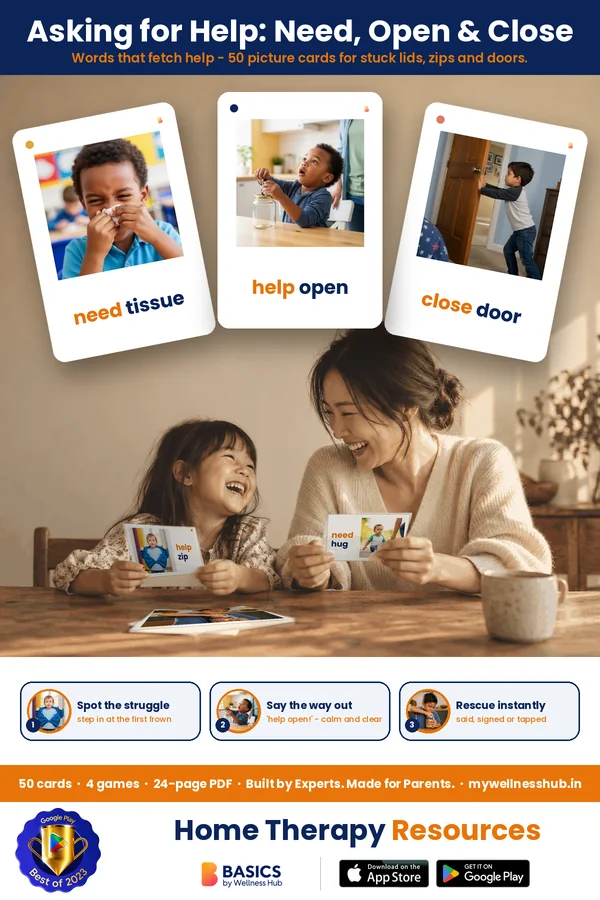
- Sets: 50 two-word phrase cards, 3 coach cards, 3 make-your-own cards
- Activities: 4 games, 10 two-minute plays, practice log, carryover and readiness pages
- Visuals: Picture-supported cards for each phrase
Educational Benefits
1. Builds Requesting Assistance Skills
- Children learn to ask for help using clear, two-word phrases.
- Reduces frustration by giving them a reliable way to request support.
- Promotes independence and self-advocacy in daily routines.
2. Expands Two-Word Phrase Communication
- Supports children moving from single words to combining two words.
- Encourages spontaneous speech and phrase generation.
- Helps children with speech delay or autism communicate more effectively.
3. Strengthens Expressing Body Needs
- Teaches children to identify and state needs like water, tissue, or a hug.
- Improves self-awareness and the ability to communicate physical needs.
- Fosters confidence in expressing what their body requires.
4. Reinforces Container and Barrier Concepts
- Children practice using open and close with real-world objects.
- Enhances understanding of how to request access or closure.
- Supports learning through visual cues and hands-on activities.
5. Promotes AAC Parity and Inclusion
- Ensures every child, including AAC users, can participate fully.
- primary_keyword supports equal communication opportunities for all learners.
- Encourages consistent use of AAC strategies in group and individual settings.
Instructions for Use
Step 1: Print and Prepare the Cards
- Download and print the PDF on sturdy paper or cardstock.
- Cut out each two-word request card and optional coach cards.
- Laminate for extra durability and repeated use.
Step 2: Introduce Requesting Assistance
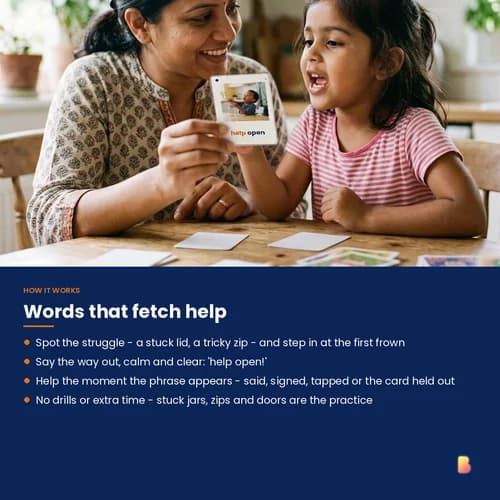
- Present help phrase cards first to model how to ask for help.
- Use real-life situations to demonstrate the help skill naturally.
- Encourage children to repeat or sign the phrases as needed.
Step 3: Model Two-Word Phrases in Context
- Show need phrase cards during routines like snack or playtime.
- Model the correct two-word phrase, such as need water, in context.
- Prompt children to use the phrase before providing the item.
Step 4: Practice Open and Close Concepts
- Use open and close cards with actual containers or doors.
- Demonstrate the action while saying the phrase aloud.
- Reinforce understanding by letting children try the actions.
Step 5: Play Games and Use Activities
- Engage children with included games like Help the Animals.
- Incorporate two-minute plays for quick, fun practice.
- Use the activities to reinforce two-word phrase expansion.
Step 6: Track Progress and Encourage Carryover
- Use the practice log to note new phrases and successes.
- Encourage families to use the cards at home for consistency.
- Celebrate every attempt to communicate, supporting ongoing growth.
Activities Using the Resource
1. Matching Two-Word Phrases to Pictures
Objective: To build understanding of the primary_keyword by connecting phrases to real-life images.
How to Play:
- Lay out several phrase cards and matching picture cards (e.g., help open, need water).
- Ask the child to pair each phrase with the correct image.
- Review matches together, saying each phrase aloud.
Skill Development:
- Increases phrase-picture association accuracy.
- Improves visual scanning and discrimination.
- Builds confidence in using the primary_keyword.
2. Requesting Assistance Role-Play Game
Objective: To practice requesting assistance using two-word phrases in everyday scenarios.
How to Play:
- Set up props (e.g., closed jar, zipped bag) and place relevant cards nearby.
- Child selects a card (e.g., help zip) and uses it to request help with the prop.
- Adult responds immediately, modeling the correct action.
Skill Development:
- Strengthens real-world requesting skills.
- Encourages turn-taking and social interaction.
- Reinforces use of assistance-related vocabulary.
3. Expressing Body Needs Sorting Activity
Objective: To help children identify and express body needs using two-word phrases.
How to Play:
- Spread out cards like need water, need tissue, need hug.
- Present scenarios (e.g., pretend sneezing, feeling thirsty).
- Child chooses the matching phrase card for each scenario.
Skill Development:
- Boosts identification of physical needs.
- Enhances phrase selection accuracy.
- Supports expressive communication.
4. Open and Close Object Hunt
Objective: To reinforce understanding of container and barrier words through hands-on exploration.
How to Play:
- Hide objects that can be opened or closed (e.g., box, door) around the room.
- Give the child open or close cards to use as they find each object.
- Child says the phrase and performs the matching action.
Skill Development:
- Builds comprehension of open/close concepts.
- Promotes generalization to real objects.
- Develops following multi-step directions.
5. Two-Word Phrase Expansion with Props
Objective: To encourage two-word phrase expansion using real items and cards.
How to Play:
- Place several props (e.g., jar, tissue, ball) and corresponding phrase cards on the table.
- Child picks a card and matches it to a prop, then says the phrase (e.g., open jar).
- Adult models expanded phrases as appropriate.
Skill Development:
- Supports phrase-to-object matching.
- Encourages spontaneous phrase use.
- Fosters early sentence building.
6. Frustration Replacement Practice
Objective: To replace frustration with asking by using the primary_keyword in supported situations.
How to Play:
- Notice when a child struggles (e.g., can't open a container).
- Prompt or model the correct two-word request from the cards.
- Respond positively as soon as any attempt is made.
Skill Development:
- Reduces communication-related frustration.
- Reinforces positive help-seeking behavior.
- Builds independence with the primary_keyword.
Frequently Asked Questions
Q1: What ages and developmental stages are these Two-Word Request Cards best for?
A1: These cards are ideal for children in early childhood, typically ages 2–6, who are at the first-phrase stage of communication. They suit children with speech delay, autism, or those using AAC. For best results, ensure the child can use a few basic "want" or "more" phrases before starting.
Q2: Can these cards be used in classroom group activities?
A2: Yes, these cards are designed for both individual and small group use in classrooms. Group activities like matching games and role-play help reinforce two-word phrase expansion in a social context. Try using the included games or sorting activities during circle time or language centers.
Q3: Are these cards suitable for speech therapy sessions targeting requesting assistance?
A3: Absolutely, these cards directly support requesting assistance goals in speech therapy. The fixed request-word-first frame and real-life scenarios help children practice asking for help in meaningful ways. Therapists can pair cards with props to create interactive, motivating sessions.
Q4: What is the best way to print and prepare these cards for repeated use?
A4: Print the PDF on sturdy cardstock and laminate each card for durability. Laminated cards withstand frequent handling and can be wiped clean. Cut out the cards individually and store them in a small box or pouch for easy access.
Q5: How do these cards support children with special needs or varying communication abilities?
A5: The cards use clear visuals and simple two-word phrases, making them accessible for children with diverse communication needs. They work well for AAC users and can be paired with sign language or speech-generating devices. Adjust the pace and model phrases as needed to meet each child's abilities.
Q6: Can these cards be used on a tablet or computer without printing?
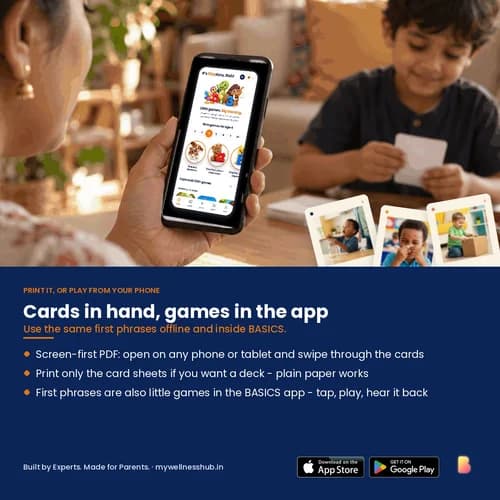
A6: Yes, the PDF is screen-ready for digital use on tablets, computers, or interactive whiteboards. Display cards digitally for group modeling or individual practice. Use annotation tools to highlight or circle key words during activities.
Q7: What specific skills and learning goals do these cards target?
A7: These cards target two-word phrase expansion, requesting assistance, expressing body needs, and understanding container and barrier words. Children learn to replace frustration with asking for help or needs using the primary_keyword. Consistent practice builds independence and confidence in everyday communication.
Q8: What are the usage rights for these Two-Word Request Cards?
A8: Your purchase grants a single-user license for personal, classroom, or clinical use. Sharing, posting, or distributing the PDF to others is not permitted. For multi-user or organizational licensing, contact Wellness Hub directly.
Q9: How do I receive and download my digital PDF after purchase?
A9: After completing your purchase, you will receive an instant download link via email from Wellness Hub. The PDF is ready for immediate use on any device or for printing. If you encounter any issues, Wellness Hub's support team is available to assist.
Q10: What is Wellness Hub's refund or exchange policy for digital resources?
A10: Wellness Hub does not offer refunds or exchanges on digital PDF resources once downloaded. This policy ensures the integrity of digital content distribution. If you have concerns about your order, reach out to Wellness Hub's customer support for assistance.
Usage Rights and Restrictions
Allowed Usage:
- Personal use by parents, teachers, and therapists.
- Printable for classroom, home, or therapy settings.
- Can be used in group or one-on-one learning sessions.
Not Allowed:
- Reselling, redistributing, or modifying the resource for commercial use.
- Sharing publicly (e.g., on blogs, social media, or websites) without permission.
- Uploading the file to public sharing platforms.
If you need a bulk license for schools or therapy centers, please contact us.
Conclusion
The Two-Word Request Cards: Help, Need, Open, Close PDF empowers children at the first-phrase stage to communicate their wants and needs confidently. Designed for early learners, children with speech delay, autism, or those using AAC, this resource helps replace frustration with clear, simple requests in everyday routines.
By focusing on two-word phrase expansion and container and barrier words, children build practical skills they can use at home, in the classroom, or during therapy. These cards encourage independence, self-advocacy, and meaningful participation in daily life.
Start using the Two-Word Request Cards: Help, Need, Open, Close PDF today to give your child or students a powerful tool for expressing themselves and building lifelong communication skills.