


Whose Turn? First Turns — 50 Printable Turn-Taking Photo Cards for Waiting and Listening
₹80
Grade Levels
Grade 1 – Grade 2 (Ages 5–9)
Content Overview
Format: PDF | Pages: 22 | Features: 50 photo cards for turn-taking practice and waiting well
Categories
Share


About the Product
Introduction
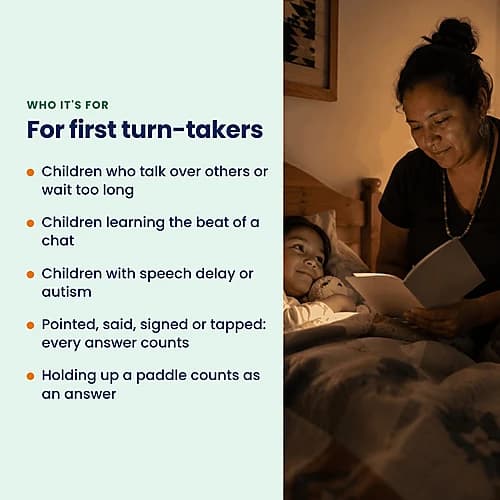
Whose Turn? Everyday Moments: Turn-Taking Photo Cards is a 22-page digital PDF designed for children learning the rhythm of conversation. This resource features 50 real-life photo cards, each capturing a split-second when a turn could change hands—like a friend pausing mid-story or a sibling explaining a game. Perfect for children who miss conversational cues, including those with speech delays or autism, these cards make practicing social timing accessible and engaging.
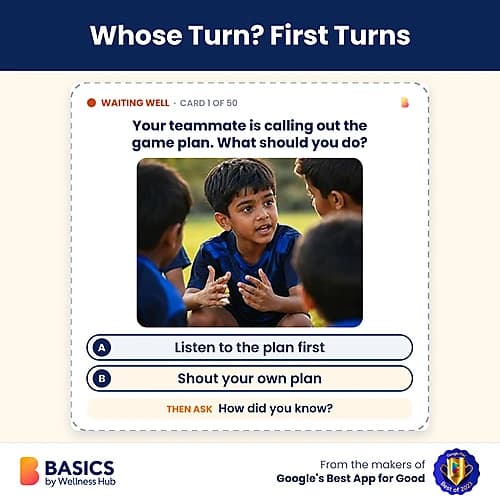
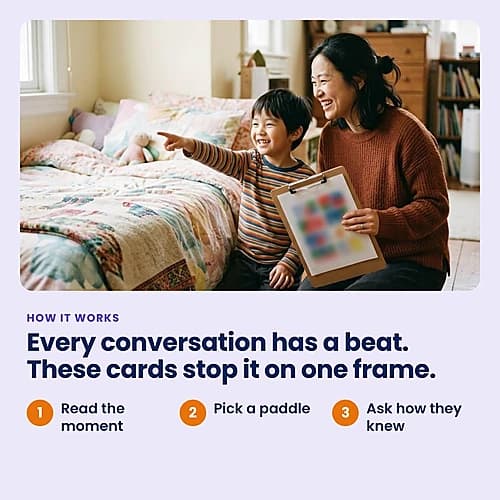
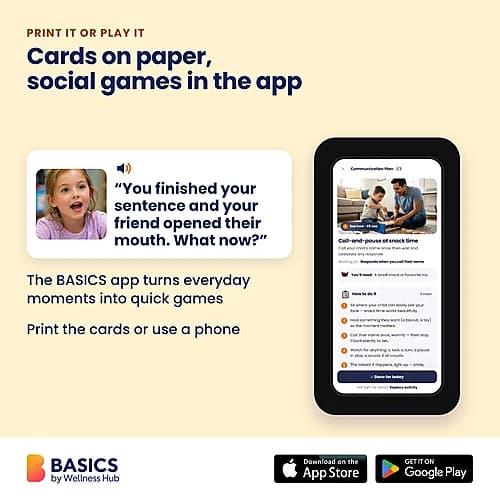
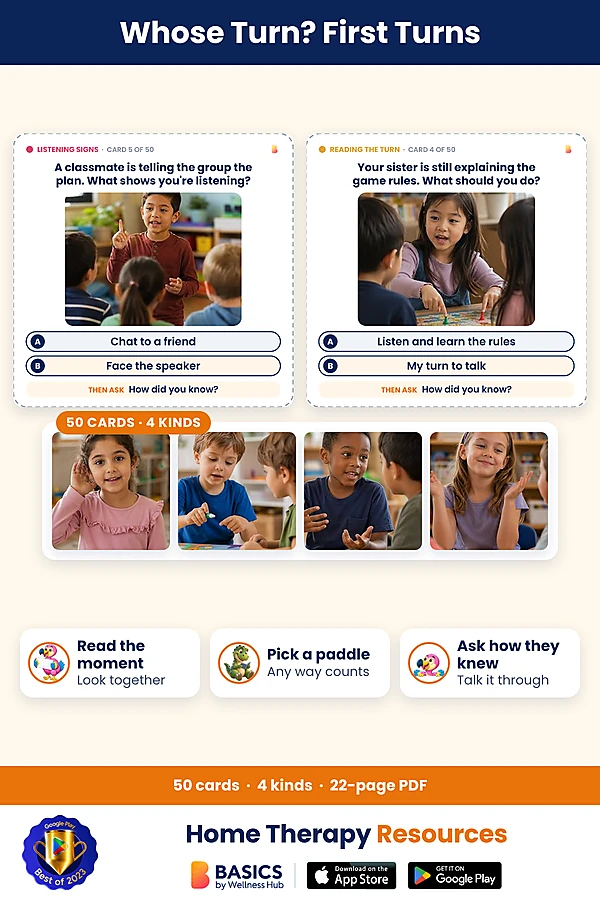
Children practice waiting while holding an idea, and learn to notice when a turn is ending using the Reading the Turn skill. Each card presents a photo, a question, and two paddle choices—one showing the right turn-taking move, the other a common mistake. As children select and explain their choices, they build confidence in conversation, improve listening, and develop real-world social skills.
Families, teachers, and therapists can use these cards in home, classroom, and therapy settings to support Listening Signs in natural interactions. The resource includes a color-coded system for four key moves, an answer key with reasoning prompts, and multiple ways to play—making it flexible for group games, one-on-one practice, or AAC-supported communication.
Product Details
- Resource Name: Whose Turn? Everyday Moments: Turn-Taking Photo Cards
- Format: Printable and screen-ready PDF
- Total Pages: 22
- Grade Level: Elementary / Special Education
- Designed For: Children learning conversation timing, including those with speech delay, autism, or using AAC
- Printing Notes: Print single- or double-sided; laminate for durability
- Best Used In: Home, classroom, therapy sessions
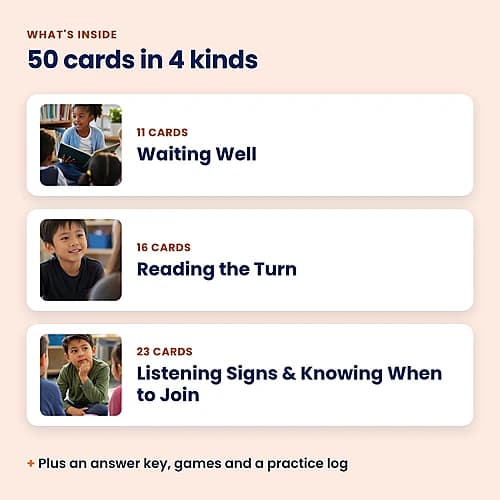
- Sets / Flashcards / Activities: 50 photo cards, 4 move cards, 2 games, practice log, certificate
- Visuals / Illustrations: Real-life photographs, color-coded moves, illustrated sample card, thumbnail map
Educational Benefits
1. Builds Turn-Taking Awareness
- Helps children recognize the subtle cues that signal when to speak or wait.
- Supports understanding of conversational flow in real-life settings.
- Promotes active engagement during group or paired activities.
2. Strengthens Listening Signs Recognition
- Teaches children to spot nonverbal and verbal signals that show someone is ready for input.
- Encourages attention to body language, pauses, and facial expressions.
- Improves ability to respond appropriately in conversation.
3. Enhances Social Communication Skills
- Supports children who struggle to find the right moment to join in.
- Provides practice with both holding back and stepping in at the right time.
- This resource offers a safe way to rehearse these skills before real conversations.
4. Supports AAC and Diverse Communication Styles
- Gives full credit for answers shown, signed, pointed, or tapped—verbal speech not required.
- Ensures equal participation for children using augmentative and alternative communication.
- Fosters inclusive learning for all communication needs.
5. Promotes Self-Regulation and Patience
- Encourages waiting while holding an idea, a key part of self-control.
- Helps children manage impulses to interrupt or withdraw.
- waiting while holding an idea is practiced in every round, building patience over time.
Instructions for Use
Step 1: Print and Prepare the Cards
- Print the PDF single- or double-sided on sturdy paper for durability.
- Cut out the 50 photo cards and 4 move cards along the guidelines.
- Laminate cards for repeated use in various settings.
Step 2: Introduce the Four Moves
- Show and explain each move card: Waiting Well, Reading the Turn, Listening Signs, Knowing When to Join.
- Discuss how each move helps in conversation timing.
- reading the turn can be modeled with sample scenarios for clarity.
Step 3: Demonstrate with the Sample Card
- Start with the labeled sample card to show how a round works.
- Model choosing a paddle and explaining the choice.
- Encourage children to point, tap, sign, or say their answer.
Step 4: Play a Practice Round
- Shuffle the deck and select a photo card to play.
- Read the question aloud and present both paddle choices.
- listening signs should be referenced as children decide which paddle fits the moment.
Step 5: Encourage Reasoning and Discussion
- After a paddle is chosen, ask "How did you know?" to prompt reasoning.
- Use the answer key for guidance on what cues to notice.
- Praise all forms of reasoning—spoken, signed, or shown.
Step 6: Explore Games and Everyday Carryover
- Try included games like Two Chairs and Hold Your Idea for variety.
- Use the practice log and certificate to track progress and celebrate milestones.
- Apply skills to real-life moments, reinforcing learning beyond the cards.
Activities Using the Resource
1. Turn-Taking Photo Card Rounds
Objective: To help children use Whose Turn? Everyday Moments: Turn-Taking Photo Cards to practice recognizing when to wait or step in during conversation.
How to Play:
- Shuffle the deck and select a photo card.
- Present both paddle choices (A and B) for each scenario.
- Ask the child to choose and explain their answer using waiting while holding an idea.
Skill Development:
- Builds turn-taking judgment in real situations.
- Strengthens impulse control through structured choices.
- Encourages verbal or AAC-based reasoning.
2. Color-Coded Move Sorting
Objective: To develop understanding of the four conversation moves by sorting cards based on the skill shown.
How to Play:
- Lay out the four move cards: Waiting Well, Reading the Turn, Listening Signs, Knowing When to Join.
- Deal out a set of photo cards.
- Have the child sort each card to the correct move, focusing on reading the turn.
Skill Development:
- Increases awareness of conversational roles.
- Reinforces visual categorization and sorting skills.
- Supports recognition of nuanced social cues.
3. Listening Signs Charades
Objective: To improve recognition of nonverbal cues that signal listening and readiness in conversation.
How to Play:
- Select a Listening Signs photo card.
- Child acts out the body language or facial expression shown.
- Others guess the move, discussing how listening signs are communicated.
Skill Development:
- Enhances observation of nonverbal communication.
- Builds expressive skills through gesture and mimicry.
- Fosters group participation and turn-taking.
4. Hold Your Idea Challenge
Objective: To practice waiting while holding an idea until the right conversational gap appears.
How to Play:
- Present a scenario where the child must wait for a visible or spoken cue.
- Use a timer or visual prompt to signal when it's their turn.
- Child shares their idea only when the cue appears.
Skill Development:
- Develops patience and self-regulation.
- Encourages internal rehearsal of thoughts.
- Teaches timing for appropriate conversational entry.
5. AAC and Nonverbal Turn Practice
Objective: To ensure children using AAC or nonverbal communication can fully participate in turn-taking activities.
How to Play:
- Present a photo card and both paddles.
- Child indicates their choice by pointing, tapping, or using their AAC device.
- Reinforce that showing or signing a reason is as valid as speaking.
Skill Development:
- Promotes inclusive communication strategies.
- Builds confidence in AAC or gesture-based responses.
- Validates diverse expressive styles in social situations.
6. The Reasons Pile Reflection Game
Objective: To deepen understanding by encouraging children to explain the reasoning behind their turn-taking choices.
How to Play:
- After each round, place chosen cards in a "Reasons Pile."
- Review the pile, asking, "How did you know it was your turn?" for each card.
- Discuss different cues, especially those related to knowing when to join.
Skill Development:
- Strengthens metacognitive awareness of social cues.
- Improves articulation of reasoning, verbally or nonverbally.
- Encourages reflective thinking about conversation timing.
Frequently Asked Questions
Q1: What age or developmental level are Whose Turn? Everyday Moments: Turn-Taking Photo Cards best for?
A1: These cards are designed for elementary-aged children and those in special education who are learning conversation timing. They are especially helpful for children who struggle with turn-taking, including those with speech delays or autism. The real-life photos and simple paddle choices make them accessible for a wide range of developmental levels.
Q2: Can these photo cards be used in group classroom activities?
A2: Yes, the cards are ideal for small groups or whole-class social skills lessons. Each card's clear scenario and paddle choices allow for group discussion, voting, or role-play. For best results, assign roles so every child practices both waiting well and knowing when to join.
Q3: Are these cards suitable for speech therapy or social communication groups?
A3: Absolutely, therapists use these cards to target conversation timing, listening signs, and reading the turn in structured practice. The resource supports both verbal and nonverbal responses, making it effective for children using AAC or sign language. Try pairing the cards with the included games for engaging, skill-focused sessions.
Q4: What is the best way to print and prepare the cards for repeated use?
A4: Print the PDF single- or double-sided on thick paper, then cut out the cards along the guidelines. Laminating the cards increases durability for frequent handling in classrooms or therapy. Store sorted by move (Waiting Well, Reading the Turn, Listening Signs, Knowing When to Join) for easy access during sessions.
Q5: How does this resource support children with special needs or AAC users?
A5: The cards are fully accessible for children who communicate by speech, signs, or AAC devices. Each answer can be shown, pointed to, tapped, or signed, and reasoning can be expressed in any modality. This ensures equal participation and validates diverse communication styles in every round.
Q6: Can these cards be used digitally without printing?
A6: Yes, the PDF is screen-ready for use on tablets, computers, or interactive whiteboards. Children can indicate their paddle choice by pointing, tapping, or using their AAC device on screen. This flexibility supports teletherapy, hybrid classrooms, and home learning.
Q7: What specific skills and learning goals do these turn-taking photo cards address?
A7: The resource targets waiting while holding an idea, reading the turn, listening signs, and knowing when to join a conversation. It helps children recognize subtle cues, manage impulses, and practice timing their responses. Over time, children gain confidence and independence in real-world social settings.
Q8: What are the licensing and usage rights for Whose Turn? Everyday Moments: Turn-Taking Photo Cards?
A8: Purchase includes a single-user license for one household, classroom, or therapy caseload. You may print or use the PDF digitally for your direct students or clients. Sharing, posting, or distributing the file beyond your licensed group is not permitted.
Q9: How do I receive and download this PDF resource after purchase?
A9: After purchase, you will receive an instant download link via email and on your Wellness Hub account dashboard. The file is a high-quality PDF ready for printing or digital use. If you have trouble accessing your download, Wellness Hub's support team can assist promptly.
Q10: What is Wellness Hub's refund or exchange policy for digital resources?
A10: Wellness Hub offers refunds for accidental duplicate purchases or technical issues that prevent access to the resource. Due to the digital nature of the product, refunds are generally not available once the file is downloaded. If you experience any problems, contact Wellness Hub support for help or resolution.
Usage Rights and Restrictions
Allowed Usage:
- Personal use by parents, teachers, and therapists.
- Printable for classroom, home, or therapy settings.
- Can be used in group or one-on-one learning sessions.
Not Allowed:
- Reselling, redistributing, or modifying the resource for commercial use.
- Sharing publicly (e.g., on blogs, social media, or websites) without permission.
- Uploading the file to public sharing platforms.
If you need a bulk license for schools or therapy centers, please contact us.
Conclusion
Whose Turn? Everyday Moments: Turn-Taking Photo Cards empowers children to master the rhythm of conversation by focusing on real-life moments where a turn could change hands. Designed for those who find it hard to spot the right time to speak or wait, this resource supports children who communicate in many ways, including AAC users and those with social communication challenges.
Children build confidence as they practice reading the turn and knowing when to join, developing patience and self-regulation in home, classroom, or therapy settings. Each photo card encourages careful observation and thoughtful responses, making learning both practical and engaging.
Start using Whose Turn? Everyday Moments: Turn-Taking Photo Cards today to help your learners recognize conversation cues and join in with confidence. Give every child the tools to participate, connect, and thrive in social interactions.